



Log in
Lords-and-ladies (Arum maculatum): the poisonous plant you need to know
Michaël Berthoud
/
5 June 2021
Today, we’re going to talk about a poisonous plant that I find particularly problematic: lords-and-ladies (Arum maculatum). It’s very important to know which poisonous plants grow near you. I often come across this one on my walks or when I’m teaching. It’s also problematic because it can be mistaken for edible plants that foragers often gather, such as wild garlic.
Table of contents
In short, the three plants most likely to be confused with lords-and-ladies are:
- Wild garlic
- Common sorrel
- Good King Henry
The first thing I recommend is visiting the Infoflora website (for Switzerland) or Telabotanica (for France) and checking the distribution maps to see whether lords-and-ladies grows near you. It probably does. If so, read the whole article and then watch the video. With experience, you’ll be able to tell the difference at a glance, provided you take the time to learn. If you’re a beginner, read all the advice and precautions carefully.
How to recognise lords-and-ladies
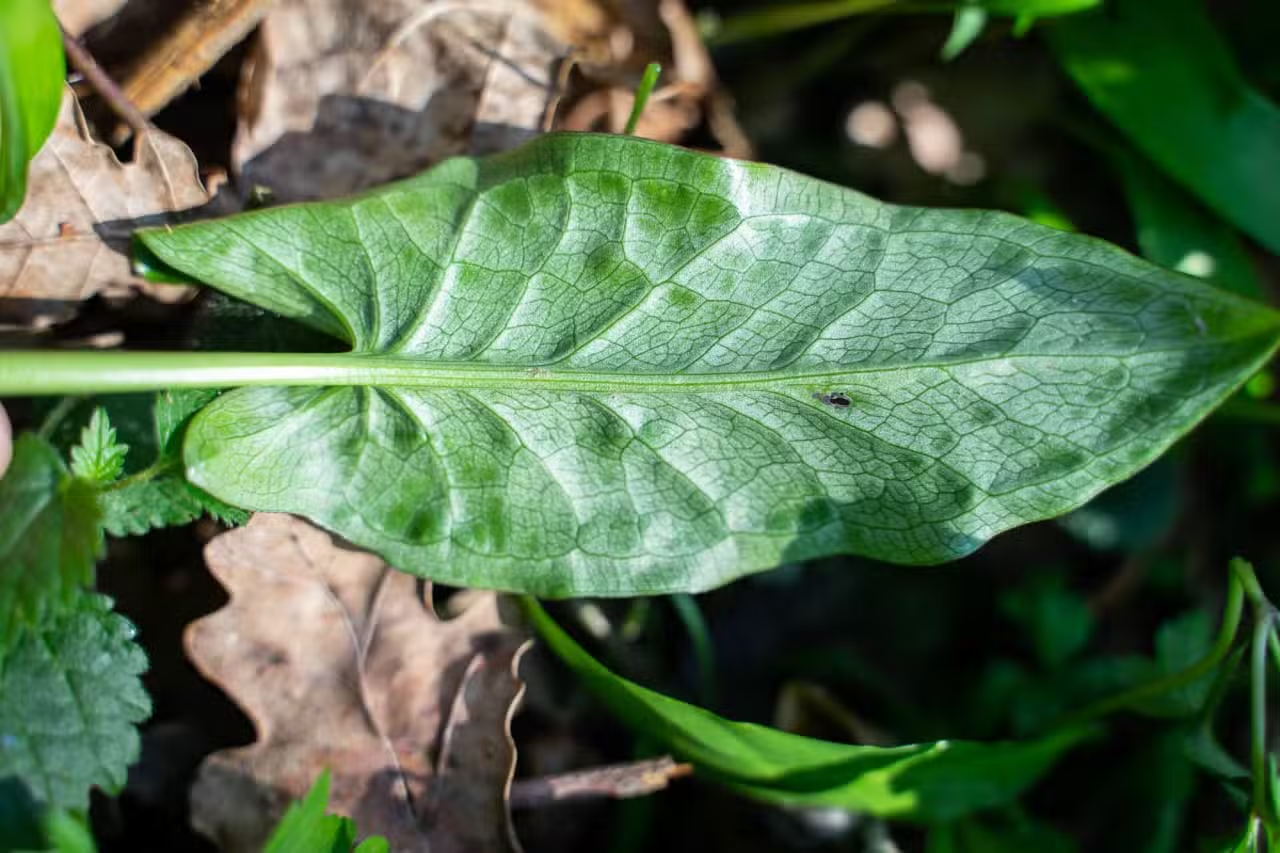
Lords-and-ladies belongs to the Araceae family. It is a spring geophyte that stores energy underground so it can grow before competing plants. Its leaves are dark green, with very pronounced reticulate veins (forming a network). They are hastate, meaning shaped like a halberd or, more simply, a spearhead. They appear between March and June, then disappear.


The flower consists of the spathe, a light green, antenna-shaped bract, and the spadix, the inflorescence itself, shaped like a brown spike. Together, they form an extraordinarily ingenious system for trapping small midges in a chamber. Hairs keep them inside; they become coated in pollen, then the hairs retract to release them. Since memory is not their strong suit, they get caught again, perhaps eventually pollinating a flower.
Once fertilised, the flower produces a spike of small, beautifully red berries. They begin to develop in June and can be found in woodland undergrowth in summer and autumn.
Lords-and-ladies is normally a woodland plant that favours shade and cool soils rich in organic matter, preferably clayey and alkaline. However, as we shall see, it can also grow at woodland edges and, more rarely still, in the middle of pastures.
One important way to recognise it and distinguish it from other species is to look closely at its veins. You will notice that a vein runs parallel to the edge of the leaf, all the way around it. This is particularly useful when distinguishing common sorrel from lords-and-ladies.

Toxicity of lords-and-ladies
Lords-and-ladies is poisonous. All parts contain calcium oxalates with needle-shaped crystals that irritate the skin, mouth, tongue and throat—in short, all mucous membranes. This can lead to difficulty breathing, burning sensations, vomiting… The most dangerous parts are the red berries, which also contain saponins[1, 2, 3].
The plant’s very acrid taste in the mouth prevents people from eating large quantities of it, so serious harm is often avoided. All parts can cause irritation in many people, and the plant must be handled with care[1, 2, 3].
Oxalate crystals are neutralised by drying, cooking the plant or macerating it in water[4]. This means it is mainly the raw leaves and berries that are dangerous. Be careful: an undercooked dish could also prove harmful.
Nevertheless, lords-and-ladies has been used for its medicinal properties in the past. In particular, it has been used fresh, applied externally to infected wounds[3] or for rheumatism. The root is said to be diaphoretic, diuretic, expectorant, strongly purgative and anthelmintic. More strangely, it has even been eaten! The roots were dug up, then cooked for a long time or dried[4]; they have a mild flavour and contain up to 25% starch, which is valuable in times of food shortage.
Arum leaves are also eaten in the Middle East! Here is a story from a blog reader:
I wanted to share an experience with you: some Kurdish friends living in Haute-Savoie invited me to eat with them. They had cooked wild plants gathered near their home and were delighted to have found them there, just as they had in Iraqi Kurdistan!
Anne, blog reader
The dish was delicious, and I asked to see the plant because I didn’t recognise the taste… (They didn’t know its French name)… When I saw it, I didn’t recognise it. Not wild spinach… Not wild garlic.
I tried to bite into it, and a terrible burning sensation filled my mouth. It lasted almost 24 hours! They told me it should never be eaten raw. Only cooked!
I’ve never found out the name of this plant, but after reading your article, I think it might be wild arum?
In any case, I had no digestive problems. They’re used to eating a lot of it when they find it in spring.
An ethnobotanical study conducted in Iraqi Kurdistan describes the consumption of Arum rupicola leaves, known locally as Kardi, Kardu or Xas[5].
The leaves are traditionally treated with water containing sumac, then cooked with rice, bulgur wheat or wild leeks. Some preparations also involve lacto-fermentation or drying.
Be aware that these descriptions do not constitute a validated detoxification method: raw arums are toxic, and improper preparation can still be dangerous. All these uses, whether raw or cooked, should therefore be avoided.
The day lords-and-ladies found its way into my kitchen
Arum recently played a strange trick on me. I’ve just moved to Les Pléiades, a small mountain in the Swiss Prealps, to an idyllic spot beside a beautiful alpine pasture. There are plenty of wild plants for me to eat, particularly good King Henry, also known as wild spinach. I was gathering it, along with salad burnet, to make a lemonade. Then, all of a sudden, the improbable happened: while gathering wild spinach, I realised something was wrong…
I looked in my basket and realised it contained two different species. I immediately recognised the arum that had slipped in among the good King Henry leaves. Impossible, improbable, but there it was: this woodland arum had left the forest and colonised the fields! Excited (because I knew this was rare), I went back for my camera to film it all. And I forgot to sort through what I’d gathered… Back at home, I started making my lemonade and only then noticed an arum leaf mixed in with the salad burnet…

In all the time I’ve been gathering wild plants, no toxic plant has ever ended up in my kitchen. I’ve always sorted through what I’ve gathered meticulously, taken the time to identify plants and left them alone whenever I had any doubts. Yet, in the very week my first book came out in bookshops, a toxic plant managed to find its way into my kitchen. A humbling lesson. No one is immune.
The first lesson is to sort through what you gather carefully as you pick it, leaf by leaf, and again in the kitchen. Be meticulous and leave nothing to chance: sorting twice is better than once, and far better than not at all.
The second lesson is that what’s written in books reflects only an author’s experience. I checked the literature and found no mention of lords-and-ladies growing in the middle of a field. So it’s extremely rare, but it can happen.
So what happened? Quite simply, this arum found a little woodland-like habitat in the middle of the meadow, beneath the good King Henry. The soil there is rich in nutrients, cool and shaded, just as it is in a forest. Don’t believe everything books say: it’s always your own experience and judgement that will help you decide.
Plants that could be confused with lords-and-ladies
Good King Henry
Good King Henry is an excellent wild vegetable. It looks remarkably like spinach and can be used in the same way. Confusion between the two plants is common, and people have contacted me about it. It grows in alpine pastures enriched by grazing livestock. Its leaves have a distinctive spearhead shape and prominent veins, and its small flowers are clustered in greenish-red spikes. After fruiting, small black seeds appear that look remarkably like Andean quinoa. No wonder: they belong to the same botanical family, the Amaranthaceae.

Good King Henry can be mistaken for lords-and-ladies. Although the two do not usually grow in the same habitat, confusion is rare but possible. Here are some tips for telling them apart. One characteristic of lords-and-ladies is a vein that forms a thin border around the leaf (see image below). This is an excellent way to distinguish it from Good King Henry and common sorrel.
Good King Henry
- The underside of its leaves is covered in tiny blisters, little bead-like structures that give it a grainy appearance. They feel ‘damp’ to the touch.
- Pick leaves from stems bearing easily recognisable flower spikes.
- Pick from July or August onwards: the leaves of lords-and-ladies have normally disappeared by then, as they grow in spring.


Lords-and-ladies
- Hairless leaves that feel dry, almost sticky, like rubber.
- Leaves appear in spring and disappear when summer arrives.
- inflorescences shaped like an antenna.
- A vein running parallel to the edge of the leaf.

Wild garlic
This is the most common risk because both plants favour cool, damp woodland. I would say there are two possible risks. The first is accidentally adding one or two leaves of lords-and-ladies to a harvest of wild garlic.
Lords-and-ladies often grows among clumps of wild garlic. It is therefore important to pick wild garlic, like all the other plants you forage, one leaf at a time!
One or two leaves in a pesto should not make it deadly, but could already be enough to cause symptoms.
The second risk would be to mistake the plants completely and pick only lords-and-ladies. Its large leaves are spearhead-shaped, so they are difficult to confuse with wild garlic. However, the young leaves are oval and can be mistaken for young wild garlic leaves.
The best way to tell them apart is that wild garlic has parallel veins, while arum has a network of veins, even on very young leaves.
Discover the plants that can be confused with wild garlic (autumn crocus, arum and lily of the valley).
Wild garlic
- Leaves with parallel veins
- Lanceolate leaves
- Garlic smell
Arum
- Leaves with a reticulate network of veins
- Adult leaves shaped like a spearhead, with two basal lobes
- No distinctive smell


Common sorrel
Common sorrel, Rumex acetosa, also has spearhead-shaped leaves. However, its flowers grow at the top of slender purple stems 40–50 cm tall.
It grows in meadows and likes the sun. As we have seen, arum is mainly a woodland plant, so the greatest risk is at woodland edges, where the two plants can grow together, which is quite common. Their young leaves look very similar, and both have a network of veins. The best way to tell them apart is the same as for good King Henry: look for the vein that runs all the way around the leaf.
Here are the key tips to remember:
- Gather common sorrel 5 m into the field, away from woodland edges.
- First identify the inflorescences of common sorrel and gather their leaves.
- Look for a vein running parallel to the edge of the leaf.

Références
- [1] Prakash Raju KNJ, Goel K, Anandhi D, Pandit VR, Surendar R, Sasikumar M. Wild tuber poisoning: Arum maculatum – A rare case report. Int J Crit Illn Inj Sci. 2018 Apr-Jun;8(2):111-114. doi: 10.4103/IJCIIS.IJCIIS_9_18. PMID: 29963416; PMCID: PMC6018264.
- [2] “Arum maculatum” World Heritage Encyclopedia.
- [3] Petit Larousse des plantes qui guérissent, Larousse.
- [4] Frohne. D. and Pfänder. J. A Colour Atlas of Poisonous Plants. Wolfe 1984 ISBN 0723408394
- [5] Pieroni A, Zahir H, Amin HIM, Sõukand R. Where tulips and crocuses are popular food snacks: Kurdish traditional foraging reveals traces of mobile pastoralism in Southern Iraqi Kurdistan. J Ethnobiol Ethnomed. 2019 Nov 27;15(1):59. doi: 10.1186/s13002-019-0341-0. PMID: 31775812; PMCID: PMC6882212.



8 comments
✍️ Leave a comment






29 November
Les Pléiades
- Marie Mellioret

Making a Christmas star Sold Out
Lally railway station, car park, Blonay, Switzerland.
04 April
La Sarraz
- Michaël Berthoud

Wild edible and medicinal spring plants in La Sarraz
La Sarraz football pitches car park. Route de Cossonay.
10 April
Les Pléiades
- Michaël Berthoud

Natural incense stick-making workshop
Lally railway station, car park, Blonay, Switzerland.
No events found.
Hello. An observation from my own experience: in a maize field, so disturbed ground where I don’t pick plants to eat, I nevertheless saw white goosefoot growing alongside very young thorn-apple plants. The two looked dangerously similar to me for an untrained eye.
What do you think?
Author
Hello Laure,
Thank you for sharing your experience! Thorn-apple doesn’t grow in my area, so I don’t have any experience of it and can’t say what I think. But I’ll bear your observation in mind 😉
Best wishes,
Michaël
Hello Michaël,
Thank you for such a humble response.
I wanted to suggest one more piece of advice as an extra safety net… hopefully no one will ever actually need it: stay humble and pay attention when we eat; if something seems wrong, it’s better not to eat it. And let’s take the time to savour our food rather than wolfing it down. That’s more in tune with our digestive system and provides an additional safeguard.
With arum, when it’s raw and fresh, you notice straight away: the oxalate crystals are so unpleasant that apparently the amount eaten is rarely enough to cause serious harm… though I imagine some people are more sensitive than others. Cooked, if I’m not mistaken, it tastes distinctly unpleasant.
As an aside, this approach can also be useful with cultivated produce. I once had a very bitter squash, and we tried adding other ingredients to make it easier to eat. Years later, I learnt that a bitter squash isn’t edible: it’s a sign that it has been cross-pollinated with a toxic ornamental gourd.
Happy foraging
Valentine
P.S. I didn’t have to go beyond my garden to see that arum can make do with very little shade and spread into other habitats, now that I’ve made more room for biodiversity there. It has managed to establish itself on ground that is often quite dry and gets sun during the hottest hours of the day, down on the plain!
Author
Hello Valentine,
Thank you for your comment and for sharing your experiences. I agree: taking the time to do things properly helps us avoid risks and enjoy ourselves more, too!
Best wishes,
Michaël
Hello!
Just to say that your article came at exactly the right time… just after I was poisoned. In fact, it’s the only one that reassures me about how and why I could have confused goosefoot with lords-and-ladies.
After attending various foraging workshops (we were talking about humility, weren’t we? Nature doesn’t let you fool yourself for long; the lesson is immediate!), including yours, I was on my way to look for wild garlic with my four-year-old goddaughter when I thought I recognised some goosefoot beside the path. I even thought we’d have been better off foraging for that than for the wild garlic, which was proving elusive.
We found a patch of wild garlic. We were happy. Picking it leaf by leaf. All was well.
Then I came across those ‘wild spinach’ plants again. I did a (too) quick check online; otherwise, I’d have seen your article!
The disaster was that this was the first time I’d dared to pick anything other than wild garlic or wild strawberries. I regretted it, but we came through unharmed… by the next day. It felt strange, and it was very frightening too.
So thank you for this article!
Sophie
Author
Hello Sophie,
Thank you for sharing your experience. They really do look alike at certain times of year. I’m glad it turned out well for both of you!
I’ve just added an identification tip to this article, with a picture: the vein running around the edge of the leaf. It can really help distinguish lords-and-ladies from other plants, such as goosefoot, one of the well-known ‘wild spinach’ plants, and common sorrel.
Happy foraging,
Best wishes,
Michaël
Hello,
A very interesting page. But there’s a typo: ‘lords-and-ladies (Arum macultum)’…
Good work
Author
Hello,
Thank you for your feedback and for pointing it out!