



Log in
Common elder: how to identify it, distinguish it from similar plants and cook with it
Michaël Berthoud
/
27 August 2026
Every year, in May and June, the scent of common elder delights us. Powerful yet subtle, it drifts around hedgerows and woodland edges long before we notice the large white inflorescences. Then, in late summer, the spectacle begins again: the flowers have given way to clusters of small, glossy black berries. Two very different harvests from one of Europe’s most popular shrubs.
Table of contents
The history of common elder
Common elder (Sambucus nigra L.) has long been part of life for people across Europe. Its flowers and fruits have been used as food and in homemade preparations, as well as for many traditional purposes. Over the centuries, the shrub has also become associated with beliefs and supposed magical properties. Gardens, hedgerows and even cemeteries have helped maintain this close connection with people.
Common elder has long held a place in Celtic traditions. In the British Isles, it was nicknamed the “Old Lady” and associated with the witch, one aspect of the Goddess. According to belief, washing one’s eyes with the green sap from its wood made it possible to see invisible beings. Considered a protective shrub, it was also used to make amulets: its branches were cut before the full moon in October[7].
Its scientific name was published by Carl von Linné in 1753 in Species Plantarum. Today, Sambucus nigra is still recognised as an accepted species, native to a vast region stretching from Europe to western Iran. Kew Science describes it as a food plant, a medicinal plant and a potentially toxic plant, depending on the parts used[3].

Distribution and habitats
Common elder is found throughout France, Switzerland and Belgium, from 0 to 1,600 metres above sea level.
You will often find it in hedgerows, thickets and at woodland edges, often in partial shade. It also favours wasteland, disturbed ground and some areas around homes. It is found across much of Eurasia and has been introduced to the Americas, Africa and Australia.
Its presence near homes should not, however, make us forget the basic rules of foraging: avoid shrubs exposed to chemical treatments, those near busy roads and those exposed to other sources of pollution.
Common elder
|
Sambucus nigra L.
|
2010–2025
|
GBIF
Loading map…
Identifying common elder
Common elder is a shrub or small tree, generally reaching 4 to 5 metres, sometimes up to 7 metres. Several features help you recognise it throughout the seasons.
Bark and shoots
Its bark is grey and dotted with numerous small lenticels. These slightly raised marks, which look almost like warts, are particularly visible on young branches.

The shoots are woody and contain abundant white pith. This feature is very useful for distinguishing it from red-berried elder.
The leaves
The leaves are opposite and pinnate: they consist of several leaflets arranged on either side of a central axis. There are usually five to seven leaflets, oval to lanceolate, with toothed edges and long, pointed tips.

From a distance, these leaves can resemble those of an ash. An ash, however, grows into a much larger tree, and its bark does not have the same small lenticels.
Flowers
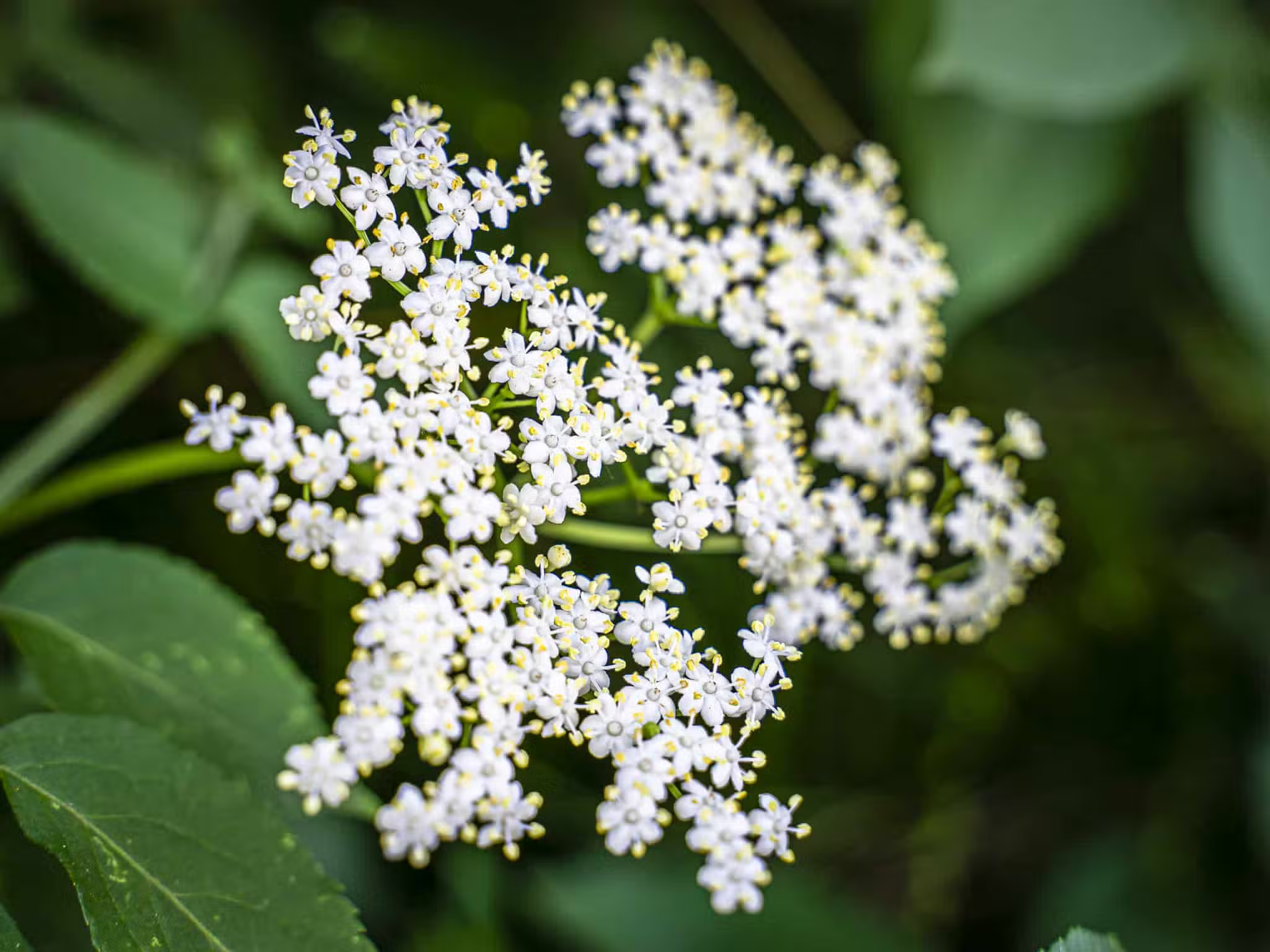
The flowers appear mainly in May and June. Small and white to yellowish-white, and very fragrant, they measure up to 7 millimetres across. Each has five rounded lobes and five yellow stamens.
They are grouped in large corymbs that are generally flat or slightly domed. Picture a flower cluster whose peduncles start at different heights but bring the flowers almost level with one another.

Fruit
From late summer onwards, numerous glossy black berries appear, measuring around 4 to 6 millimetres. While the flowering corymbs tend to face upwards, the fruit-laden clusters lean over or hang down.
But take care: dark colouring alone is not enough. Always check the whole plant, particularly whether it has woody stems and what colour the pith is.

Distinguishing common elder from red-berried elder and dwarf elder
The genus Sambucus includes two other species worth our attention: red-berried elder and dwarf elder. Comparing several features is much safer than taking a quick look at the fruit.
Dwarf elder
Dwarf elder (Sambucus ebulus) is a herbaceous perennial, not a shrub. Its aerial parts remain green and flexible: they do not develop true woody stems.
It generally flowers in July and August, later than common elder. Its leaves, flowers and fruit can nevertheless be confused with those of common elder.
Here is the decisive feature: if you cannot see hard, woody shoots, do not pick it.
Dwarf elder should not be considered an edible substitute for common elder: it also contains other potentially toxic substances, including certain lectins. Nevertheless, studies into its edibility are under way[9].


Red-berried elder
Red-berried elder (Sambucus racemosa) is woody, like common elder. It is found mainly at mid-mountain elevations.
Its flowers tend to be yellowish, and its fruit turns red when ripe. If you make a clean cut through a shoot to examine its pith, you will find another useful distinguishing feature: red-berried elder has orange pith, while common elder has white pith.
Red-berried elder is also considered a food plant, depending on the parts used and how they are prepared: the berries must be cooked and strained before consumption.


Comparison of elder species
This infographic shows the different elder species in pictures. Comparing the images directly is a good way to learn to tell them apart.

Culinary uses
Common elder offers us two parts of interest: its flowers in spring and its berries in late summer. They have very different aromas and are prepared in very different ways.
Using the flowers
Harvest the corymbs when the flowers have just opened, ideally in dry weather. When you get home, spread them out on a flat surface so the insects can leave the harvest undisturbed. Then remove as many of the peduncles and other green parts as possible, as they add bitterness.
The flowers can flavour a liquid through a hot infusion or a cold infusion. In Europe, syrup is probably the best-known preparation made from them. But their aroma also works very well in:
- Lemonades and other drinks
- Flavoured wines
- Vinegars
- Ice creams and sorbets
- Crèmes brûlées
- Tarts and other desserts
- Herbal teas and infusions
Once dried, the flowers can also be ground to a powder and added in small quantities to flour to flavour biscuits.
For a cold infusion, take particular care to remove insects: their presence can encourage unwanted fermentation and turn the preparation into vinegar.


Cooking with the berries
The berries must be harvested when fully ripe: black and shiny, with the cluster drooping under their weight. Wear suitable clothing: their purple juice stains badly!
Traditionally, they are made into syrups, jellies, juices, sparkling lemonades or fermented wines. They make particularly beautiful deep-purple jellies.
The berries are rich in polyphenols, particularly anthocyanins, which give them their dark colour. They also provide fibre, vitamins and various minerals. Their composition varies considerably, however, depending on the variety, growing conditions and degree of ripeness. It is therefore better to regard them as a fruit of interest than to assign them a fixed nutritional value or universal health benefits.

Common elder flu remedy syrup
Find out how to make a common elder flu remedy syrup.
Precautions
Elders may contain cyanogenic glycosides that can release hydrogen cyanide during digestion and cause digestive problems: stomach pains, diarrhoea, vomiting… The amounts vary between species and between parts of the plant.
Several people have told us they experienced digestive problems after consuming preparations made with raw berries. Personally, I found the flowers delicious in a tart, but particularly laxative… This supports a traditional precaution recommending that preparations be strained and that the flowers and berry seeds not be eaten directly in large quantities.
- The leaves and unripe berries contain the highest levels of cyanogenic glycosides[4] and should not be eaten.
- The flowers are considered suitable for moderate consumption[8]. We nevertheless recommend straining preparations or limiting the amount consumed if they are not strained.
- The berries should be harvested when fully ripe. Cooking reduces their glycoside content[5], and straining preparations is recommended.
Cooking is therefore no substitute for correct identification or sorting the fruit. If the plant is herbaceous, if the pith is not white or if you are unsure which elder species you have, do not eat what you have gathered.
When correctly identified and properly prepared, common elder gives us two delicious seasonal treats: the subtle fragrance of its flowers in spring and the rich, fruity flavour of its berries in autumn.
Références
- [1] InfoFlora — Sambucus nigra L.
- [2] Tela Botanica — Sambucus nigra L.
- [3] Kew Science, Plants of the World Online — Sambucus nigra L.
- [4] Senica, Mateja; Stampar, Franci; Mikulic-Petkovsek, Maja, Harmful (cyanogenic glycoside) and beneficial (phenolic) compounds in different Sambucus species, Journal of Berry Research, 2019, 1–15
- [5] Senica, M., Stampar, F., Veberic, R. & Mikulic-Petkovsek, M. (2016). Processed elderberry (Sambucus nigra L.) products: A beneficial or harmful food alternative?, LWT—Food Science and Technology, 72, 182–188.
- [6] Uhl, K. & Mitchell, A. E. (2024). Elderberry, an Ancient Remedy: A Comprehensive Study of the Bioactive Compounds in Three Sambucus nigra L. Subspecies, Annual Review of Food Science and Technology, 15, 27–51.
- [7] Maria Freeman, Vivre la tradition celtique au fil des saisons, Guy Daniel Éditeur, 2001
- [8] Senica, M., Stampar, F., Veberic, R. and Mikulic-Petkovsek, M., The higher the better? Differences in phenolics and cyanogenic glycosides in Sambucus nigra leaves, flowers and berries from different altitudes, J. Sci. Food Agric., 2017, 97, 2623-2632
- [9] Senica, Mateja; Stampar, Franci; Mikulic-Petkovsek, Maja, Harmful (cyanogenic glycoside) and beneficial (phenolic) compounds in different Sambucus species, Journal of Berry Research, 2019, , 1–15



4 comments
✍️ Leave a comment





29 November
Les Pléiades
- Marie Mellioret

Making a Christmas star Sold Out
Lally railway station, car park, Blonay, Switzerland.
04 April
La Sarraz
- Michaël Berthoud

Wild edible and medicinal spring plants in La Sarraz
La Sarraz football pitches car park. Route de Cossonay.
10 April
Les Pléiades
- Michaël Berthoud

Natural incense stick-making workshop
Lally railway station, car park, Blonay, Switzerland.
No events found.
Thank you for this concise article, which brings together all the most important information so clearly. I now feel more confident about getting to know this plant, foraging for it and discovering what it has to offer.
Author
Thank you for your feedback 😊🌿
Many thanks for the article on the different elder species. The precise descriptions and well-chosen photos make it easy to tell them apart.
Thank you also for sharing the ‘recipes’ that show how to consume them safely.
Author
Hello,
Thank you for your feedback ^^
Happy foraging! 🌿