



Log in
Whitebeam: how to identify and cook its wild fruits
Michaël Berthoud
/
13 November 2026
The whitebeam (Sorbus aria), a member of the Rosaceae family, produces small wild fruits called alises or alouches.. When fully ripe, they are sweet and develop a delicious aroma somewhere between quince, pear and apple.
Whitebeam, Whitebeam
Sorbus aria (L.) Crantz syn. Aria edulis (Willd.) R. Roem.
Family: Rosaceae
Parts used: Fruits
Foraging season: Autumn

Turn over a whitebeam leaf: its underside is covered in white felt-like hairs that contrast with the green upper surface. This is a useful first clue for spotting the tree along woodland edges and on rocky slopes.
History of the plant
Fruits that supplemented bread flour
Whitebeam berries have not always been reserved for jam-making. Its German names, Gewöhnliche Mehlbeere (literally “common flour berry”) and Echter Mehlbeerbaum (literally “true flour-berry tree”), aptly evoke the fruit’s texture and this use as food.
A 2025 scientific publication by the Bayerische Landesanstalt für Wald und Forstwirtschaft (Bavarian State Institute of Forestry) offers three possible explanations for the German name:
- The whitish down on the leaves, which makes them look as though they have been dusted with flour.
- The former use of dried, ground fruits to supplement flour during times of food shortage.
- The floury texture of the fruit’s flesh.
The publication notes that several explanations coexist, without definitively establishing the name’s etymological origin [7].
Regarding traditional medicinal uses, according to Fournier, it is used like the wild service tree to treat coughs, catarrh and diarrhoea[18].

Names that change
The scientific name historically used for whitebeam is Sorbus aria (L.) Crantz, particularly in Swiss floras and traditional botanical literature. It is, for example, the name most often used in scientific studies.
However, taxonomic classification is changing: Aria edulis (Willd.) M.Roem. is now accepted and used by several major international databases and countries:
| Botanical reference | Accepted name |
|---|---|
| InfoFlora (Switzerland) | Sorbus aria |
| FloraWeb (Germany) | Sorbus aria |
| INPN (France) | Aria edulis |
| Plants of the World Online (Kew) | Aria edulis |
| USDA GRIN (United States) | Aria edulis |
Although more universal than common (local) names, some scientific names also vary from country to country. This can cause some confusion if, for example, you consult a French flora and a Swiss one side by side.
To complicate its nomenclature further, it has two names in French:
- Whitebeam : used notably in Swiss[2] and French floras[19]
- Whitebeam : used, for example, by Fournier (in his historical book on medicinal plants), who considers the name a corruption of the term alisier
But take care: there are several species of whitebeam! One is its relative, the wild service tree, Sorbus torminalis. To avoid confusion, it is best to say "whitebeam« rather than simply »service tree’.
Alisier blanc is the name adopted by TelaBotanica and Infloflora, so that is the one we use.
Distribution and habitat
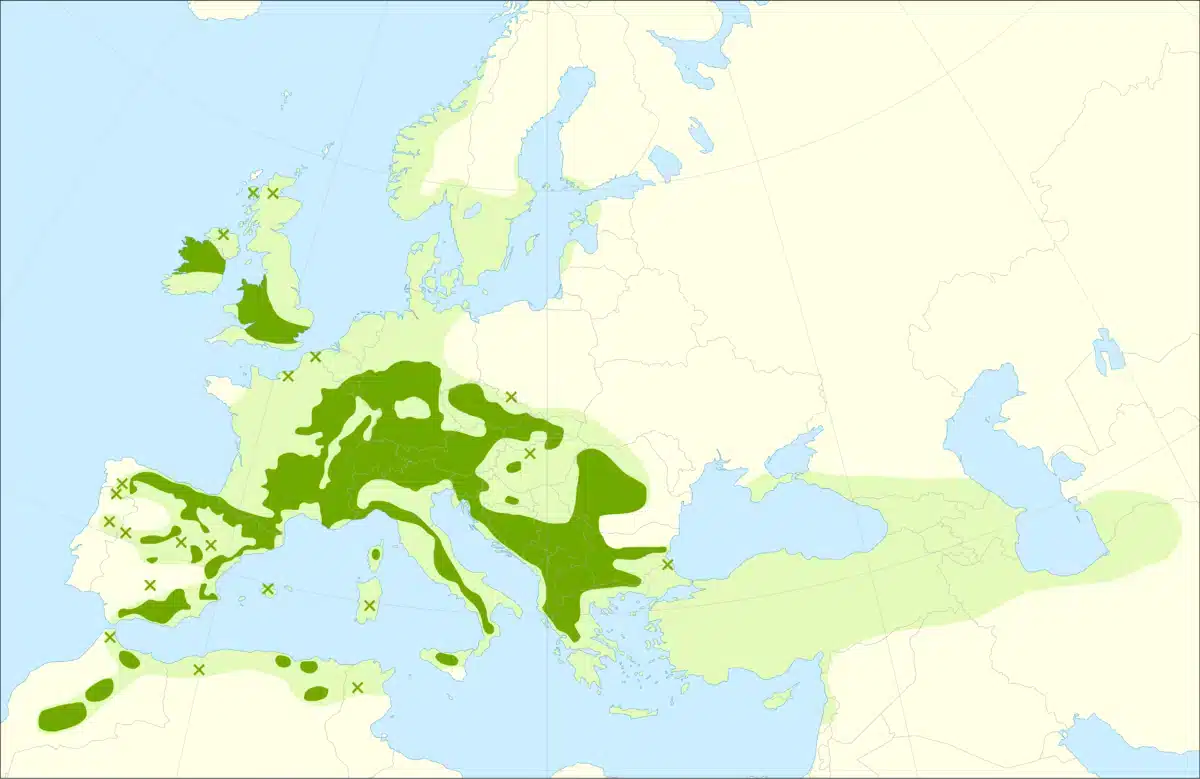
Whitebeam is a European species found across Europe. You can find it in open woodland, scrub and rocky places, from lowland areas up to the subalpine zone[2].
In the local landscape, look for it particularly along woodland edges and on well-exposed slopes. It tends to be scattered and generally does not form dense stands, so it can go unnoticed among other broadleaved trees.
In France, it is very widespread in the South-West, the Massif Central, the South-East and the Mediterranean region. It is more scattered in central and north-eastern France, and rare or absent across much of the North-West and the Atlantic coast. It has regional protection in the former Haute-Normandie region, under the ministerial order of 3 April 1990[9].
In Switzerland, it occurs across almost the entire country, but you are most likely to encounter it in mid-altitude mountain areas.
How to recognise common whitebeam
Common whitebeam may grow as a shrub or a tree reaching 15–20 m. To identify it, look for several features together[2]:
- The leaves are simple and oval, with a doubly toothed edge, sometimes slightly lobed.
- The upper surface is dark green and the underside is white and felted. This contrast is particularly useful.
- The leaves are arranged alternately along the shoot: they do not grow in opposite pairs.
- The flowers are white and clustered in corymbs, usually in May.
- The fruits are round to oval, orange to red, about 8 to 15 mm long, and dotted with fine white down
The fruits look like tiny apples. Do not rely on their colour alone, though: several shrubs bear red fruits in autumn.
For years, this tree eluded me. I encountered it only occasionally, although I knew it was common. After a season particularly favourable to fruiting, I began to notice it everywhere around my home! Indeed, when it bears fruit, it becomes much more visible among the autumn foliage.


Possible confusion
The wayfaring tree (Viburnum lantana) deserves particular attention. It too has oval, toothed leaves with hairy undersides. It also grows in hedgerows and along woodland edges[4].


The most practical distinguishing feature is how the leaves are arranged on the shoot: on the wayfaring tree, they grow in opposite pairs rather than alternately.
| Feature | Whitebeam | Wayfaring tree |
|---|---|---|
| Leaf arrangement | Alternate, staggered along the shoot | Opposite, in pairs |
| Leaf appearance | Strong contrast between the green upper surface and white underside | Distinctly wrinkled upper surface, greyish, hairy underside |
| Fruit | Small orange to red ‘apples’ | Slightly flattened fruits, red then black |
These differences should be considered together. The wayfaring tree must not be gathered instead of whitebeam. The University of Zurich’s toxicology database lists unripe fruits among the toxic parts, while noting that the evidence on fruit toxicity is contradictory[5].
Gathering whitebeam fruits
Wait until they are ready
October is the ideal time, when the fruits begin to blett. This timing should be adjusted to the location and the season.
Bletting is an advanced stage of ripening when the flesh softens. The fruit becomes slightly soft, less astringent and very pleasant to eat. Its sweetness and apple-like aroma are then much more pronounced than in fruit that is still firm.
If they are astringent and lack flavour, wait a little longer. But not too long, as whitebeam berries can develop mould over time.

Foraging responsibly
Don’t forget, either, that wild fruit is a valuable food source for wildlife, as this photograph of hazel dormice eating whitebeam berries shows[7]. Because the whitebeam is a tall tree, you are bound to leave some fruit behind. Nevertheless, avoid harvesting with poles or other tools, which are often prohibited by law.

How do you prepare whitebeam berries?
As we have seen, whitebeam berries are sweet, with a delicious aroma reminiscent of apples, quinces and pears. They are traditionally prepared using the usual methods for wild fruit[6]:
- Compotes
- Jellies
- Jams
- Syrup
- Liqueurs
- Steam-extracted juice
- Blended and added to flour to make it go further
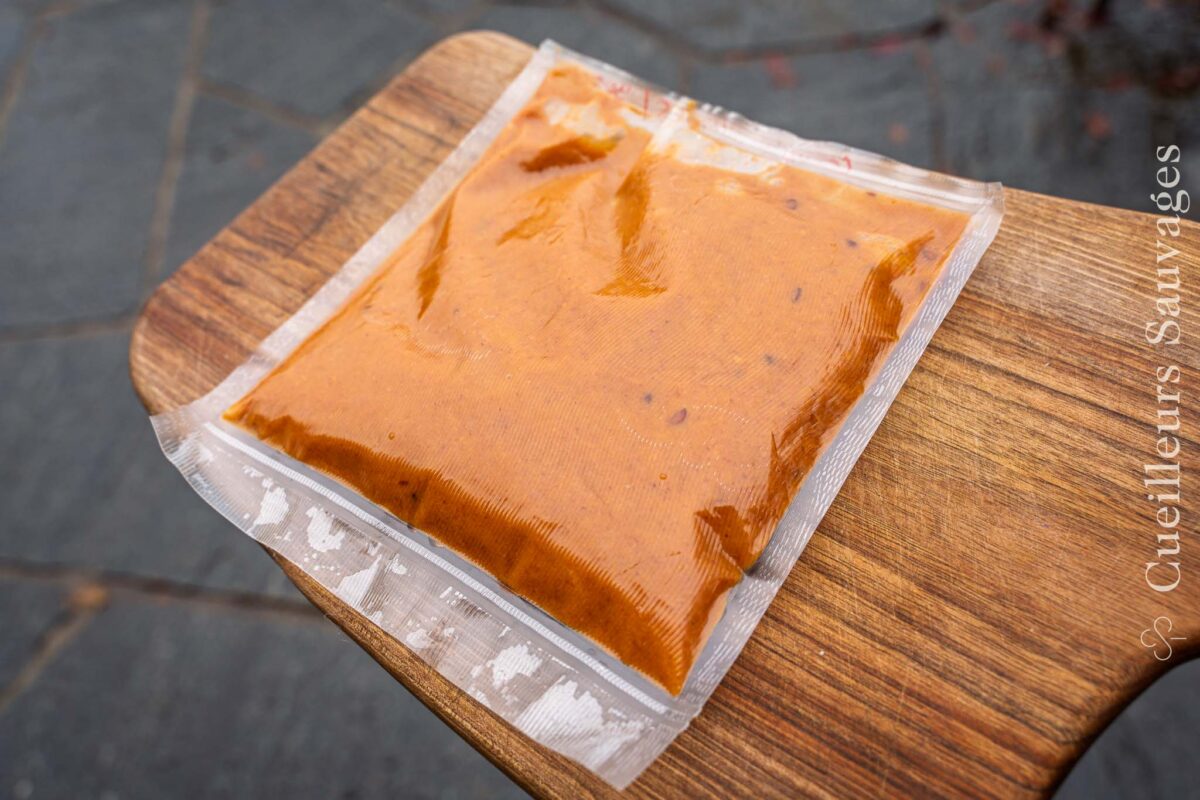
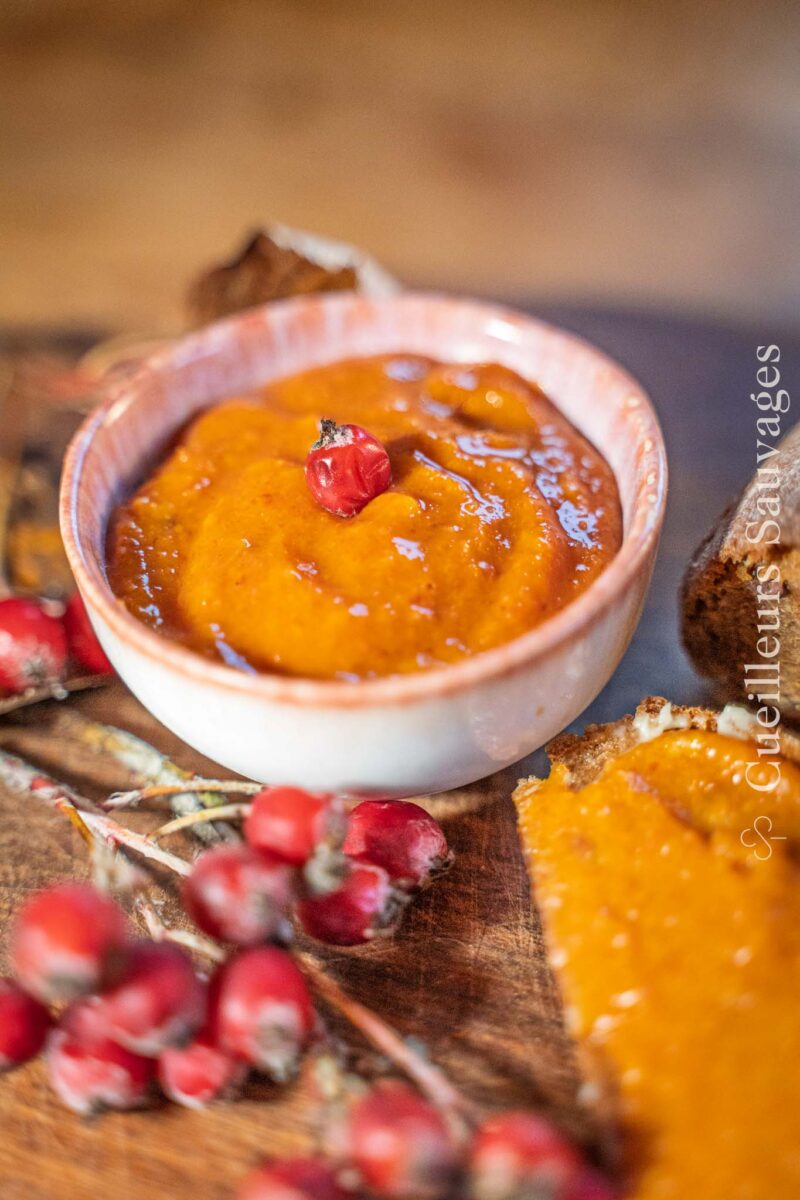
Jellies, syrup and liqueurs are easy to make, as you simply immerse the fruit in the liquid.
Making a fruit sauce takes longer:
- Cook the washed fruit in an equal volume of water.
- Mash well during cooking; 10 minutes is enough.
- Pass the fruit through a food mill to make a purée. The fruit clearly contains a lot of pectin, as the purée quickly becomes sticky.
From 750 g of fruit, I obtained 470 g of purée. It takes time, but it is well worth it, because this pulp is delicious! You can spread it on a slice of bread or mix it directly into flour:
Rustic whitebeam berry bread
The fruit of the whitebeam can be added to bread dough as a pulp. We tried making a version with wholemeal emmer flour.Discover our recipe for whitebeam fruit bread and our preparation tips.
Medicinal uses and nutritional properties
As we have seen, whitebeam features in traditional medicinal uses. A scientific review of the genus Sorbus (which also includes rowan), published in 2020, reports the use of the leaves for diarrhoea, as well as traditional uses of the fruit and inflorescences as a diuretic, laxative and emmenagogue. They have thus been used to treat painful menstruation, constipation and kidney disorders[6]. Note that these are traditional uses that have not been studied or demonstrated.
Whitebeam fruit has a high dry-matter content. It contains glucose, fructose and pectins, among other things[10]. It also contains carotenoids and various phenolic compounds, including phenolic acids and flavonoids. Extracts of the fruit have shown antioxidant activity in laboratory tests (in vitro)[10, 11].
Studies are currently very limited and do not yet establish any benefits to human health from eating the fruit[12].
Precautions concerning whitebeam seeds
Cyanogenic compounds that can release hydrogen cyanide have been detected in whitebeam leaves, with considerable variation between individual plants[13]. Cyanogenic glycosides, notably prunasin and amygdalin, have also been identified in the seeds of several other species in the genus Sorbus[14, 20].
As a precaution, it is therefore recommended that you remove the seeds from whitebeam fruit before using it in cooking, particularly for preparations in which the fruit is ground, blended or mashed. For making bread, as in traditional practice, we recommend using strained purée rather than the whole fruit blended with its seeds.
This recommendation is based on knowledge of the genus Sorbus and the risk of cyanide release when tissues containing cyanogenic glycosides are broken down[14, 20]. It does not mean that the toxicity of Sorbus aria seeds has been directly demonstrated: quantitative data remain insufficient.
References
[2] InfoFlora. Sorbus aria (L.) Crantz — Alisier blanc. Description from Flora Helvetica, 2018. Accessed 2 November 2026.[3] University College Cork, Irish Tree Explorers Network. Sorbus aria. ‘How it Looks’ and ‘Cultural Importance’ sections, undated. Accessed 2 November 2026.
[4] InfoFlora. Viburnum lantana L. — Viorne lantane. Description from Flora Helvetica, 2018. Accessed 2 November 2026.
[5] University of Zurich, Institute of Veterinary Pharmacology and Toxicology. Viburnum lantana — Arznei- und Giftpflanzen. Accessed 2 November 2026.
[6] Sarv, V., Venskutonis, P. R. and Bhat, R. (2020). The Sorbus spp.—Underutilised Plants for Foods and Nutraceuticals: Review on Polyphenolic Phytochemicals and Antioxidant Potential. Antioxidants, 9(9), 813. doi:10.3390/antiox9090813.
[7] Bayerische Landesanstalt für Wald und Forstwirtschaft (2025). LWF Wissen 88 – Beiträge zur Mehlbeere. Foreword by Dr Peter Pröbstle.
[8] By Giovanni Caudullo — Caudullo, G., Welk, E., San-Miguel-Ayanz, J., 2017. Chorological maps for the main European woody species. Data in Brief 12, 662-666. DOI: 10.1016/j.dib.2017.05.007Data: https://doi.org/10.6084/
[9] Arrêté du 3 avril 1990 relatif à la liste des espèces végétales protégées en région Haute-Normandie complétant la liste nationale. Journal officiel de la République française, no. 123, 29 May 1990, Art. 1. NOR: PRME9061200A.
[10] Petkova, N. T., Ognyanov, M. H., Vrancheva, R. Z. & Zhelev, P., Phytochemical, nutritional and antioxidant characteristics of whitebeam (Sorbus aria) fruits, Acta Scientiarum Polonorum Technologia Alimentaria, 2020, 19(2), 219–229
[11] Šavikin, K. P., et al., Sorbus aucuparia and Sorbus aria as a Source of Antioxidant Phenolics, Tocopherols, and Pigments, Chemistry & Biodiversity, 2017, 14, e1700329
[12] Tamayo-Vives, C., et al., Crataegus monogyna Jacq., Sorbus aria (L.) Crantz and Prunus spinosa L.: From Edible Fruits to Functional Ingredients: A Review, Foods, 2025, 14, 2299
[13] Fikenscher L.H., Hegnauer R., Ruijgrok H.W.L. (1981). Die Verbreitung der Blausäure bei den Cormophyten. 15. Mitteilung: Neue Beobachtungen zur Cyanogenese bei den Rosaceen. Planta Medica, 41(4), 313–327. DOI: 10.1055/s-2007-971722. This study is the best available primary evidence of cyanogenesis in S. aria, but only in the leaves.
[14] Takaishi K., Kuwajima H., Hatano H., Go H. (1977). Cyanogenic Glycosides and Glycosidase of Sorbus Species. Chemical & Pharmaceutical Bulletin, 25(11), 3075–3077. DOI: 10.1248/cpb.25.3075. This is the best primary study demonstrating the presence of amygdalin and prunasin in the seeds of several Sorbus species, but it does not include S. aria.
[15] Petkova N.T., Ognyanov M.H., Vrancheva R.Z., Zhelev P. (2020). Phytochemical, nutritional and antioxidant characteristics of whitebeam (Sorbus aria) fruits. Acta Scientiarum Polonorum Technologia Alimentaria, 19(2), 219–229. DOI: 10.17306/J.AFS.2020.0786. The seeds were explicitly removed before analysis.
[16] EFSA CONTAM Panel (2019). Evaluation of the health risks related to the presence of cyanogenic glycosides in foods other than raw apricot kernels. EFSA Journal, 17(4):5662. DOI: 10.2903/j.efsa.2019.5662. Main reference for the acute reference dose (ARfD), toxicokinetics and the effects of food processing.
[17] Bundesministerium für Soziales, Gesundheit, Pflege und Konsumentenschutz. Österreichische Liste essbarer Wildpflanzen und Blüten, version amended in 2023. Sorbus aria fruit is permitted without any particular warning; by contrast, S. torminalis carries an explicit instruction to remove the seeds because of cyanogenic glycosides.
[18] Fournier, Dictionnaire des plantes médicinales et vénéneuses de France, Omnibus, 1947
[19] TelaBotanica, Alisier blanc Sorbus Aria, accessed 6 November 2026
[20] University of Zurich. CliniTox: Sorbus aucuparia. Toxicological data on amygdalin in the seeds, fruit and leaves.
[21] European Commission (2003). Opinion of the Scientific Committee on Animal Nutrition on Undesirable Substances in Feed. Mechanisms of cyanide release from cyanogenic glycosides.



4 comments
✍️ Leave a comment





29 November
Les Pléiades
- Marie Mellioret

Making a Christmas star Sold Out
Lally railway station, car park, Blonay, Switzerland.
04 April
La Sarraz
- Michaël Berthoud

Wild edible and medicinal plants in spring in La Sarraz
La Sarraz football pitches car park. Route de Cossonay.
10 April
Les Pléiades
- Michaël Berthoud

Natural incense stick-making workshop
Lally railway station, car park, Blonay, Switzerland.
No events found.
Very interesting: this is a wealth of useful information for anyone who knows little or nothing about this woodland tree. I had no idea its fruit was edible.
Author
Thank you very much for your comment! Whitebeam is indeed a rather little-known tree, and its fruit deserves more attention. Nature still has plenty of discoveries in store for us!
All the best, and happy foraging 🌿
Michaël
Thank you very much for this article. There is a lot of fruit on the whitebeams this year, so it’s a good opportunity to make some preserves. Warm regards, Myriam
Author
Hello Myriam,
Thank you very much for your kind comment! It’s true that whitebeam berries are particularly abundant this year. In fact, that’s what made us want to devote an article to them.
We wish you many enjoyable foraging trips and delicious things to make! 🌿
Michaël