



Log in
Botanical printing in a rusty pot
Marie Mellioret
/
19 March 2026
Discover botanical printing in a rusty pot, a fascinating nature art technique. Marie guides you through this natural alchemy, in which iron and tannin-rich plants reveal delicate botanical prints in natural hues.
I’ve been practising this wonderful technique of botanical printing in a rusty pot for several years now. It’s time I shared it with you, because it is such a source of wonder and originality. Through this process, we truly connect with nature: we take time to observe the leaves and their delicate shapes, then let the alchemy between the plants, rust and paper do its work. Slowly, nature reveals its prints in timeless tones, as though it had painted with the ink of time, sharing a secret with us.
What is ‘impression botanique à la marmite de rouille’ (botanical printing in a rusty pot)?
In fact, I invented this French name because this botanical printing method is mainly used in English-speaking countries, particularly Australia and Ireland, but also in Spain. In those countries, it is called ‘Ecoprint on dirty pot’, which could be translated into French as ‘impression végétale dans un pot sale’ (‘plant printing in a dirty pot’).
The ‘dirty pot’ is a plant-dyeing technique inspired by traditional plant-printing methods. It is a recent innovation in the contemporary botanical printing movement (known as ecoprinting in English), practised by Irish artist Nicola Brown, with whom I trained remotely.
What inspired me so much about this technique is that it does not require industrial mordants, but uses a natural substance, the iron in rust, as a natural mordant. It is a completely environmentally friendly botanical printing technique. That is why I call it impression botanique à la marmite de rouille in French.


How does this botanical printing method work?
The essential elements for this technique to work are:
- Heat
- Moisture
- Pressure
- Tannin-rich plants
First, we go out foraging to choose the plants. Then we place them between sheets of paper, pressed between ceramic tiles like little bundles. The bundles are then immersed in a pot of rusty water and heated until the magic of the elements prints the plants onto the paper.
Then comes the moment of discovering, with immense joy, the surprises the botanical prints hold. Every time, I’m filled with wonder. It’s almost hard to believe that the patterns of the veins can appear like delicate watercolours revealed by nature itself. Although I can’t paint, I feel like an artist working with nature, thanks to the harmony that emerges in these prints.
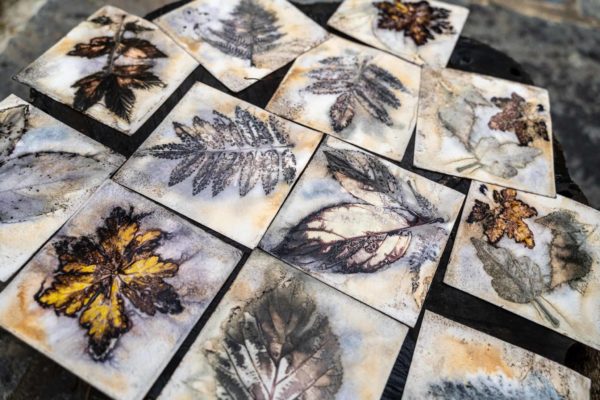
Rust, however, will always produce subtle, soft yet deep shades that look entirely natural and weathered by nature, as though they had come from an old herbarium or recalled the pigments of the earth. We can have fun experimenting with the colours by adding materials during cooking to create a muted, delicate and enveloping palette of sepia, ochre, dusty rose and smoky blue-violet.
In short, tannin-rich plants imprint their beautiful veins on the paper (or fabric) with the help of various elements, such as the rust used here as the main mordant. It’s a matter of understanding the alchemy of the elements so that the magic can happen and the colours turn out at their best.
That’s the whole art of this technique… getting in touch with your inner alchemist!
Choosing tannin-rich plants
Tannin is a natural substance found in most plants that helps protect them from predators and heal their wounds. It enables the veins to be printed onto the paper. The climate, soil type and season all influence the prints, and each region has its own plants that work particularly well. For example, around here we have:
- Geraniums
- Meadowsweet
- Sycamore maple
- Dogwood
- Rose hips
- Blackberries
- Rowan
- Ferns
- Etc.


If you’d like to learn more about this method, find out which plants in your area work well for printing and explore the finer points of the process, I’d be delighted to guide you in my classes here at the chalet and, soon, through an online course.
To discover these botanical prints, you are warmly invited to our exhibition from 30 May to 1 June 2026 at Les Pléiades in Switzerland. To celebrate 10 years of Cueilleurs Sauvages and the wonder of nature, we will open our doors and present Marie Mellioret’s nature art.



6 comments
✍️ Leave a comment






29 November
Les Pléiades
- Marie Mellioret

Making a Christmas star Sold Out
Lally railway station, car park, Blonay, Switzerland.
04 April
La Sarraz
- Michaël Berthoud

Wild edible and medicinal spring plants in La Sarraz
La Sarraz football pitches car park. Route de Cossonay.
10 April
Les Pléiades
- Michaël Berthoud

Natural incense stick-making workshop
Lally railway station, car park, Blonay, Switzerland.
No events found.
Hello. I’ve wanted to learn this technique for a while. I used to follow Nicola Brown, and it really interested me. I signed up for one of your courses last year, but unfortunately you had to cancel it. Sadly, I’ll be away during your open days this year too. But I’d be very interested in an online course. Please keep me posted! Best wishes
Author
Hello Sue, and thank you for your message. I’d be delighted to put you on the list for updates about the online course on this subject! I’m really looking forward to sharing this wonderful botanical printing technique more widely! Wishing you a lovely flower-filled season, and see you soon, Marie 🙂
Bravo! You reveal the secret life of plants. I’m more than 8,000 km away, so I really appreciate being able to watch your videos. Thank you for sharing; it’s wonderful. Keep up the good work. See you soon 💡
Author
Thank you, Marie-Jo, for your warm message. We’re delighted to share your appreciation of nature. Have a lovely day, Marie 🙂
Hello,
I find this technique fascinating! I’m passionate about plants, gardening and photography myself, but not particularly good at drawing… The plant textures and environmentally friendly techniques you use are a wonderful approach, with such poetic results! I’d be interested in learning more about this rust-pot technique. Thank you in advance for your reply. Catherine
Author
Thank you, Catherine. Yes, I’ll be sharing this technique in an online course if you’re not in Switzerland and can’t come to us. But it won’t be ready until next year. We’ll let you know in our newsletter. Wishing you all the best and many lovely nature-inspired creations, Marie.