



Log in
The secrets of wild garlic: how to recognise it and use it in cooking
Michaël Berthoud
/
28 March 2023
Winter is behind us. Spring offers me a gentle melody from the treetops. At last, the forest is waking up. I walk through woodland where the ground is cool and damp, lit by sunlight filtering through the still-bare branches. A green carpet stretches out before me, and a scent catches my nose. It’s wild garlic! The foraging can begin.
Wild garlic
Scientific name Allium ursinum
Family Amaryllidaceae
Flowering: April–May
Habitat: damp deciduous woodland
Altitude: up to ~1500 m
Leaf harvest: late February–May
Flower harvest: May
Seed harvest: May
Table of contents
Wild garlic is one of the first food sources available to herbivorous wildlife in spring, and it was probably one for our ancestors too. Wild garlic was known to the Celts and Romans and may have formed part of the diet of Mesolithic hunter-gatherers (10 000–5000 BC). Bulbs have, in fact, been found in Dutch villages [5].
In the French Jura, researchers found impressive quantities of wild garlic pollen at the sites of lakeside villages on Lake Clairvaux, in some cases exceeding the quantities of cereal pollen. The site dates to 36 000 BC; that is the Palaeolithic. Since pollen was found, this means people ate it after flowering, unlike our habits today [6].
Where can you find wild garlic?
Wild garlic (Allium ursinum), like many spring plants, grows from a bulb. This bulb stores energy, allowing it to get a head start before the trees put on their leaves and shade the ground. Wild garlic is very common in deciduous woodland in France and Switzerland. I look for places with deep soil to find it. You are generally most likely to come across it along rivers, in damp, shady deciduous woodland known as ‘alluvial woodland’.
Don’t look for it in conifer forests: it doesn’t favour them!


How to recognise wild garlic?
The young leaves are lance-shaped and become more oval over time. I take one in my hands: it has no hairs and feels very soft. The whole plant gives off that characteristic smell of garlic. I crush a leaf between my fingers and smell its powerful aroma!
You’ll need to look closely at the leaf, as this is the part that can be confused with poisonous plants. Starting at the bulb, you’ll notice that the leaf begins with a petiole (the stalk of a leaf). This petiole has a triangular cross-section, with one flat side and one curved side. It is neither round nor square.
Another important feature to look for is that the upper surface is glossy and the underside is matt. As you walk, you can see the glossy upper surfaces of the leaves on the ground.

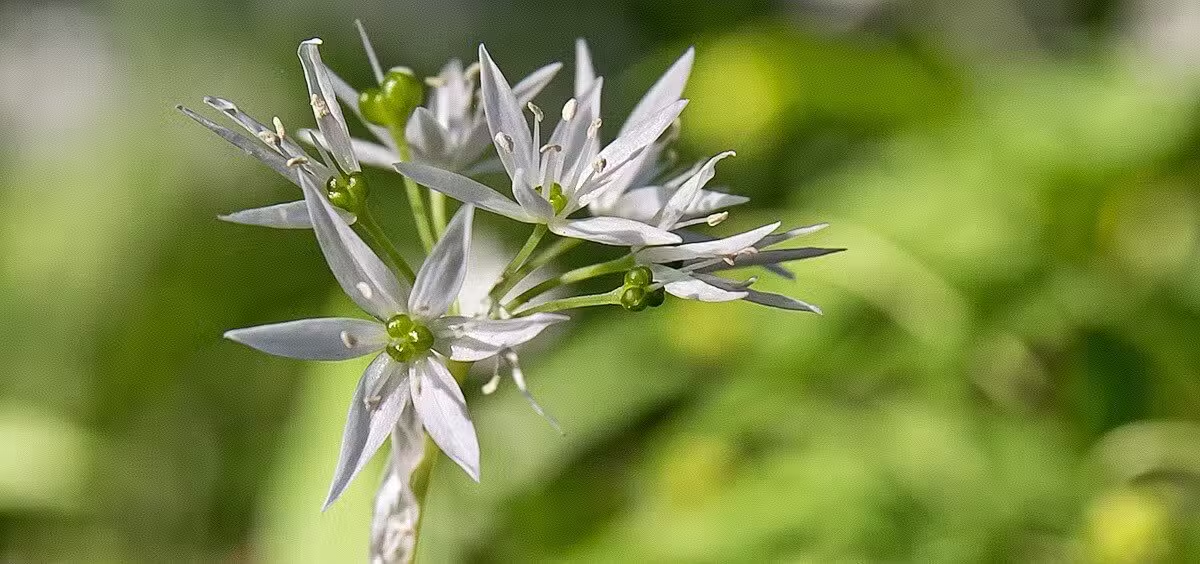
Later come white flowers, each with six white petals, clustered in umbels. These delicate flowers brighten the woodland floor from April to June, depending on the region, and provide precious nectar for pollinating insects.
Beware of lookalikes! See the end of the article!


When should you harvest wild garlic?
The shoots begin emerging en masse as early as late February. March is the best time to harvest wild garlic leaves in lowland areas. The leaves are then large but still green, tender and glossy. The longer you wait, the older they become, and the more likely they are to be eaten by insects or develop discoloured patches.
From late March, around the spring equinox, wild garlic begins to flower. First, flower buds appear and open, brightening the woodland floor with white flowers. Both the buds and the flowers are edible.
During May, wild garlic will have been pollinated, and its flowers develop into edible seeds.

Conservation status and threats
Although wild garlic is generally very abundant, it can be less common in some parts of Europe and may even be protected!
- Switzerland
- Not threatened or protected[7]
- France
- Not threatened or protected[8]
- Belgium
- Protected in green spaces and Natura 2000 sites in the Brussels-Capital Region[9]
Foraging wild garlic responsibly
As we have seen, wild garlic grows from a bulb. The bulbs are edible and very tasty. However, I strongly advise against harvesting them, as the plants could quickly disappear.
Wild garlic has a North American relative called ramps, Allium tricoccum. In Canada, unlike Europe, it is traditionally the bulbs that are harvested, rather than the leaves. This has led to the species’ decline in Quebec, where the plant has been classified as “vulnerable”. Harvesting there is limited to 50 bulbs/plants, weighing no more than 200 g in total. There has even been a programme to encourage people to sow ramps seeds in maple woods[4].
To avoid that happening, harvesting the bulbs is discouraged
You can, however, harvest the leaves. The youngest have a sweeter, fresher flavour. They are absolutely delicious. The larger leaves are very good too. Harvesting them is simple and quick. Generally, we stop picking them after flowering. But, as we have seen, our ancestors ate them even after that, so you can too. They do not become toxic, despite what an urban myth claims.

We’ll look at the risks in a moment. For now, let’s stress that smell is not a reliable way to identify it: once the scent is on your hands, everything smells of garlic! We should also avoid cutting whole clumps of leaves. Pick one leaf at a time and check what goes into your basket. You’ll notice that other plants often grow among clumps of wild garlic. They may be edible, like ground elder, or poisonous, like arum or two-leaved squill.
Picking just one wild garlic leaf per clump is one of the basic principles of harvesting this plant sustainably. If we remove all its leaves, we prevent it from photosynthesising and producing sugars, and therefore energy. If we pick from the same place every year, the bulb’s reserves are gradually depleted and the population disappears.
So we don’t cut every clump. We take a leaf here, a leaf there. It takes longer, but it’s more respectful. We’re not here to rush, are we?
Harvesting small quantities of buds, flowers and fruits
As we explain in a recent article on the subject, studies have examined sustainable methods of harvesting wild garlic. The authors demonstrated that harvesting young leaves under 10 cm long, flower buds, flowers and fruits has harmful effects on populations of this plant.
Wild garlic needs to photosynthesise through its leaves to nourish its bulb. If you pick very young leaves, you prevent it from building up its energy reserves for the entire season.
And if you harvest its reproductive parts, bear in mind that they take a great deal of energy for a plant to produce. Picking them, too, will reduce the amount of wild garlic at your site the following year. Year after year, the population will gradually decline.
Here are the harvest limits recommended by the French association of professional foragers [10] :
| Harvesting leaves | Limit harvesting to 30%, with a rest period of 2 to 5 years depending on the type of harvesting. |
| Harvesting seeds | Limit harvesting to 20% of the mature resource |
| Harvesting bulbs | 1 plant in 50 (2%) of the available resource |
In general, we even advise against harvesting buds, seeds and bulbs.
Cooking with wild garlic
Every part of wild garlic is edible
Every part of this plant is edible. But as we’ve seen, we’ll stick to mature leaves over 10 cm long.
All parts have more or less the same garlicky flavour and can be used in the same way. Any recipe that calls for garlic works with wild garlic!
Wild garlic is a seasoning. It adds flavour, so be inventive! Honestly, you can add it to any dish and it’ll taste good 😉
Leaves
Wild garlic leaves are best eaten raw. You can pick them from when they first appear until the plant flowers in May or June. Choose leaves that haven’t already been nibbled by insects and look unblemished. Avoid pathsides and polluted areas.
Wild garlic pesto is a classic among foragers. It’s excellent with bread or for flavouring meat or pasta. Wild garlic canapés with cream cheese will delight your guests, as will preserved flower buds. You can also add a few chopped leaves to a wild salad. But beware of the risk of botulism: eat your pesto promptly, or ferment the leaves instead.

I add it to all sorts of vegetable dishes. Cooking makes it lose much of its pungency and its properties, so I add it towards the end and cook it for no more than 2–3 minutes.
- Used as a vegetable
- Dried leaves used as a seasoning
- Preserved as pesto
- Preserved by lacto-fermentation
- Plenty of possibilities for appetisers

Tofu stir-fry with wild garlic
Here’s my Asian-style tofu stir-fry recipe with wild garlic.

Even more pungent
Wild garlic goes very well with ginger and all sorts of spices! Here’s a ‘fresh seasoning’ to add at the end of cooking to give your dish flavour, a kick and vitamins!
Wild garlic and ginger seasoning
- 3 cm of fresh ginger, peeled
- 1 handful of wild garlic
- Chop everything by hand or in a food processor—or, better still, with a pestle and mortar!
Add this mixture to your dishes at the end of cooking to preserve all its beneficial properties. You can also try a blend with turmeric!

Cooking the buds, flowers and bulbs
The flower buds, flowers and bulbs are edible and have the same garlicky flavour as the leaves. However, we hardly use them any more because harvesting them has depleted wild garlic populations.
Preserving wild garlic
You should know that this plant freezes easily. It’s a good way to have some all year round. Make sure, though, to spread the leaves out individually. They will quickly turn black after thawing. It’s best to chop them before freezing and add them straight to your dish.
You can also dry the leaves and then grind them. Wild garlic takes a long time to air-dry, especially the petiole, which is very fleshy and full of water. Don’t do what you see in the photo: cut it into 1 cm pieces so it dries faster. You’ll get a wonderful green seasoning that you can add to salads or any other dish and use like garlic powder.

The leaves and flower buds can also be lacto-fermented! I’ll write an article about that soon.
Another fun option is to make wild garlic butter!
- Leave a block of butter to soften.
- Mix in a large handful of chopped wild garlic. Use your hands to make sure the two ingredients are thoroughly mixed.
- Season if you like.
- Shape into small balls or divide between ice-cube moulds.
- Put them in a glass food container, then place it in the freezer.
54 edible wild plants
Our book on wild plants, with a foreword by Anne-Sophie Pic, is available in bookshops and online!
Inside, you’ll find plenty of foraging tips and recipes to suit every taste!
Medicinal properties of wild garlic
Dioscorides mentioned its detoxifying properties as early as AD 50. This wild garlic is thought to have properties comparable to cultivated garlic, although fewer scientific studies have been carried out on it. The scientific community has only been interested in it for about twenty years!
It is antiseptic, has depurative and digestive properties, stimulates blood circulation and has great potential for treating cardiovascular diseases. [1] It is also very rich in vitamin C and contains antioxidants, mainly in the leaves [3]. Ideal for putting winter behind you in spring!
It has also been used externally to treat wounds, thanks to its antiseptic properties.

A tincture for the skin and digestion
A tincture is made by macerating plants in alcohol, which effectively extracts their active compounds. You can use this recipe for a spring cleansing course or to treat the following symptoms: psoriasis, scaly skin conditions, blemished skin, diarrhoea, wind and colic, and high blood pressure.
- Fill a jar with chopped wild garlic.
- Cover with 96% alcohol (available from Aligro in Switzerland).
- Leave to macerate for two weeks.
- Strain and squeeze out the plant material.
- Bottle and label with the date and alcohol volume. Store away from light.
Dosage: 10–15 drops in a little water, divided into four doses per day.
Plants that can be mistaken for wild garlic
Cases of poisoning are reported every year and can be fatal. The garlic smell is a useful identifying feature, but after picking a dozen or so leaves, your hands will smell so strongly that you will no longer be able to tell the difference! So you need other identifying features. Remember: if you have the slightest doubt, do not pick it, and seek advice.
The main and most dangerous plants that can be mistaken for it are:
- Lily of the valley, Convallaria majalis
- Autumn crocus, Colchicum autumnale
- Lords-and-ladies, Arum maculatum
To learn more, I suggest reading the article on wild garlic and the risk of confusing it with other plants.

The information given here may not be sufficient to identify or use a plant safely. Remember: if in doubt, leave it out! Seek advice from a professional guide, buy good reference books and use photo-based plant identification apps with discernment. We regularly run courses on edible, medicinal and poisonous wild plants.
Références
[1] Danuta Sobolewska,corresponding, Irma Podolak,, Justyna Makowska-Wąs. « Allium ursinum: botanical, phytochemical and pharmacological overview. » Phytochem Rev. 2015; 14(1): 81–97. https://www.ncbi.nlm.nih.gov/pmc/articles/PMC4352197/
[2] Maria Treben, « La santé à la pharmacie du Bon Dieu. Conseils d’utilisation des plantes médicinales. » Ennsthaler Gesellschaft. 2008.
[3] Antioxidant and scavenger activities of Allium ursinum,
www.Infotox.ch
[4] Ail des bois, Espèce vulnérable au Québec, Ministère de l’Environnement et de la Lutte contre les changements climatiques.
[5] Danuta Sobolewska,corresponding, Irma Podolak, Justyna Makowska-Wąs.Allium ursinum: botanical, phytochemical and pharmacological overview. Phytochem Rev. 2015; 14(1): 81–97
[6] Habiter au bord des lacs. Dater et analyser le passé: La palynologie. Musée d’archéologie nationale.
[7] Inflora, Allium ursinum, consulté le 21 novembre 2024
[8] INPN, Allium ursinum, consulté le 21 novembre 2024
[9] Bruxelle Environnement, Plantes protégées de la région Bruxelles-Capitale, Allium ursinum, consulté le 21 novembre 2024
[10] Association française des professionnels de la Cueillette de plantes sauvages, Livret technique dе cueillette, L’AIL DES OURS Allium ursinum L., , (2024), Version 2



14 comments
✍️ Leave a comment






29 November
Les Pléiades
- Marie Mellioret

Making a Christmas star Sold Out
Lally railway station, car park, Blonay, Switzerland.
04 April
La Sarraz
- Michaël Berthoud

Wild edible and medicinal spring plants in La Sarraz
La Sarraz football pitches car park. Route de Cossonay.
10 April
Les Pléiades
- Michaël Berthoud

Natural incense stick-making workshop
Lally railway station, car park, Blonay, Switzerland.
No events found.
Hello,
I’ve just picked armfuls of wild garlic and came across a fox and saw lots of burrows (along the Broye in Auboranges). Should I wash the leaves because of echinococcosis? Or stick to cooked recipes? That would be a shame, because pesto is so delicious! Thanks 😉
Author
Hello Mathé,
Unfortunately, simply washing them in water isn’t enough. Only cooking reliably kills the parasites. If you’ve seen foxes and there are burrows nearby, I recommend cooking the leaves. Also avoid paths where lots of people walk their dogs. Put simply, if you’re unsure, cook them.
Personally, if I don’t suspect there are many dogs or foxes around (though there’s no such thing as zero risk), I eat the leaves raw.
Generally, a little white vinegar is enough to disinfect wild plants’
Author
Hello,
I’ve just written a detailed article on the subject. Vinegar kills bacteria, but I haven’t found any study proving that it is also effective against parasite eggs.
I now recommend washing three times in succession with water.
See more details: https://cueilleurs-sauvages.ch/echinococcose-risques-et-prevention-lors-de-la-cueillette-des-plantes-sauvages
Best wishes,
Michaël
No, white vinegar is not enough to protect against echinococcosis. It is better to avoid places where too many animals pass through and to check whether the vegetation around the foraging site has been heavily trampled.
Author
Hello Dominique,
Thank you for your reply. If you have a reliable source for this, I’d be interested, as I haven’t found anything.
Best wishes,
Michaël
Hello,
We’ve been out foraging and found some flower buds. Do you know whether we can eat them and, if so, do you have a recipe?
Thank you and best wishes
Author
Hello,
Yes, every part of wild garlic is edible! I’ve updated the article to make this clearer and added some recipe ideas.
Best wishes
Michaël
Hello! I picked some wild garlic today in a forest in the Jura. You recommend cooking the leaves to eliminate the parasites that cause echinococcosis. As I can find little information on other websites, I hope you don’t mind me asking how to cook them. At what temperature and for how long?
Thank you in advance for your reply, and for your very interesting articles.
Author
Hello Joëlle,
It’s a complex subject that I should cover in detail in an article. Indeed, only cooking destroys the parasite eggs. The temperature must be at least 80°C, with a cooking time of 10–15 minutes.
Personally, I also eat wild garlic raw. That’s a choice everyone has to make for themselves. But bear in mind that foxes also defecate in vegetable growers’ fields, so the risk exists outside foraging too.
Michaël
Can white vinegar kill these eggs? It is generally recommended for disinfecting wild plants.
Author
Hello, I replied to your other comment.
Have a lovely day
Michaël
Hello,
Could we rinse it with a disinfectant for vegetables, like the kind used in catering?
Author
Hello,
Apparently, chemical agents do not work against echinococcosis. More information here: https://cueilleurs-sauvages.ch/echinococcose-risques-et-prevention-lors-de-la-cueillette-des-plantes-sauvages