



Log in
Can you harvest spiked rampion?
Michaël Berthoud
/
26 April 2022
Spiked rampion is an easy plant to recognise in spring. It is delicious, and you can cook it like asparagus. But take care: although it sometimes grows in abundant colonies, it is often found only here and there, so it should be harvested responsibly.
Spiked rampion
Phyteuma spicatum L. (InfoFlora, TelaBotanica)Family Campanulaceae
Flowering May–June
Habitat Lowland and mountain forests
Abundance Locally abundant, sometimes scarce
Parts used Roots, leaves, inflorescences
How to recognise spiked rampion
Spiked rampion is a particularly interesting edible wild plant because it is easy to recognise and use. You will soon come across it on your walks throughout France and Switzerland. It belongs to the Campanulaceae family, which is characterised by its bell-shaped flowers.
As we shall see, there are several species of rampion, and their bell shape is not particularly obvious, unlike that of bellflowers, for example. The flowers are small and grouped in dense spikes that look like asparagus before they open. Once open, they give the plant a distinctive tousled appearance.
It grows in forests with open understorey and along paths.


The inflorescences are therefore the easiest part to recognise. Start by looking for them in May or June. Then examine the leaves. They come in several shapes. Those at the base of the plant are heart-shaped, while those on the stem are narrower and lanceolate (spear-shaped).
Some leaves, though not all, have a distinctive purple blotch in the centre. This is a very good way to identify the plant before it flowers.
Before flowering, the leaves are easy to overlook and can resemble other triangular leaves. Look for the purple blotch in the centre of the leaves. With a little experience, you’ll also be able to recognise the plant without it.
Can spiked rampion be confused with other plants?
Spiked rampion can be confused with other plants, mainly other species in the genus Phyteuma. It can be confused, for example, with round-headed rampion (Phyteuma orbiculare L.), a mountain-dwelling relative with beautiful deep-purple inflorescences. Some of these purple rampions grow in sensitive alpine habitats and are less common than spiked rampion.
I therefore recommend not picking them. But I highly recommend admiring them!

Which parts can you use?
Every part of rampion can be used.
Let’s start underground. The root is harvested before flowering, when the young leaves appear in April. It is fleshy; clean it with a brush. This is one of the few wild plants you can enjoy raw, like a carrot. It is sweet, with a spicy note. Hence its scientific name, spicatum.
The leaves, also gathered before flowering, can be cooked or eaten raw. They are delicious and mild, with a very subtle nutty flavour. They are excellent in salads or can be cooked as a leafy vegetable.
The inflorescence is gathered when it looks like an asparagus spear. You can eat it raw, boiled or steamed. It is juicy and crunchy, absolutely delicious. If you wait too long, it dries out, but you can still eat it; it is just less juicy.
Discover lots of recipes in my first book on wild plants:
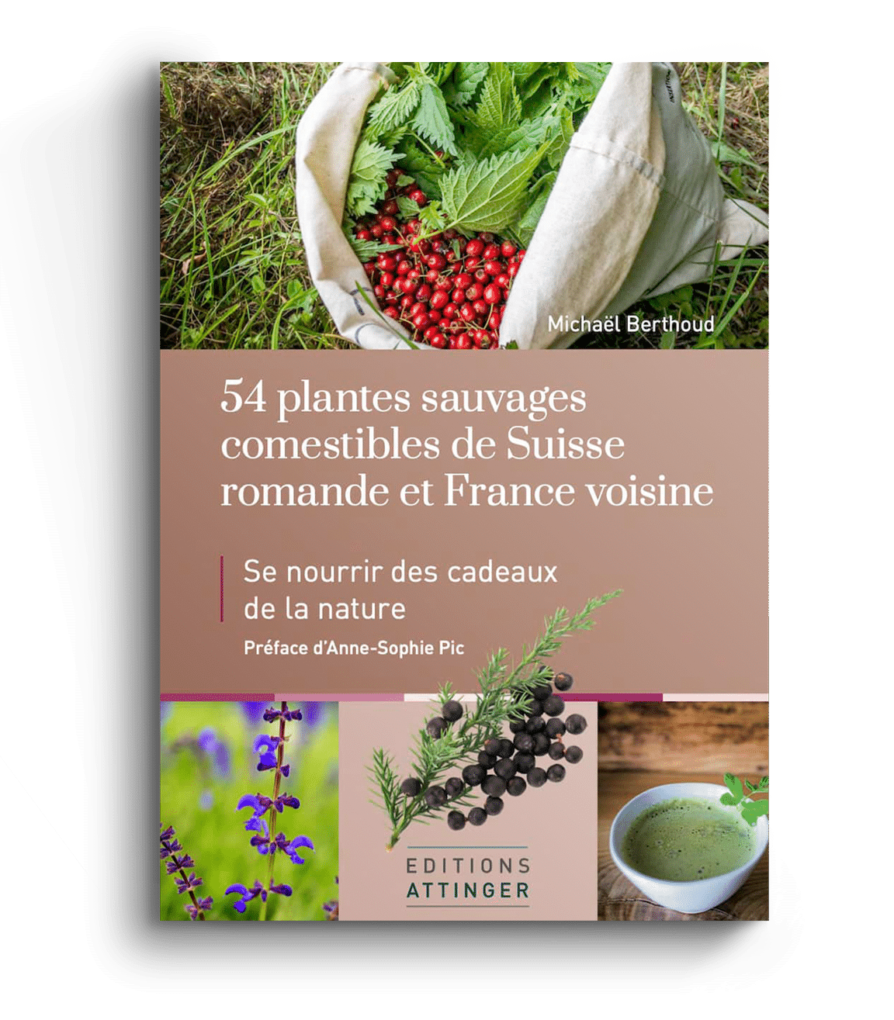
54 edible wild plants
Our book on wild plants, with a foreword by Anne-Sophie Pic, is available in bookshops and online!
Inside, you’ll find plenty of foraging tips and recipes to suit every taste!
Harvesting spiked rampion
Spiked rampion is not a protected plant, and it is relatively abundant. It often grows in colonies in open woodland, where plenty of light reaches the forest floor. In such places, you can gather plenty without harming the population. As it is a perennial, it has energy stored in its roots, and if you cut off its flowering head, it can produce another one in the same year if the season allows.
The problem is that it is too easy to recognise and looks too much like an asparagus spear. It is more “fun” to use than a dandelion leaf. And it often grows beside busy woodland paths. In these places, it does not grow in dense colonies but sparsely, here and there along your walk. So you pick a few; the next walker does too. And then, look, so does the next one…

Sustainable foraging
You can see where I’m going with this. They made the mistake of growing too close to the paths, where they are too visible. In the end, they will never get the chance to flower. As long as the leaves can photosynthesise, they will continue to nourish the root and the plant will survive. But little by little, the population will decline because it can no longer reproduce. Eventually, there will be no spiked rampion left there.
So, back to the principles of sustainable foraging:
- Only gather where the plant is abundant.
- Gather only what you need, always with care.
Remember, no one should ever be able to tell that a forager has been there!
This is particularly important for plants such as spiked rampion, where we gather the flowers, which are their reproductive organs. The same applies to wild asparagus: wild asparagus shoots, star-of-Bethlehem species…
And you?
Do you know spiked rampion? Is it fairly abundant where you live, or is it uncommon?



4 comments
✍️ Leave a comment






29 November
Les Pléiades
- Marie Mellioret

Making a Christmas star Sold Out
Lally railway station, car park, Blonay, Switzerland.
04 April
La Sarraz
- Michaël Berthoud

Wild edible and medicinal spring plants in La Sarraz
La Sarraz football pitches car park. Route de Cossonay.
10 April
Les Pléiades
- Michaël Berthoud

Natural incense stick-making workshop
Lally railway station, car park, Blonay, Switzerland.
No events found.
Hello, here in Zinal in the Val d’Anniviers, rampions (all three species are present) are very common, and so far not many people know about them, so it’s mostly the cows (and deer?) that eat them each year, but they still come back.
Author
Hello Laetitia,
Thanks for sharing, and good for the cows ^^
Best wishes,
Michaël
I wonder what type of soil it grows in. I haven’t spotted any in my area yet (metamorphic rocks and acidic soil).
Author
Hello Sophie,
It needs neutral to slightly alkaline soil, so probably not the type of soil you have where you live. You can find this sort of information on Tela Botanica, for example. https://www.tela-botanica.org/bdtfx-nn-49275-synthese
Michaël