



Log in
How many edible wild plants are there on Earth? What percentage of plants can we eat safely? This question comes up quite often during the courses we run, and it is not easy to answer because the subject is so vast.
Table of contents
At a rough guess, I’d say there are a lot of edible wild plants. When I go for a walk in the countryside near my home, I can identify dozens of edible and medicinal species, while poisonous ones are generally fewer in number, in my opinion. But there’s a difference between an estimate and a more precise count.
This winter, I wanted to delve into the fascinating world of ethnobotany, a branch of ethnology that explores the relationship between human societies and the plant world. By a curious coincidence, as this article is published, Tela Botanica is launching a MOOC on ethnobotany. If that interests you, take a look!
Of course, I’m not the first to ask this question, and there are many studies of plant uses around the world.
My instinct tells me there are two ways to approach the question:
1. How many wild plants do local people use in a given region?
Researchers answer this first question by asking people in a region how they use wild plants for food or medicine. They count the plants used and calculate what percentage they represent of the region’s known vascular flora. This is what the ethnobotanical studies I found do.
2. The second approach is to ask how many useful plants there are in total in a given region, not just how many local people use.
Some edible plants in a region are unknown to local people, and it would be interesting to count those too. That is what I have tried to do at the end of the article, using a database of plants.
Ethnobotanical studies
Let’s start with the first approach. The answer to the first question can be found in numerous studies from around the world. I used around ten from Europe and Asia to try to get an overall picture.
The figures I found in the European studies range from 3.5 to 9% of the flora used by local people. I could not find studies with figures for Switzerland or France. I have summarised them in the following table:
| Country | % of edible plants | References |
|---|---|---|
| Korea | 33.6–54% | [1-4] |
| Spain | 5–9% | [5-6-7] |
| Hungary | 7.0% | [11] |
| Estonia | 6.0% | [8] |
| Belarus | 5.0% | [10] |
| Poland | 4.0% | [9] |
| Slovakia | 3.5% | [10] |
I find this figure rather low, as I have a feeling that more than 10% of plants in Europe can be used.
In the four Korean studies I cite, however, researchers found that between 33 and 54% of the local flora was used for food.

The difference between Korea and Europe is truly striking! This could indicate that Koreans know far more about the uses of their local flora than Europeans do, which is possible.
But caution is needed: the difference could also be due to how these uses are counted, or to the total number of plants… Comparing studies is not always easy.
If we take these figures as accurate, they nevertheless show how widely knowledge and use of edible plants vary from region to region.
Uses of wild plants according to Flora Indicativa
The second way to approach the question is to ask how many edible plants there are in total, not just how many are used. This means knowing whether each plant in a given region, or indeed on Earth, is edible.
Of course, we do not have that kind of comprehensive knowledge for all the plants on Earth, which is home to between 300 000 and 400 000 vascular plants! There are, however, lists and databases containing enough of them to make an estimate.
One of these is Flora Indicativa, a database of indicator, or bioindicator, values for more than 6000 plants found in Switzerland and the Alps. As I explored it, I was surprised to discover that the authors had added information on edibility, medicinal uses and toxicity for most of the plants. What a mammoth undertaking!
So I had some fun compiling statistics from these three sets of data: edibility, medicinal use and toxicity. After removing potential duplicates, the list contains 5644 plants in total.
Here, ‘edible’ means that at least one part of a plant can be eaten. A plant can therefore fall into several categories. For example, yew (Taxus baccata) is classed as toxicity level 3, but also as edible, because its aril (the red pulp surrounding the seed) can be eaten, provided you do not swallow the seed.
Here are the results [13]:
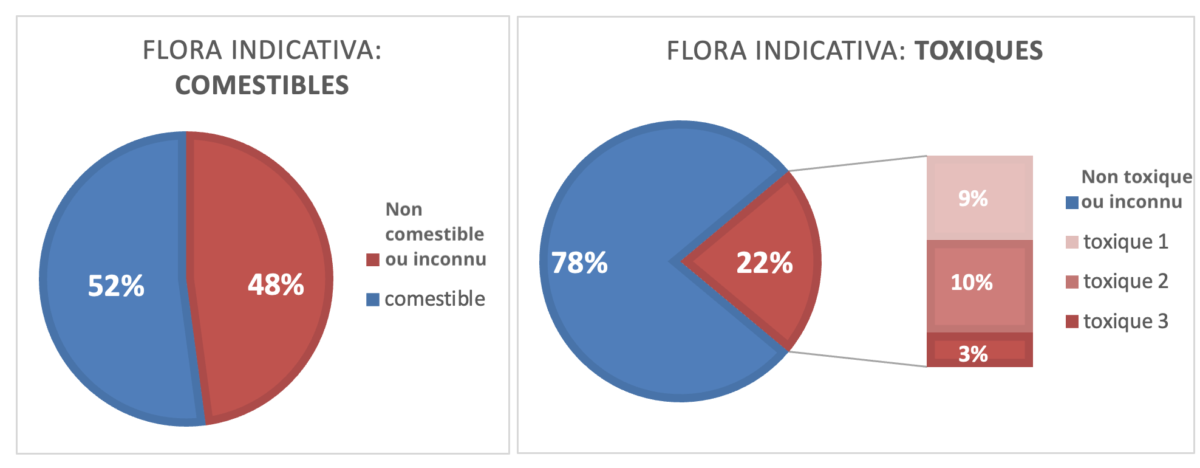
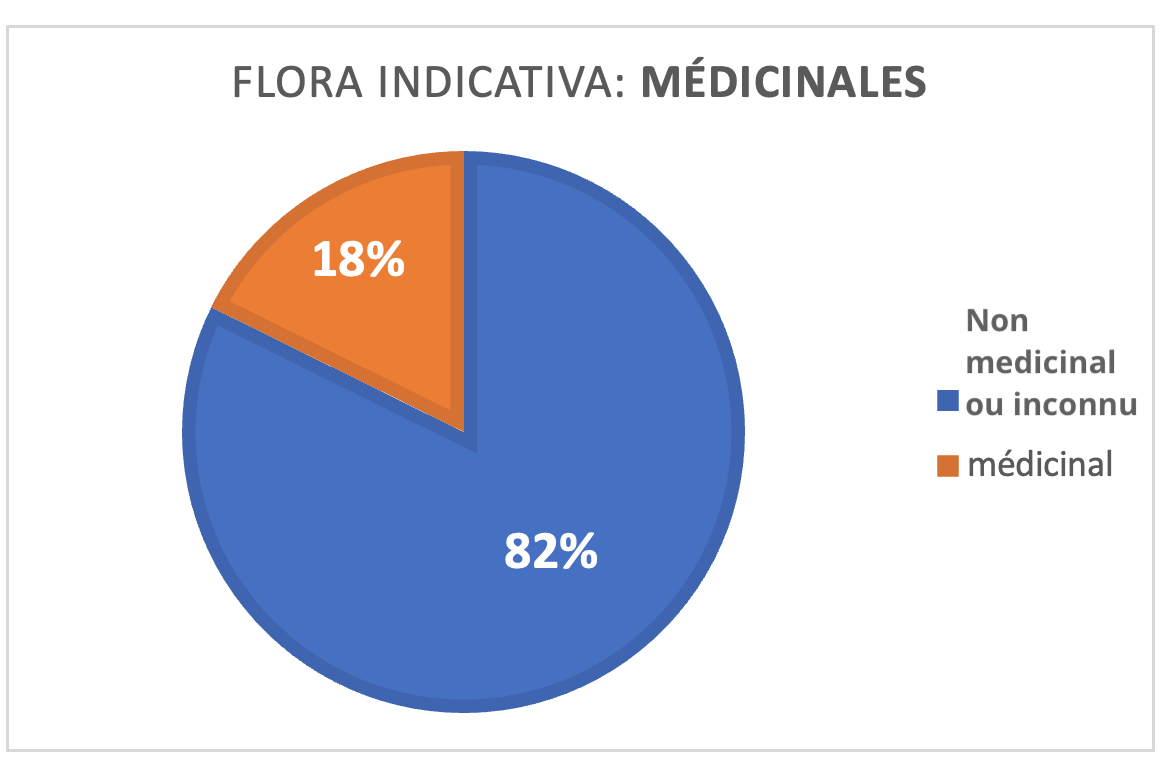
According to Flora Indicativa, 52% of the plants listed are edible. Consequently, more than half of the plants found in Switzerland and the Alps, native and non-native alike, would be edible! That is well above the 3–10% of plants used in Europe. There would therefore be a large gap between the number of edible plants and the number used locally.
Toxic plants account for 22% of those listed. We must therefore take care whenever we forage, since around 1 plant in 5 would be toxic. Toxic plants that are generally not deadly (toxicity levels 1 and 2) account for 19%, while only 3% are classed at the third level of danger (plants that are deadly in small quantities, such as aconites or certain hemlocks).
Very dangerous plants are therefore much rarer than edible ones, which is rather reassuring ^^.
Plants known for their medicinal properties account for 18%, a much lower proportion than for edibility.
We should take these figures for what they are: a rough estimate of what we know about the diversity of life. But they give us a general idea for Switzerland and, by extension, temperate Europe.
An attempt to count the edible, medicinal and poisonous plants in the meadows and forests of Les Pléiades
Following the same logic, I wanted to find out what these percentages were on a smaller scale: my local area, Les Pléiades. And to help me with this estimate, I was lucky enough to have Françoise Hoffer, one of the most active and renowned botanists of the Cercle Vaudois de Botanique, accompany me around where I live.

Alopecurus pratensis L. Meadow foxtail is an edible plant found in Les Pléiades that I haven’t used yet. I imagine I could try using it to smoke dishes, for example.
So we walked through the pastures and forests around where I live and recorded all the plants we saw. We didn’t carry out a complete survey of the whole area, but our list is fairly representative of the plants you encounter on a walk near my home.
We recorded 148 plants in May 2024[14]. Ideally, to improve on this result, we would need to carry out several surveys over the course of the year, but that wasn’t possible.
I then only had to compare this list with the Flora Indicativa database to find the figures for my area, with a surprise in store:


While the percentage of toxic plants doesn’t vary much, the percentage of edible plants in my area is surprising: it rises to 73 %! In short, when I go for a walk near my home in May, three-quarters of the plants are edible. That doesn’t mean they taste good, but that they can be eaten safely.
Nor does it mean I could use them all, as some may be protected or threatened. In any case, we won’t pick protected plants, and we’ll pick the others sparingly.
The other big jump is in medicinal plants, at 43% in my area, compared with 18% in the full Flora Indicativa list. Could my area have more medicinal plants than elsewhere, or is this an effect of scale?
Finally, there are only 11% of plants in my area that we know nothing about at all: whether they are edible, can be used for their medicinal properties, or are toxic. This figure seems quite low to me and may reflect the fact that we carried out this survey in an area heavily altered by humans: pastures, managed forests and pathsides. A survey of a wilder area would certainly show a different figure, perhaps a higher one?
To conclude
That’s where this little study ends. It isn’t a proper ethnobotanical study, and it certainly has its flaws. Nevertheless, I think these figures reveal some trends and are interesting. I’m surprised and delighted by the number of edible plants in my area!
Wild plants cannot be reduced to mere rows in a table. Yet this kind of exercise makes me aware of the diversity of life and how much I still have to learn. For many of the plants among that 73% are unfamiliar to me.
I imagine they won’t all taste pleasant, as some may be acrid or bitter, but I probably still have some lovely surprises in store!
Let’s explore the flora of your region
Would you like to know which edible, medicinal and toxic plants grow in your area or on your land? I can visit you in French-speaking Switzerland to carry out a survey of the plants and their uses.
🙋♂️ A walk with you on your land or somewhere near your home.
🌿 A survey of edible, medicinal and toxic plants.
🔎 For each plant, you’ll learn how to identify it and about its uses, or what precautions to take.

Références
[1] Won-Bok Seo, Jin-Hwan Jang, Ki-Oug Yoo, Distribution of Vascular Plants in Mt. Ilsan (Hwacheon-gun, Gangwon-do), Korean Journal of Plant Resources , 2009
[2] Byun J.G., Jang J.W., Yang J.C., Lee Y.M., Jung S.Y., Ji S.J., Jang J., Lee H.J., Hwang H.S., Oh S.H., The Flora of Vascular Plants in Mt. Gariwang Protected Area for Forest Genetic Resource Conservation, South Korea, Korean Journal of Plant Resources, 2013, 26(5) DOI:10.7732/kjpr.2013.26.5.566
[3] Park, Kyu Tae et al. , The Vascular Plants in Mt. Bohyeon, Gyeongbuk, Korea, Korean Journal of Plant Resources , 2015, 28(2):193-216, http://dx.doi.org/10.7732/kjpr.2015.28.2.193
[4] Jeong, G., , P., Jeong, S., Lee, S., Choi, H., Nam, B., Lee, Y., & Choi, H., Distribution of Vascular Plants in Gongdeoksan (Mungyeong, Gyeongbuk), Korean J. Plant Res., 2008. 21, pp. 270-280.
[5] Bonet MA, Use of non-crop food vascular plants in Montseny biosphere reserve (Catalonia, Iberian Peninsula), International Journal of Food Sciences and Nutrition, 2002 May;53(3):225-48. doi: 10.1080/09637480220132841. PMID: 11951586.
[6] Rigat M, Bonet MÀ, Garcia S, Garnatje T, Vallès J., Ethnobotany of food plants in the high river Ter valley (Pyrenees, Catalonia, Iberian Peninsula): non-crop food vascular plants and crop food plants with medicinal properties, Ecol Food Nutr., 2009 Jul-Aug;48(4):303-26. doi: 10.1080/03670240903022320. PMID: 21883071.
[7] Benítez, G.; Molero-Mesa, J.; González-Tejero, Wild Edible Plants of Andalusia: Traditional Uses and Potential of Eating Wild in a Highly Diverse Region, Plants, 2023, 12, 1218. https://doi.org/10.3390/plants12061218
[8] Raivo Kalle, Renata Sõukand, Wild plants eaten in childhood: a retrospective of Estonia in the 1970s–1990s, Botanical Journal of the Linnean Society, 2013, Volume 172, Issue 2, Pages 239–253, https://doi.org/10.1111/boj.12051
[9] Łuczaj Ł., Kujawska M, Botanists and their childhood memories: an under-utilized expert source in ethnobotanical research, Botanical Journal of the Linnean Society, 2012, 168: 334–343
[10] Łuczaj, Ł., Köhler, P., Pirożnikow, E. et al. , Wild edible plants of Belarus: from Rostafiński’s questionnaire of 1883 to the present, J Ethnobiology Ethnomedicine, 9, 21 (2013). https://doi.org/10.1186/1746-4269-9-21
[11] Andrea, Dénes., Nóra, Papp., Dániel, Babai., Bálint, Czúcz., Zsolt, Molnár. , Wild plants used for food by Hungarian ethnic groups living in the Carpathian Basin, Acta Societatis Botanicorum Poloniae, 2012, 81(4):381-396. doi: 10.5586/ASBP.2012.040
[12] Łukasz Łuczaj, Ethnobotanical review of wild edible plants of Slovakia, Acta Societatis Botanicorum Poloniae, 2012, 81(4):245–255 DOI: 10.5586/asbp.2012.030
[13] E. Landolt et al., Flora indicativa. Ökologische Zeigerwerte und biologische Kennzeichen zur Flora der Schweiz und der Alpen, Haupt, Berne, 2010.
[14] Note Floristique du 01.05.2024, Les Pléiades, Suisse.









29 November
Les Pléiades
- Marie Mellioret

Making a Christmas star Sold Out
Lally railway station, car park, Blonay, Switzerland.
04 April
La Sarraz
- Michaël Berthoud

Wild edible and medicinal spring plants in La Sarraz
La Sarraz football pitches car park. Route de Cossonay.
10 April
Les Pléiades
- Michaël Berthoud

Natural incense stick-making workshop
Lally railway station, car park, Blonay, Switzerland.
No events found.