



Log in
Blue masterwort liqueur
Michaël Berthoud
/
15 September 2023
Masterwort is a surprising plant used to make a peppery-tasting digestive liqueur. It is a wild edible plant that grows in Alpine regions. If ground elder or plantain have become too familiar and you want to discover a lesser-known plant, this masterwort liqueur recipe is for you.
Masterwort, a jewel of the Alps
Masterwort, Peucedanum ostruthium, is one of our favourite plants, and we have already written an article on how to identify and use it. It grows in the Alps, particularly in Valais, where it is widely used, whereas elsewhere it is often unknown.
It was once used for its medicinal properties and in fumigations. Its name shows just how highly it was regarded. And to find out the best time to harvest it, our PDF foraging calendar will help! Broadly speaking, you can harvest it all year round, except when there is snow or the plant is in flower.

I’ve searched extensively for information on how to cook it, even on English-language websites. There’s… almost nothing online… and books aren’t very clear about how to use it. That’s because its bitterness makes it difficult to cook with. I experiment a bit in the dark and sometimes make wonderful discoveries!
Masterwort is a bitter, peppery plant. Bitter edible plants are generally medicinal: it’s a sign that they aid digestion. Its peppery flavour makes it unique; there’s something very invigorating about it. We’ll use the roots in this recipe, but we could also use the fruits.
The roots must be harvested where the plant is sufficiently abundant. This is often the case, as it produces numerous underground rhizomes. There is a risk of confusing it with toxic plants, such as aconite-leaved buttercup. See the article mentioned above for more information.


Making masterwort liqueur from a tincture
I like making tinctures from fresh plants. They’re useful to have in our natural home medicine cabinet. I generally make 1/2 L or 1 L, as the preparation takes almost the same amount of time and they keep for years.
I’ve mainly tried masterwort tincture for its digestive properties. Over time, I’ve managed to address those minor digestive problems through my diet. So I only use this tincture in small quantities, and I thought I could use some of our stocks to make liqueurs!
So I’m going to explain how I dilute them. This assumes you have a tincture made from fresh plants using 96% alcohol. You can use this method with any plant tincture, which can be handy. That way, the tincture becomes a base ingredient you can use in folk medicine or cooking.
You can, of course, make a liqueur without a tincture or pure alcohol, using vodka or another spirit. In that case, go straight to the easy recipe at the end of the article.
1. Dilute the tincture
A quick reminder: this isn’t a dye for fabric, but a plant maceration in alcohol.
I have a tincture of fresh masterwort roots. They have steeped for 2 weeks in 96° alcohol (in Switzerland, we’re lucky enough to find it at Aligro). An important first point: given that the roots contain 78% water (I measured this by weighing them and then drying them in the oven; let’s round it to 80%), my tincture is actually 68° alcohol, with the rest made up of water.
First, we’ll dilute the tincture. I want a liqueur at 25% ABV. That’s a matter of preference; we could have chosen 30%. The formula on this website helps us work out how much water to add:
- To make 100 mL of masterwort spirit at 25°, I dilute 37 mL of my 68° tincture with 63 mL of water.
It’s surprising: as soon as I add the water, the potion turns cloudy like absinthe, as if by magic…


2. Add a neutral spirit
We’ve made good progress. I taste it… phew… it’s still too strong! The alcohol content is right, but the masterwort flavour is far too intense; it really packs a punch, as they say! So we need to dilute it further. We won’t add water, because that would lower the alcohol content. We’ll simply add a neutral spirit at 25°.
I’ve tried several ratios, and my favourite is to add an equal amount of liquid. So if I have 100 ml of masterwort spirit at 25°, I add 100 mL of a neutral spirit at 25°.
- To make 100 mL of neutral spirit at 25°, dilute 26 mL of 96° alcohol with 74 mL of water.
- Then add these 100 mL of neutral spirit to the 100 mL of masterwort spirit prepared earlier.
This step is essential with masterwort, which really does have a strong flavour. Perhaps you’ll want to dilute it a little more or a little less? My original tincture is very concentrated because it’s for medicinal use. With other, milder plants, by contrast, you wouldn’t want to dilute it. You have to experiment.
3. Add the sugar
We're nearly there! All that's missing is the sugar. I checked my books, and the amount varies between 200 and 300 g per litre. It depends on the plant, the alcohol content and your taste. I chose 200 g per litre; again, that's a matter of preference.
4. Let's taste our masterwort liqueur!
And there we have it: we can finally taste our liqueur!
The recipe for two-headed unicorn milk
Do you know the Astérix and Obélix films? There's a scene where they set off in search of two-headed unicorn milk. I love it; it's so funny! I haven't found the famous druid yet, but I think my recipe comes close to his!
But wait… there's a trick!
Just leave your liqueur in an open glass, exposed to the air. The masterwort will oxidise and the liquid will change colour, becoming almost turquoise! It's fantastic! Sometimes you make wonderful discoveries by experimenting for yourself.
This beautiful colour lasts for a few weeks, then the liquid turns whitish again. I had the same experience when I made a infusion of masterwort roots in milk for a crème brûlée and left it uncovered in the fridge. Surprising…
However, I didn't get the same result when I left a liqueur made with vodka to oxidise (as in the easy recipe at the end of the article). Perhaps you need to start with a neutral or stronger spirit?

Don't have 96% alcohol or masterwort tincture?
Well, not everyone has a masterwort tincture or can get hold of 96% alcohol. So here’s a simpler alternative using alcohol that anyone can find. If you’d like to buy dried masterwort roots, that’s possible too. Some online shops, such as this one, sell them.
For the quantities in this simple recipe, vodka will do. I’ve estimated the proportions based on my tincture recipe, so the result may not be exactly the same. See whether the dilution suits your taste.
This recipe is from my book 54 Plantes sauvages comestibles de Suisse romande et France voisine:
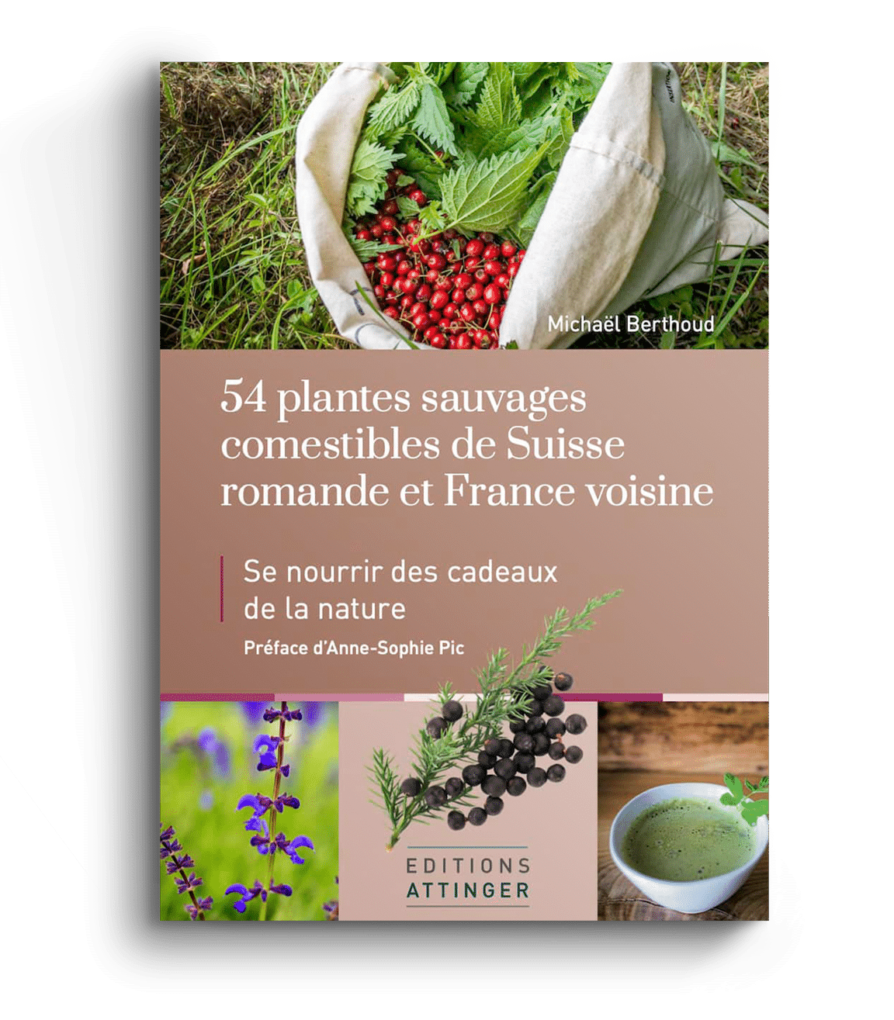
54 edible wild plants
Our book on wild plants, with a foreword by Anne-Sophie Pic, is available in bookshops and online!
Inside, you’ll find plenty of foraging tips and recipes to suit every taste!

Masterwort liqueur
Here’s an easy recipe for masterwort liqueur made with the roots and vodka.
Servings 1 L
Ingredients
- 20 g Dried masterwort roots or 90 g of fresh roots cut into small pieces
- 0.7 L Vodka or another spirit at 35% ABV, as neutral as possible
- 0.28 L Water or 0.2 L if the roots are fresh
- 200 g Sugar
Instructions
Using dried roots (bought online)
- Pour 0.7L of 35° vodka into a large jar.
- Add 0.28L of water. You will have 1L of alcohol at 25°.
- Add 20gr of dried roots.
- Leave to infuse for 2 weeks, then strain through a cloth coffee filter.
- Add 200gr of sugar.
Using fresh roots
- Pour 0.7L of 35° vodka into a large jar.
- Add 0.2 L of water and 90 g of fresh roots.
- Leave to infuse for 2 weeks, then strain through a cloth coffee filter.
- Add 200gr of sugar.
Precautions
Masterwort contains furanocoumarins that may cause photosensitivity. People with sensitive skin should therefore take care to wear gloves when harvesting it to avoid contact with the sap followed by exposure to the sun, which could cause burns or itching.
The quantities of coumarins in traditional masterwort drinks are potentially sufficient to trigger biological effects when consumed[1]. We have already observed someone feeling unwell after drinking the liqueur. It should therefore be consumed in moderation.
The information given here may not be sufficient to identify or use a plant safely. Remember: if in doubt, leave it out! Seek advice from a professional guide, buy good reference books and use photo-based plant identification apps with discernment. We regularly run courses on edible, medicinal and poisonous wild plants.
Références
[1] Vogl, S., Zehl, M., Picker, P., Urban, E., Wawrosch, C., Reznicek, G., … & Kopp, B., Identification and quantification of coumarins in Peucedanum ostruthium (L.) Koch by HPLC-DAD and HPLC-DAD-MS, Journal of agricultural and food chemistry, (2011), 59(9), 4371-4377









29 November
Les Pléiades
- Marie Mellioret

Making a Christmas star Sold Out
Lally railway station, car park, Blonay, Switzerland.
04 April
La Sarraz
- Michaël Berthoud

Wild edible and medicinal spring plants in La Sarraz
La Sarraz football pitches car park. Route de Cossonay.
10 April
Les Pléiades
- Michaël Berthoud

Natural incense stick-making workshop
Lally railway station, car park, Blonay, Switzerland.
No events found.