



Log in
Common sorrel: identification, uses and precautions
Michaël Berthoud
/
13 March 2025
Common sorrel is a delicious wild edible plant, common in our meadows and gardens. Its tangy flavour brings a refreshing touch to wild salads, but some precautions are needed. Here is an overview of how to identify and use it.
Common sorrel
French names: Oseille commune, Rumex oseille
Rumex acetosa L.
Family: Polygonaceae
Parts used: leaves
⚠️ Precautions: common sorrel has some toxicity due to the oxalic acids it contains. See the notes at the end of the article.
Where does common sorrel grow?
Common sorrel is very common, as the name suggests ^^. It likes fairly deep soils rich in organic matter. You can therefore find it in many hay meadows, parks and gardens[1]. It is usually one of the first plants you identify when you start foraging, as it often grows near dandelions and plantain, for example, two other very common plants.
The map of its worldwide distribution confirms its abundance across Eurasia and shows that it is found as far as the Far East, and even in the United States [2].
Botany
Common sorrel belongs to the Polygonaceae family. This family also includes rhubarb, docks and Japanese knotweed, for example. The genus Rumex also includes edible plants such as Alpine dock, broad-leaved dock and curled dock.
There is a small regional difference in French terminology for docks: the names used in France and Switzerland differ. In Switzerland, the docks I have just mentioned are referred to by their scientific names. In France, however, most docks are called patiences. Broad-leaved dock is therefore called patience à feuille obtuse, and curled dock patience crépue.
Sorrel, on the other hand, crosses the border without difficulty: it is called oseille in both countries.
How to identify common sorrel
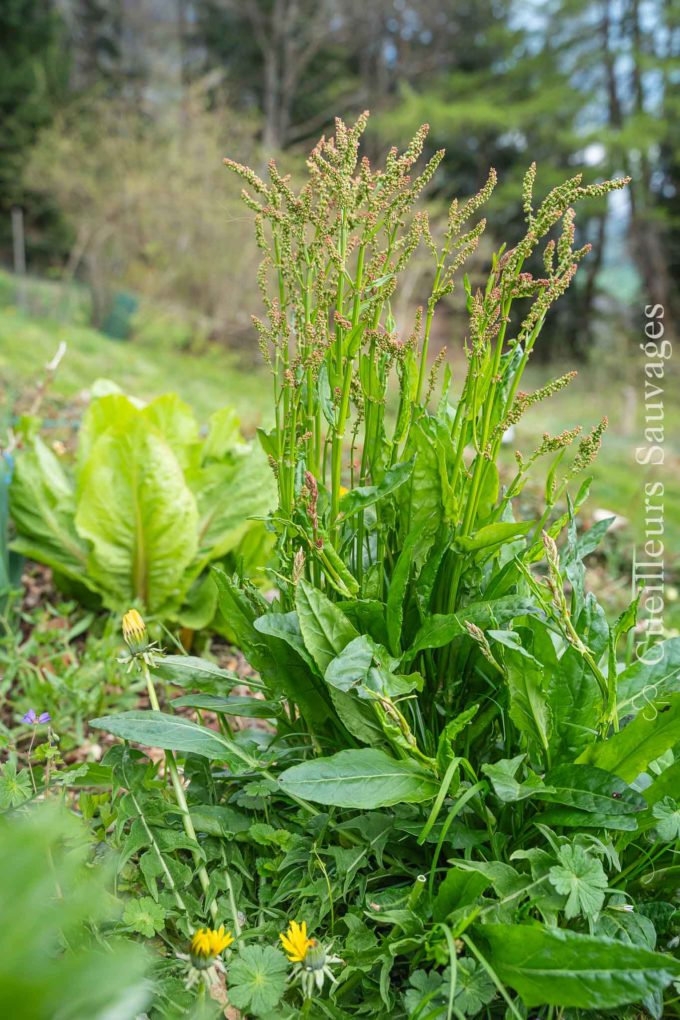
Common sorrel is fairly easy to recognise, although there is some risk of confusion. The plant grows in a basal rosette, meaning it has numerous leaves whose petioles emerge from the same point underground. Its leaves are 5 to 10 cm long, elongated and hairless.
One of their main characteristics is that they are sagittate: in other words, they have two small lobes that point downwards at the base of the leaf blade.
In spring, there is just a basal rosette of numerous leaves. Then a reddish stem appears, which will bear the inflorescence. The flowers are numerous and grow close to the stem. At this time of year, the stems are easy to spot because they grow before the grasses. All you need to do is kneel down to see the many common sorrel stems in a meadow.


Possible confusion
Confusion with broad-leaved dock
Common sorrel can be confused with other docks. Broad-leaved dock is also common in some meadows. On our courses, people often point to a dock and ask us, “Isn’t that common sorrel?”
When the dock is mature, the difference is obvious because it is much larger. It is less obvious when both plants are younger. You will notice, however, that the dock is much more crinkled or wrinkled than common sorrel.

Confusing common sorrel with lords-and-ladies
A more concerning risk is confusing common sorrel with lords-and-ladies, as the latter is highly toxic. We have already discussed lords-and-ladies because it can also be confused with wild garlic. Since lords-and-ladies grows in woodland, it should not be possible to confuse the two, as common sorrel prefers sunny places. However, I have seen them growing together.
Just down the road from my home, I saw the two plants growing side by side in the middle of a field, which is a problem. What had happened was that several trees once stood there but had been cut down. Lords-and-ladies grew in the shade and coolness beneath a tree and, because it is a perennial, remained there after the tree was cut down.
Don’t worry: there is a way to tell them apart. In the image below, you can see that lords-and-ladies has a distinctive feature: a vein running along the edge of the leaf blade. This provides a reliable way to distinguish it from common sorrel and good King Henry.


Culinary uses of common sorrel
Now that we know how to recognise common sorrel and avoid confusing it with other plants, we can finally taste it ^^. This plant is a staple of wild food cookery, with a very refreshing tangy flavour.
The simplest way is to eat it raw. That way, you’ll preserve its tangy flavour. You can add it to spring and summer salads, simply chopped roughly, whether the other ingredients are wild or not. We think of it more as a seasoning than as a salad ingredient in its own right. You can also make various pestos by blending it with oil. Be sure to wash it thoroughly before eating it raw to avoid the risks posed by parasites.
You can also cook it. Sorrel soup is a classic recipe that you can adapt in almost any way you like, adding potatoes, garlic, shallots and so on.
Another classic is the famous sorrel sauce, which goes wonderfully with oily fish such as salmon. Simply blanch the sorrel in cream and white wine, blend and season.
Eating common sorrel provides many benefits. Here are the 6 essential nutrients for which it provides more than 10% of the recommended daily intake [6]. Remarkably, 100 g of sorrel meets 60% of your vitamin C needs!
| Constituent | Average content [mg/100g] | % of nutrient reference value |
|---|---|---|
| Vitamin C (mg) | 48 | 60 |
| Magnesium (mg) | 103 | 27,47 |
| Potassium (mg) | 390 | 19,5 |
| Manganese (mg) | 0,35 | 17,5 |
| Iron (mg) | 2,4 | 17,14 |
| Copper (mg) | 0,13 | 13 |
Precautions concerning oxalic acid
Despite these benefits, some precautions are necessary because common sorrel, like most docks, contains oxalic acid. This acid is present in several other plants in our everyday diet, such as spinach. We therefore consume it regularly without ill effects. At high doses, however, it can cause various medical problems, including kidney stones (calculi), demineralisation and calcium deficiencies [3,4,5].
Depending on the part of the plant analysed and the cultivar, the total oxalate content of common sorrel leaves varies from 273,0 to 1391 mg/100 g of fresh matter [3,5] .
This is not negligible and may have consequences for people at risk. A death has even been reported involving Rumex crispus: a 53-year-old man with insulin-dependent diabetes who consumed excessive amounts of alcohol and tobacco died after eating a soup containing approximately 500 g of curled dock [4]. Note that this is a different plant, though it belongs to the same botanical genus and is called curly dock in English.

However, it is worth putting this into perspective: that represents a very large amount of leaves, far more than people would normally eat!
A 2013 study examined the amounts of oxalic acid in common sorrel soup and pesto. The total oxalate content fell from 797 mg/100 g in the shoots to 70 in the soup and 88 in homemade pesto [3]. This is very interesting and shows a reduction of nearly 90% in oxalates, depending on the cooking method and type of preparation!
So take greater care with raw leaves.

We have not found any official recommendation on the maximum amount. Here is what is recommended:
- People with kidney problems should avoid it.
- It is advisable to eat it occasionally or in small quantities, as a treat rather than an everyday vegetable.
- Choose cooked preparations rather than eating it raw.
- Cook plants containing oxalates with foods rich in calcium (dairy products), as oxalates can also limit calcium absorption.
What about other Rumex species?
There are around thirty other Rumex species in Europe, including these three common species:
- Broad-leaved dock, Rumex obtusifolius
- Curled dock, Rumex crispus
- Wood dock, Rumex sanguinea
… are also edible in small quantities, as explained above. They too have a tangy flavour, but many are bitter. So I mainly eat the petiole (the leaf stalk), for example that of broad-leaved dock, rather like rhubarb.
Références
[1] Infoflora, Rumex acetosa.
[2] GBIF, Rumex acetosa.
[3] Tuazon-Nartea, J., & Savage, G., Investigation of Oxalate Levels in Sorrel Plant Parts and Sorrel-Based Products, Food and Nutrition Sciences, 2013, 838-843. https://doi.org/10.4236/FNS.2013.48109.
[4] FARRE, M. , FATAL OXALIC ACID POISONING FROM SORREL SOUP, The Lancet, 1989, Hospital General de Valle Hebron. 334(8678-8679), 1524. doi:10.1016/s0140-6736(89)92967-x
[5] R. Seiner, R. Honow, A. Seidler, S. Voss and A. Hesse, Oxalate Contents of Species of the Polyganaceae, Amaranthaceae and Chenopodiaceae Families, Food Chemistry, Vol. 98, No. 2, 2006, pp. 220-224. doi:10.1016/j.foodchem.2005.05.059
[6] Oseille, Aprifel, Agence pour la recherche et l’information en Fruits et Légumes, Fiches nutritionnelles. Consulté le 12 mars 2025.
[7] Korpelainen, H., & Pietiläinen, M., Sorrel (Rumex acetosa L.): Not Only a Weed but a Promising Vegetable and Medicinal Plant, The Botanical Review, (2020), 86, 234 – 246



2 comments
✍️ Leave a comment






29 November
Les Pléiades
- Marie Mellioret

Making a Christmas star Sold Out
Lally railway station, car park, Blonay, Switzerland.
04 April
La Sarraz
- Michaël Berthoud

Wild edible and medicinal spring plants in La Sarraz
La Sarraz football pitches car park. Route de Cossonay.
10 April
Les Pléiades
- Michaël Berthoud

Natural incense stick-making workshop
Lally railway station, car park, Blonay, Switzerland.
No events found.
Hello, is there any use for common sorrel seeds? Kind regards, Mimie
Author
Hello,
Depending on the season, they taste tangy, but soon become acrid. Taste them, and if you like them, you can use them as little tangy condiments.