



Log in
How to identify hemlocks: a practical guide
Michaël Berthoud
/
19 April 2023
Poison hemlock, fool's parsley and water hemlock are three very different toxic plants, but they can easily be mistaken for edible plants, which can be dangerous. In this article, we'll share all our advice on how to tell them apart and avoid confusion.
Why are hemlocks so frightening?
One of the questions we hear most often during the wild plant courses we teach is, “What about hemlock? How do you recognise it?” or “Could that be hemlock?” when I show people wild carrot. These are very relevant questions, and it's important to ask them, especially as there is more than one kind of hemlock and they can be deadly. Hemlock poisonings account for around 4% of poisoning cases in France[1], though fortunately not all are fatal.
These toxic plants are most likely to be confused with other plants whose leaves or roots are used as vegetables, such as wild carrot (Daucus carota) or wild chervil (Anthriscus sylvestris). The risk of confusion arises because their leaves look very similar, and the leaves are harvested when young. All the toxic and edible plants discussed here belong to the Apiaceae family.
We run several courses in French-speaking Switzerland that include observing fool's parsley: our training programme through the seasons, Cycle 2, and our afternoon courses on edible and toxic plants.
If in doubt, always leave it alone!
Remember that if you are unsure, it is advisable to consult a plant identification guide and, above all, not to eat the plant.
The information in this article is no substitute for going out into the field and observing a plant for yourself. Consider joining an outing led by a professional guide or a local botanical association.
Furthermore, you should not take what you read here as absolute truth. Nature is complex and cannot be neatly categorised. However, knowing these hemlocks well in theory and learning by heart the features that distinguish them from the edible plants you are interested in will help you avoid a great deal of the risk.
You will also find distribution maps for each hemlock species in this article. These maps come from the Global Biodiversity Information Facility (GBIF [3]). I strongly encourage you to consult them. Bear in mind, however, that these maps show where species have been observed and recorded; they do not represent their actual distribution. So there is no point zooming right in and saying, “Phew, there aren’t any here.” They will nevertheless help you see whether you are in an area where a hemlock species occurs and whether it is relatively rare or abundant in your region. That is valuable information.
Identifying hemlocks, as well as many other members of the Apiaceae, at the vegetative stage—that is, without flowers—is risky and difficult, even for botanists.
So be cautious and humble. If in doubt, always leave it alone.
Similar-looking leaves: hairy or hairless?
The Apiaceae are a difficult family to identify. There are 185 species in France and 120 in Switzerland. Many of them have very similar leaves early in their growth, as the image below shows. Reliable identification of members of the Apiaceae therefore requires flowers and fruits. This allows us to examine the whole plant and make sure we do not miss anything.
If you want to identify a member of the Apiaceae without its flowers, especially one with finely divided leaves that have an overall triangular outline, as in the image below, you will need patience: it is harder than identifying it when the fruits are visible.

Yet this is often necessary, because these plants make excellent vegetables with an exquisite flavour—but only if harvested young! Unfortunately, by the time the flowers appear, it is too late to harvest the leaves… hence the cases of poisoning…
Our first 2 tips
If you are new to foraging for wild plants, the simplest way to avoid confusing them with hemlocks is to avoid harvesting plants with finely divided leaves that have a triangular outline, like those in the image above. So do not harvest wild carrot or wild chervil, even though they are edible. Always start with the easiest plants to identify.
The second tip to remember: most toxic members of the Apiaceae are hairless; they have no hairs. Never pick a hairless member of the Apiaceae with finely divided leaves.
There will always be exceptions to rules like this, such as rough chervil (Chaerophyllum temulum). However, this rule applies to the hemlocks discussed in this article, as well as to the equally toxic water-dropworts.
Getting the right equipment
Once you have more knowledge and confidence and want to forage for plants such as chervil, you will need to learn the identifying features of each species by heart or have them to hand, written in a field notebook. You will also need good botanical field guides. Here are a few:
- Flora Gallica for France.
- Flora Helvetica for Switzerland.
- Flora Vegetativa is invaluable for identifying plants without their flowers.
- Petite flore de France, Belgique, Luxembourg et Suisse. An essential guide with a unique, particularly well-thought-out landscape layout.
In this way, you will gradually become familiar with these plants and learn which species grow near you. This takes time, and that is normal.
To be sure: wait until flowering
We have just seen that several members of the Apiaceae have similar leaves and can be difficult to tell apart, especially before flowering. To identify some members of the Apiaceae with certainty, you need to wait until you can examine their flowers and fruits. In this family, the fruits are highly distinctive for each species. They are schizocarps that split in two when dry. These fruits look like small seeds of varying shapes, such as fennel seeds.
The illustration below shows the achenes of five toxic or edible species mentioned in this article. Notice that poison hemlock has fruits with 10 wavy ribs, unlike other species, which have achenes with smooth ribs (caraway), hairy achenes (wild carrot) or smooth achenes (garden chervil).
You can now see why it pays to be patient and examine the fruits of the plant you want to identify carefully. This applies, of course, to the other hemlocks discussed in this article, but also to all other members of the Apiaceae.
Ideally, you should get a guide containing this kind of illustration for the other members of the Apiaceae that grow near you, as there are many more. A botanist’s hand lens will be invaluable for this kind of observation.

What about smell?
Although smell is a very useful way to identify a plant, it is unfortunately subjective. I know this from experience: when I ask people to smell a plant during a course, some answers come up repeatedly, but they often differ.
So yes, smells are useful, but only as a final check, after observing all the other morphological features.
Poison hemlock, Conium maculatum
Poison hemlock (Conium maculatum) is a toxic member of the Apiaceae, widely known for having been used to poison Socrates. When people talk about ‘hemlock’, this is usually the species they mean. But beyond its sinister reputation, poison hemlock has a rich and fascinating history.
The history of poison hemlock dates back to antiquity. The French name ‘ciguë’ comes from the Latin ‘cicuta’, which refers to several toxic plants. The Greeks and Romans made extensive use of it for its medicinal properties. Hippocratic physicians applied it topically to treat ulcers and haemorrhoids, and used it internally to calm the nerves and soothe coughs. In domestic medicine, it was applied externally, and many physicians tried using it internally over the centuries, though it never became an established remedy for any particular disease[4].
A plant can therefore be both toxic and medicinal. Today, because of its dangers, this plant is no longer used at all in herbal medicine, but is used instead in homeopathy.

How to identify poison hemlock
Poison hemlock is a biennial or perennial herbaceous plant that can grow to one or two metres tall, with flowers arranged in white umbels. It can be recognised by its hollow, grooved stem, spotted with purple, hairless and pruinose. This stem bears numerous smaller stems, which in turn bear still smaller stems, ending in umbels of white flowers.
Its leaves are dark green and alternate, with a metallic sheen. Their petioles are hollow. They are broadly triangular, pinnate and divided into fine segments resembling parsley, and can reach an impressive 50 cm in length. As we saw above, the fruits have 10 wavy ribs.
It has an unpleasant smell reminiscent of urine.


Distribution map of poison hemlock
It generally grows in moderately damp areas, ditches and roadsides, on fairly alkaline, calcareous soils rich in organic matter. Zooming in on the map, we can see that it can be locally abundant but grows sporadically across Europe.
In Switzerland, where we live and which we know well, it is rare and very difficult to encounter in the wild, so the risk of confusing it with another plant is low. It is even classified as ‘Near Threatened’ under IUCN criteria and is protected in the canton of Vaud [6].
In France, it can be abundant in some regions and grow alongside wild chervil.
The risk is therefore much greater in France than in Switzerland!
Poison hemlock, Conium maculatum, GBIF.org (27 March 2023) GBIF Occurrence Download
The risks of misidentification
Poison hemlock is highly toxic and can be fatal if ingested. It contains several alkaloids, notably coniine, which causes neurological symptoms such as convulsions and respiratory paralysis. It is important to note that even a small amount of poison hemlock can be dangerous and that the green fruits are the most dangerous parts of the plant [4].
The risk of mistaking poison hemlock for an edible plant is significant when dealing with plants whose finely divided leaves resemble parsley. Wild plants include wild carrot (Daucus carota), wild chervil (Anthriscus sylvestris) and caraway (Carum carvi). Garden-grown plants include, for example, parsnips, parsley and celery.
How can you tell poison hemlock apart from wild carrot, wild chervil and caraway?
Fortunately, several features can help you tell poison hemlock apart from its edible relatives. If you know these features by heart, the risk becomes almost negligible. But beware: there is always a risk.
One feature makes it easy to distinguish this plant from many other members of the Apiaceae, whether edible or poisonous. If you remember only one, make it this one!
➡️ Poison hemlock has a round petiole that is hollow.
This is distinctive. Wild chervil, wild carrot, hogweed, caraway and other species of Chaerophyllum, by contrast, have a lengthwise channel (a groove or furrow) along the petiole.
This feature is useful because it lets you distinguish poison hemlock from other members of the Apiaceae even when the leaves are young.

In any case, you need to check several features. Here are five more:
- Poison hemlock has purple blotches. The same is true of rough chervil (Chaerophyllum temulum), which is also poisonous, but not of the edible plants that resemble it. So blotches are not a good sign.
- The leaves and petioles are hairless (with no hairs at all).
Wild carrot is very hairy.
Wild chervil is slightly hairy, especially at its base.
-> So if the plant is hairless, be careful! - Poison hemlock has a very unpleasant smell, unlike the other plants mentioned here, which smell pleasant.
- Poison hemlock has a pruinose stem: it has a waxy coating like a prune. Wild chervil does not: its stem is slightly hairy.
- Poison hemlock has fruits with 10 wavy ribs.
- Wild carrot: the fruits have hooked hairs.
- Wild chervil: the fruits are completely smooth.
- Caraway: the fruits have 10 smooth ribs.
- Poison hemlock has a petiolule, a short ‘stalk’ between the main axis of the leaf and the lateral segments.
This helps distinguish it from caraway, whose lateral segments attach directly to the main axis of the leaf.
With all these features and good reference books, you should be able to avoid the risks.


Fool's parsley, Aethusa cynapium
Fool's parsley (Aethusa cynapium) is an annual member of the Apiaceae, also known in French as éthuse ciguë, faux persil, ciguë des moissons, persil des chiens or ache des chiens. The genus name Aethusa comes from the Greek aíthô, meaning ‘burning’, a reference to the plant's irritant properties.
The history of this plant goes back to antiquity, when it was used for its medicinal properties. It has been used in traditional medicine to relieve many conditions: gastrointestinal disorders in children, infantile cholera, summer diarrhoea, convulsions, mental tension, sleep disorders and delirium, and as a stomachic… [7,8]

However, because of its toxicity, it has been abandoned in favour of safer plants. Today, it is mainly regarded as a weed in fields and gardens.
Identifying fool's parsley
Fool's parsley owes its French name, petite ciguë (‘small hemlock’), to its modest size compared with other members of the Apiaceae, particularly poison hemlock. It generally grows no taller than 20 cm, although in some cases, in damp, shady soil, it can reach 1.5 m. The stem is cylindrical, often pruinose, with fine grooves. It divides into numerous branches bearing the leaves and umbels.
The leaves are finely divided two or three times; they are matt on top and distinctly glossy underneath. One distinguishing feature of this species is the small leaf-like structures called bracteoles beneath the rays bearing the flowers. There are three of them; they are long and all point in the same direction. Although other members of the Apiaceae also have this feature, and the bracteoles fall off as the plant grows, it is a good way to identify fool's parsley when it is in flower.


Distribution map of fool's parsley and its habitats
The distribution map for fool's parsley shows that it is common in Europe and has a more continuous distribution than its relative poison hemlock, at least where it occurs. It grows throughout France, though less so around the Mediterranean coast and in the south-west, and across the whole Swiss Plateau.
This plant favours soils rich in organic matter, tending towards clay and limestone. It is found in fields, gardens, waste ground and woodland edges.
Fool's parsley, Aethusa cynapium L., GBIF.org (27 March 2023) GBIF Occurrence Download
The risks of mistaking other plants for fool's parsley
Like poison hemlock, fool's parsley can be confused with other plants in the same family, such as carrot or parsley, which have those distinctive triangular, finely divided leaves. Among wild plants, it is most likely to be confused with wild chervil and wild carrot, once again.
The phytochemicals reported in the plant include a volatile alkaloid, cynopine, which resembles coniine (the alkaloid in poison hemlock) in its physical and chemical properties and physiological effects[9]. Fool's parsley is toxic when fresh, but reportedly not when dried[10], as toxins such as cynopine are destroyed by drying and hay containing the plant is not toxic[11]. It is currently being studied for possible sedative effects and effects on anxiety[12]. However, we strongly advise against consuming it in any form, including dried.

However, its toxic alkaloids can cause the following symptoms: nausea, vomiting, sweating, excessive salivation and headaches. In severe cases, jaw muscle spasms and convulsions may occur[13].
Distinguishing fool's parsley from chervil, wild carrot and caraway
The same basic advice for identifying members of the Apiaceae (given above) applies here. Fool's parsley is easy to recognise when it is in flower, thanks to its three bracteoles, but identifying it early in its growth will be much more difficult.
Here are a few more features that will help you avoid confusion at the vegetative stage, before the flowers appear:
- Fool's parsley is completely hairless.
Wild carrot is very hairy. This feature alone is enough to tell the two apart.
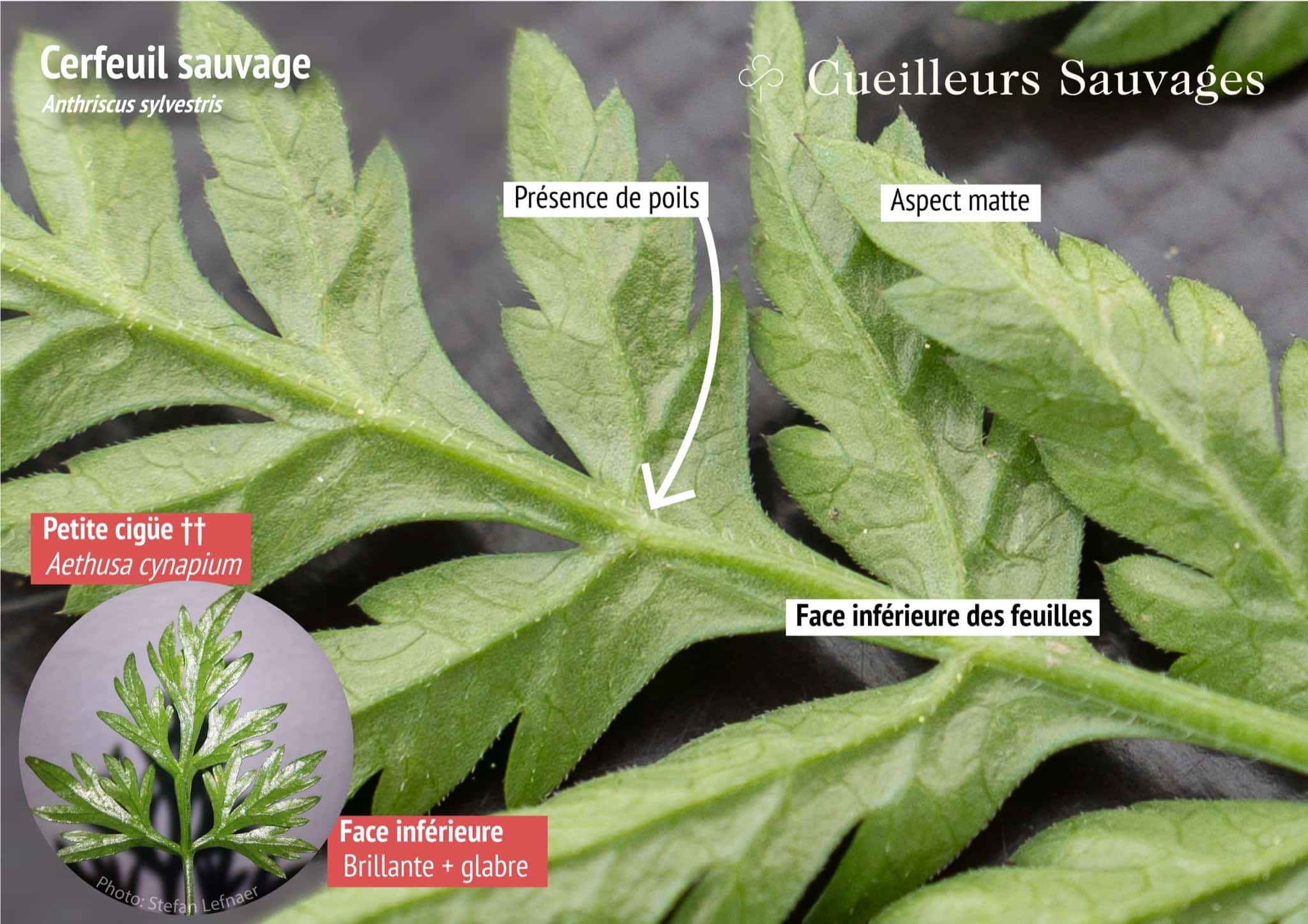
Wild chervil can be hairless, but it is often hairy on the young stems, with a few hairs at the stem nodes and on the leaves. So do not eat wild chervil if it is completely hairless. - Fool's parsley has distinctly glossy leaf undersides.
Wild chervil has matt leaf undersides (see the images below). - Fool's parsley has a slightly unpleasant smell.
Wild chervil is odourless (or has a faint, pleasant smell). - Fool's parsley has a petiolule, a short ‘stalk’ between the leaf's main axis and its lateral segments.
This distinguishes it from caraway, whose lateral segments are attached directly to the leaf's main axis.
Water hemlock, Cicuta virosa
Water hemlock, Cicuta virosa, also known by the French common name ciguë aquatique, is the last of our three hemlocks. It is a rhizomatous, perennial herbaceous plant. It is considered one of the most toxic plants[14].
Unlike the previous two species, I have found no mention of medicinal uses for water hemlock.
Identifying water hemlock
Water hemlock is an aquatic plant, which sets it apart from the other species we have just discussed. It grows to a height of 0.5 to 1.2 m and has hollow, round stems that are hairless and have no waxy bloom. The stems are grooved and may be purple towards the base, but they are never spotted.
The leaves are bright green and borne on hollow petioles. They are divided into elongated leaflets with sharply toothed edges. They look much less finely divided than the leaves of the other hemlocks. The root is a very fleshy, hollow rhizome resembling a turnip.
The aerial parts have a smell reminiscent of parsley, creating a risk of confusion, whereas the underground parts give off a very unpleasant smell [4].


Distribution map and habitats
The distribution map for water hemlock shows that it is fairly rare in France and Switzerland. It becomes more common in Belgium and further north. It is also protected in certain French departments [15].
This hemlock favours wetlands and peat bogs. You should be particularly vigilant in such places.
Water hemlock, Cicuta virosa, GBIF.org (27 March 2023) GBIF Occurrence Download
The risks of water hemlock poisoning
All parts of the plant are toxic, but the roots are particularly deadly. Symptoms of water hemlock poisoning include nausea, pain in the mouth, vomiting, abdominal pain and convulsions. Its toxicity appears to decrease with drying [14].
Taking all the plant’s characteristics into account, it seems difficult to confuse it with an edible plant.
- The leaflets are not divided, unlike those of wild carrot or wild chervil.
- The tuber is swollen and hollow.
However, cases of mistaken identity do occur. The cases I have read about in the literature involved roots mistaken for carrot roots, particularly by children [14]. So take care. But as we have seen, the risk is limited because water hemlock is not abundant in France or Switzerland and is confined to wet areas.

In conclusion: be patient and persistent
Hemlocks are dangerous and fascinating plants, each with its own history. They demand care from anyone wishing to gather edible plants that resemble them, such as wild chervil and wild carrot. The first step is to find out where they occur; then, with a few precise points of identification, it is entirely possible to learn to tell them apart. Here are a few tips to round off this long article:
- Get hold of some very good reference books, such as Flora Vegetativa [2] (it is Swiss, but works very well for France too), as well as a good flora for your country.
- Try to identify members of the Apiaceae near you when they are flowering and fruiting; it will be easier.
- Once you have identified the plant, look closely at the different types of leaves along its stem. Get to know it and observe every detail, so that you can recognise it later without the inflorescences.
- Return to the same place several times to become familiar with what grows there.
This process can take some time, but it is necessary and will help ensure safe foraging for you and those around you!
And you, are you afraid of these hemlocks? Do they stop you from gathering certain plants? Let us know in the comments; it will help us write more articles on the subject.
The information given here may not be sufficient to identify or use a plant safely. Remember: if in doubt, leave it out! Seek advice from a professional guide, buy good reference books and use photo-based plant identification apps with discernment. We regularly run courses on edible, medicinal and poisonous wild plants.
Références
[1] Vigil’Anses n°8 • Le bulletin des vigilances de l’Anses • Juin 2019
[2] Eggenerg & Möhl, Flora Vegetativa, Édition Rossolis
[3] Global Biodiversity Information Facility. GBIF
[4] Fournier, Dictionnaire des plantes médicinales et vénéneuses de France, Omnibus
[5] Le Petit Botaniste romand, Département de l’Instruction publique du Canton de Neuchâtel, 1991
[6] Infoflora, Conium maculatum, consulté le 12 avril 2023.
[7] Fleming T. PDR for herbal medicines. 2nd edition. Montvale: Medical
economics company inc; 2000. p. 316. NJ07647-1742.
[8] Vikramaditya and Joshi, P., (1997). A guide to important medicinal plants
used in homeopathy, V2, Homeopathic Pharmacopoeial laboratory, India, 4 and 23.
[9] Power FB, Tutin F. Chemical examination of Aethusa cynapium. J Am Chem Soc 1905;27:1461–76.
[10] Salisbury, E. J., (1961). Weeds & Aliens. New Naturalist Series, Collins, London., Society of the British Isles, London, UK.
[11] Moreau J. Rudiments of Hahnemann’s first material medica. L’Homdopathie Europ Fenne 1996;5:19–20.
[12] Shri R, Bhutani KK, Sharma A. A new anxiolytic fatty acid from Aethusa cynapium. Fitoterapia. 2010 Dec;81(8):1053-7. doi: 10.1016/j.fitote.2010.06.026. PMID: 20603195.
[13] Ministère de la Santé et la de Prévention, Petite ciguë, Risque en cas d’ingestion.
[14] A colour Atlas of poisonous plants, Frohne Pfänder, 1984.
[15] INPN, Cigue vireuse, Cicuta virosa L., Inventaire national du Patrimoine Natural, France.
[16] CBN, Petite Ciguë, Aethusa cynapium L. subsp. cynapium, Conservatoire botanique national de Brest
[17] Flora Helvetica, Guide d’excursion.



3 comments
✍️ Leave a comment






29 November
Les Pléiades
- Marie Mellioret

Making a Christmas star Sold Out
Lally railway station, car park, Blonay, Switzerland.
04 April
La Sarraz
- Michaël Berthoud

Wild edible and medicinal spring plants in La Sarraz
La Sarraz football pitches car park. Route de Cossonay.
10 April
Les Pléiades
- Michaël Berthoud

Natural incense stick-making workshop
Lally railway station, car park, Blonay, Switzerland.
No events found.
Author
Hello,
Thank you, yes, that is indeed an exception to the rule that “all toxic members of the Apiaceae are hairless”. I’ve added that information.
Michael
Thank you very much for your article, which gives me some pointers for identifying these plants. I’ll still be very careful, though. Could the smell of edible plants also be a useful indicator?
See you soon
Sophie
Author
Hello Sophie,
Some plants have distinctive, pleasant smells that are easy to recognise: meadowsweet, ground ivy, carrot…
Others have unpleasant smells, as explained in the article.
Smell is a very useful feature to consider alongside all the other identification features. It provides an extra clue, but you should never rely on it alone, as it can be misleading: a toxic plant might smell pleasant, for example.
Michaël