



Log in
Toxicity of coumarin-containing plants: sweet woodruff, melilot, sweet vernal grass…
Michaël Berthoud
/
4 August 2025
Some wild plants, such as sweet woodruff and melilot, can be toxic because they contain coumarins. Here is an overview to help make sense of this complex subject.
The term coumarin often comes up when discussing wild plants, as this molecule gives plants such as melilot and sweet woodruff a distinctive flavour that makes them interesting in cooking. However, concerns about these plants regularly arise: the risk of bleeding, improper drying, anticoagulant effects… Here, we will try to gain a better understanding of this molecule and its effects.
What is coumarin?
Strictly speaking, coumarin refers to the molecule 2H-1-benzopyrane-2-one (C9H6O2), a naturally occurring aromatic substance with a characteristic scent of freshly cut hay that is highly prized in perfumery.

Coumarin is therefore used as a fragrance in cosmetics, and some plants, such as sweet woodruff, are grown commercially to extract this molecule [4].
The term “coumarins” (in the plural) also refers to a broader chemical family encompassing all compounds derived from this basic molecule, including those with substituents or fused to other rings, such as furanocoumarins and pyranocoumarins… Furanocoumarins are notably responsible for the photosensitising effects of several members of the Apiaceae, such as masterwort and wild angelica.
Coumarin and its derivatives are produced by some plants to protect themselves from herbivores. A dried plant such as sweet woodruff contains approximately 1% coumarin [4]. Coumarins occur naturally in many plants, including cinnamon and tonka beans, as well as wild plants such as:
- Sweet woodruff, Galium odoratum
- Sweet vernal grass, Anthoxantum odoratum
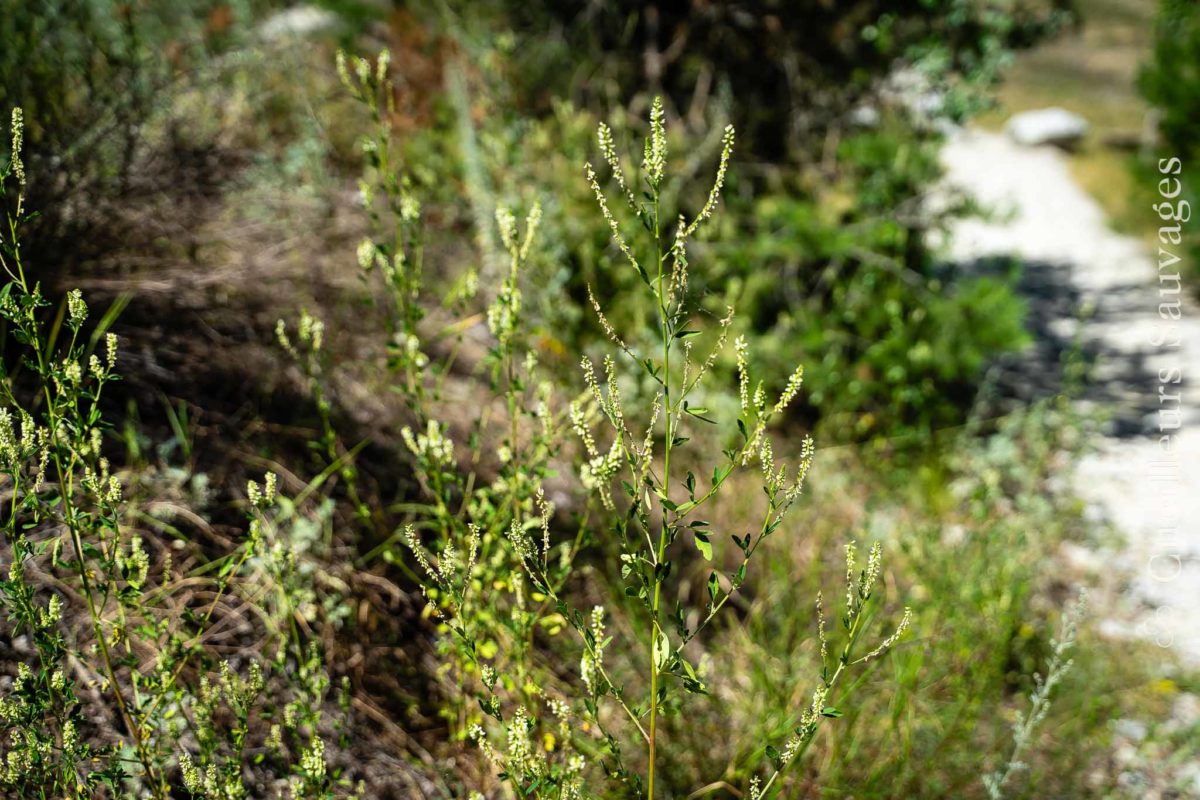
- White melilot, Melilotus albus and yellow melilot, Melilotus officinalis
- Hedge bedstraw, Galium mollugo
- Lady's bedstraw, Gallium verum
- …
Toxicity of coumarins
The first consideration is the toxicity of coumarins themselves. At high doses, they can cause various symptoms:
- Migraines
- Vomiting
- Dizziness
- Liver toxicity
On this last point, the most significant risk on the list, you may read conflicting information. Here is what we found in reliable sources.
Studies conducted in the 1990s demonstrated toxicity in rodents after they consumed high doses of coumarins: tumour formation, liver and lung problems. This naturally raised concerns about the effects on humans and led to numerous studies.
However, it was subsequently demonstrated that coumarins follow a different metabolic pathway in humans, and no toxicity has been reported in humans, even at doses 100 times higher than the daily intakes that caused tumours in rats [11].
It has therefore been concluded that exposure to the coumarin contained in food and/or cosmetic products poses no risk to human health [11]. However, as a precaution, the risk of liver toxicity is often mentioned, particularly for people with liver disorders (see the precautions below).
Drying and dicoumarol production
Although coumarin itself is not an anticoagulant, some of its derivatives (such as dicoumarol) have anticoagulant properties.
It is therefore often stated that, if a plant containing coumarin turns black during drying, the coumarin may be converted into dicoumarol through fungal fermentation.
This is possible, but does not always happen, as we shall see.
Dicoumarol does indeed have a powerful anticoagulant effect (it acts as a vitamin K antagonist). It was used as rat poison (it causes haemorrhaging), then modified and marketed as an anticoagulant medicine in the 1950s.
This concern about dicoumarol stems from two coumarin-containing plants, melilot and sweet vernal grass, both common in agricultural settings.
Here is a translation from a scientific review explaining the history of melilot and the discovery of dicoumarol:
In the late 19th century, farmers in North America began sowing Melilotus officinalis and Melilotus alba (melilots), imported from Europe, to feed their livestock. Soon afterwards, cattle began developing a new, fatal disease characterised by heavy bleeding. Francis Schofield, an English veterinarian who had emigrated to Canada, suspected that the disease was linked to eating spoiled hay, as fresh hay did not cause illness. He demonstrated that removing spoiled hay from the diet, along with transfusions of blood from healthy animals, significantly improved the condition of affected animals.
The cause and development of this new disease remained a mystery until Karl Paul Link and his colleagues at the University of Wisconsin discovered that the spoiled hay was contaminated with several species of Aspergillus. These fungi oxidise the coumarin naturally present in Melilotus to 4-hydroxycoumarin, which in turn reacts with formaldehyde and another coumarin molecule, leading to the production of dicoumarol.
Coumarin-Induced Hepatotoxicity: A Narrative Review [13].
In short, livestock can be poisoned by a substance that causes haemorrhaging, produced when the coumarins in melilot and sweet vernal grass are transformed. The conditions are quite specific, however, as the following are needed [14]:
- The presence of the fungus Aspergillus fumigatus.
- Heat during fermentation: 55-60 °C.
- Moisture.
It is therefore very unlikely that this reaction will occur when you dry plants at home. Moreover, to our knowledge, this production of dicoumarol has never been observed in sweet woodruff.
Risks in certain miso-style fermentations
A friend of ours, Johana Moret of Jardin des Toupines, makes miso with wild plants. She wanted to make a hedge bedstraw miso; this plant contains coumarin. However, making miso involves Aspergilus fungi, heat and moisture. In short, all the conditions are in place for dicoumarol to potentially be produced during the process.
We discussed this at length, did some research and calculated the risks. We concluded that it was not advisable to make such preparations.
It is not miso itself that poses a risk, but only the preparation of miso to which coumarin-containing plants are added.
Conclusion and recommendations
There are therefore two risks: on the one hand, toxicity from the molecule itself when taken in high doses; on the other, a risk of bleeding associated with one of its derivatives, dicoumarol, which forms under very specific conditions. This research helps us appreciate the complexity of the plant world!
If you are in good health, you need not worry about using these plants in cooking.
Here are the recommendations:
- Avoid culinary fermentations involving Aspergillus fungi, such as Japanese miso. For example, the safety of sweet woodruff miso remains to be verified.
- Discard any coumarin-containing plant that has turned black during drying: sweet woodruff, melilot, sweet vernal grass, lady's bedstraw, hedge bedstraw…
- Make sure you dry sweet woodruff at a temperature below 50 °C.
Coumarin-containing plants should be avoided if [4, 18, 19]:
- You have circulatory problems or are taking anticoagulants.
- You have liver problems.
- You are pregnant.
Recommended amounts, based on data on coumarin toxicity:
- Sweet woodruff: 7 g of fresh flowers is considered a safe amount for human consumption (for a 70 kg adult) [16].
- Melilot: 2.0–2.4 g per day, equivalent to two level teaspoons per day [15].
Références
Image de couverture: Hamid, Shokhan J., and Twana Salih. « Design, synthesis, and anti-inflammatory activity of some coumarin Schiff base derivatives: In silico and in vitro study. » Drug Design, Development and Therapy (2022): 2275-2288.
- [4] Chevallier. A.The Encyclopedia of Medicinal Plants Dorling Kindersley. London 1996 ISBN 9-780751-303148
- [11] B.G Lake, Coumarin Metabolism, Toxicity and Carcinogenicity: Relevance for Human Risk Assessment, Food and Chemical Toxicology, Volume 37, Issue 4, April 1999, Pages 423-453
- [13] Pitaro M, Croce N, Gallo V, Arienzo A, Salvatore G, Antonini G. Coumarin-Induced Hepatotoxicity: A Narrative Review. Molecules. 2022 Dec 19;27(24):9063. doi: 10.3390/molecules27249063. PMID: 36558195; PMCID: PMC9783661.
- [14] Bye A, King HK., The Biosynthesis of 4-Hydroxycoumarin and Dicoumarol by Aspergillus fumigatus Fresenius. Biochem J. 1970 Apr;117(2):237-45. doi: 10.1042/bj1170237. PMID: 4192639; PMCID: PMC1178855.
- [15] Final assessment report on Melilotus officinalis (L.) Lam., herba, Europenan Medicines Agency, 2018
- [16] Egebjerg MM, Olesen PT, Eriksen FD, Ravn-Haren G, Bredsdorff L, Pilegaard K. Are wild and cultivated flowers served in restaurants or sold by local producers in Denmark safe for the consumer? Food Chem Toxicol. 2018 Oct;120:129-142. doi: 10.1016/j.fct.2018.07.007. Epub 2018 Jul 5. PMID: 29981787.
- [17] Hegheș, S., Voștinaru, O., Mogoșan, C., Miere, D., Iuga, C., & Filip, L., Safety Profile of Nutraceuticals Rich in Coumarins: An Update, Frontiers in Pharmacology, 2022. 13. https://doi.org/10.3389/fphar.2022.803338.
- [18] Najmanová, I., Doseděl, M., Hrdina, R., Anzenbacher, P., Filipský, T., Říha, M., & Mladěnka, P. , Cardiovascular effects of coumarins besides their antioxidant activity, Current topics in medicinal chemistry, 2015; 15 9. https://doi.org/10.2174/1568026615666150220112437.



4 comments
✍️ Leave a comment






29 November
Les Pléiades
- Marie Mellioret

Making a Christmas star Sold Out
Lally railway station, car park, Blonay, Switzerland.
04 April
La Sarraz
- Michaël Berthoud

Wild edible and medicinal spring plants in La Sarraz
La Sarraz football pitches car park. Route de Cossonay.
10 April
Les Pléiades
- Michaël Berthoud

Natural incense stick-making workshop
Lally railway station, car park, Blonay, Switzerland.
No events found.
Brilliant, thanks for clearing that up!
Author
Hello Laetitia,
My pleasure ^^
Michaël
Really interesting
I love the smell of coumarin
Belgians make a really tasty liqueur with sweet woodruff
I hope macerating it in alcohol doesn’t make it toxic.
Author
Hello, and thank you for your comment. The liqueur is indeed popular in Belgium. As for coumarin being converted into dicoumarol, I don’t think there is a risk, since maceration takes place at room temperature and the fungus grows at a higher temperature, >55°C.