



Log in
Common hogweed: harvesting and uses
Michaël Berthoud
/
24 August 2018
One of the treasures of our meadows is common hogweed, a large, generous plant and one of the best wild vegetables. When I walk through uncultivated meadows and pastures, I can’t help noticing how full they are of riches and an astonishing abundance of life!
Common hogweed
Also known in French as grande berce, berce spondyle and patte d’ours
Scientific name Heracleum sphondylium L.
Family Apiaceae
Flowering June–September
Habitat Lush meadows, forest paths, pastures
Altitude Up to 2000 m
Parts used Leaves, stems, seeds
Harvesting leaves and stems April to October
Harvesting seeds From June
How to recognise common hogweed
As strong as Hercules!
Its scientific name, Heracleum, evokes Heracles, the hero the Romans called Hercules. Perhaps because of its great size, appearance and abundant hairiness! In the countryside, it is often known by the French name patte d’ours and fed to rabbits, which relish it. Lucky them!
To find it, I look for uncultivated meadows that farmers leave fallow or mow for hay. I also find it readily in alpine pastures and along forest paths and woodland edges. It likes cool, nutrient-rich soils.
A little botany
Common hogweed belongs to a family in which some species are difficult to tell apart. It stands out for its size: it is a robust plant that can grow as tall as a person.
The main stem is hollow, with fine grooves running along its entire length. Every part of the plant is covered in coarse hairs, giving it a rough feel.
It has dozens of small white flowers, sometimes tinged with pink, grouped in umbels at the ends of slender rays of varying lengths. Once fertilised, each flower produces a small, flattened fruit with two little projections at the top. These fruits are larger than those of most other members of the Apiaceae.
Common hogweed leaves vary in shape; they are divided into several sections called leaflets, with more or less wavy edges. These are known as pinnatisect leaves. Depending on the age of the plant, they measure between 10 and 50 cm long.
When you crush a leaf between your fingers, it releases a very pleasant, aromatic citrus scent. Once you know this scent well, it can help you recognise the plant, but it is not enough to identify it.
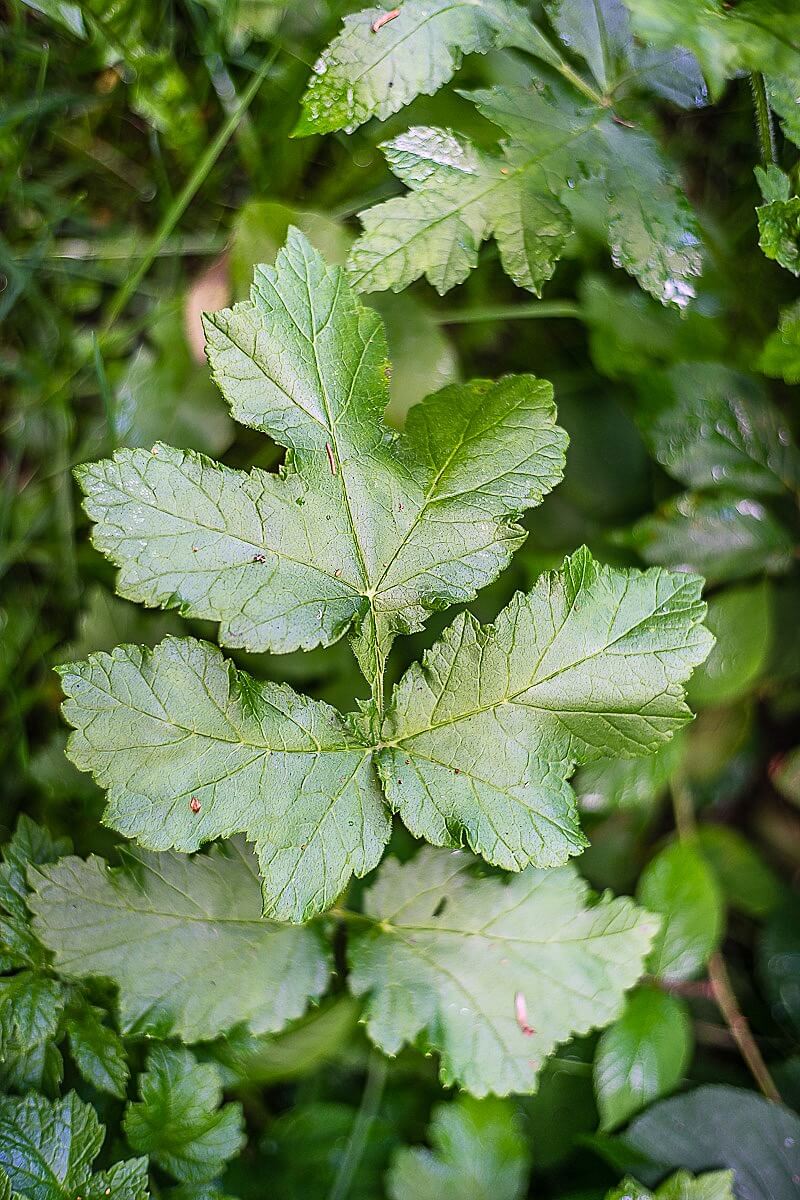
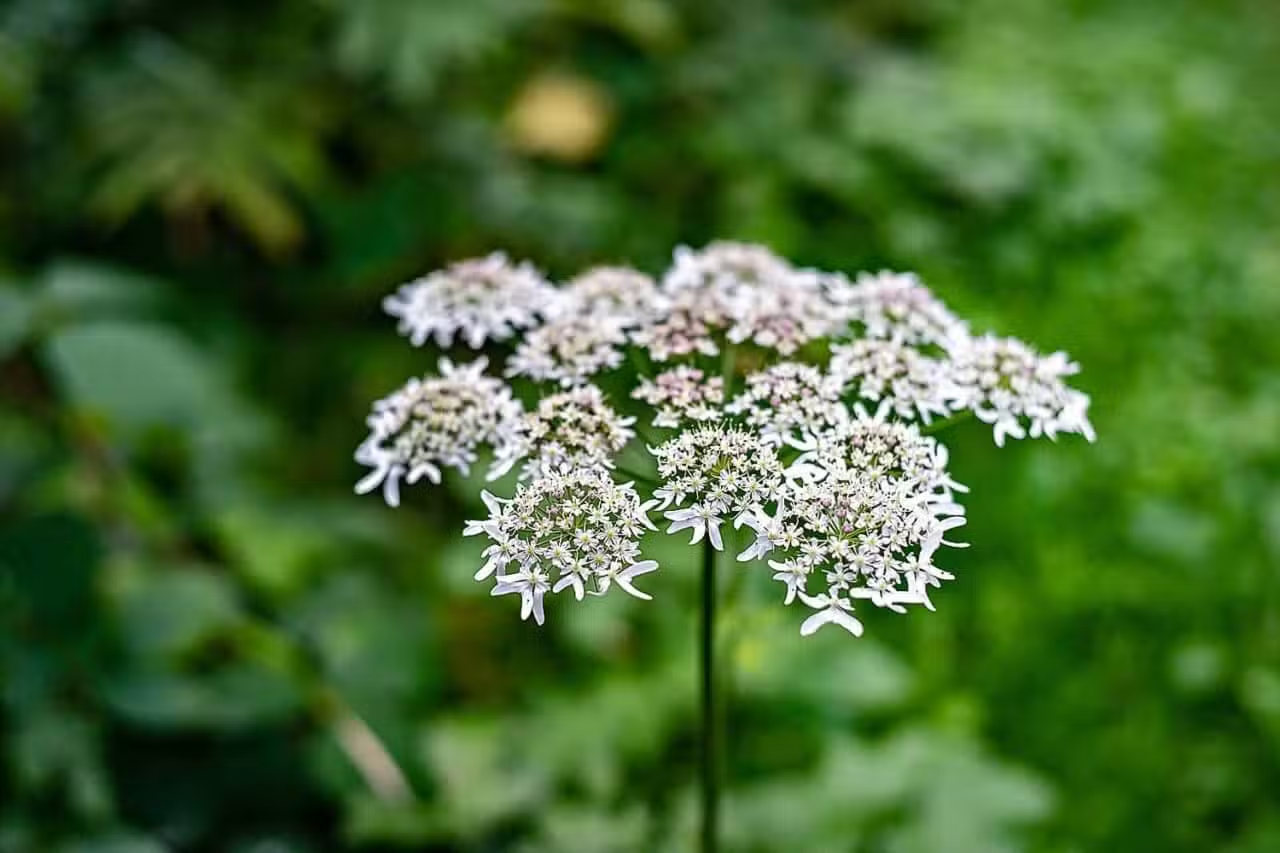
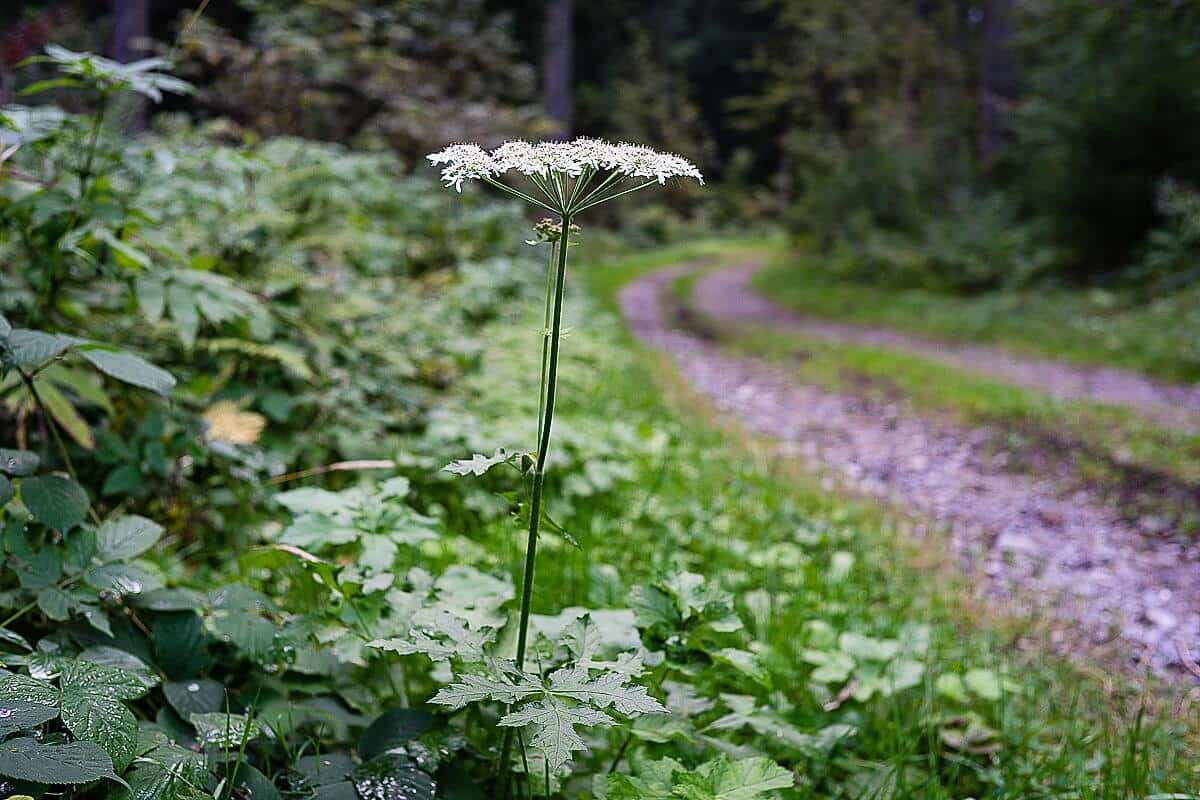
The history and names of common hogweed
On the shores of Lake Zug, archaeologists found a common hogweed fruit at the Neolithic site of Zug-Riedmatt. It dates back more than 5,000 years.[5]
The Greek name sphondylion (σφονδύλιον) appears in the writings of Dioscorides in the 1st century AD. This physician describes a plant of damp places with several features reminiscent of common hogweed: white flowers, broad fruits grouped in pairs and a strong smell. That ancient name survives today in the scientific name of common hogweed, Heracleum sphondylium.[6]
In French, the word “berce” is attested from the 17th century. Its origin remains poorly understood. In Eastern Europe, people once made a fermented drink from the leaves of common hogweed.[7]
Foraging for common hogweed
A leafy vegetable you’ll never tire of
Common hogweed is a classic wild edible plant. Once you’ve spotted it, you won’t tire of it, believe me! Every part of the plant is edible. The young leaves, while still glossy and pale green, can be eaten raw, as can the peeled stems. Their highly aromatic scent adds wonderful flavour to salads and pestos.
Once the leaves turn matt, they can be cooked and make an excellent vegetable. I love common hogweed in a quiche or a bake with ancient grains, in lasagne or added to risotto. I often simply steam it and add a drizzle of good olive oil, balsamic vinegar, salt and pepper. That’s the best way to get to know it. You can also finely chop the leaves and use them like parsley in a broth. The young leaves, while still glossy, are well suited to lacto-fermentation, either on their own or with cabbage.
When I’m out walking, I like to peel the stems while they’re still tender. They’re juicy and taste of celery with a hint of coconut.
The best part of common hogweed is its flowers before they’ve opened. They’re protected inside a large leaf sheath, and the whole thing looks like broccoli. I pick this ‘broccoli’ with its tender stem and steam it. A simple delight!

Flowers that divide opinion
The flowers have a distinctive smell. Some people find them pleasantly fragrant, while others think they smell of urine. Opinions couldn’t be more divided! So try them for yourself, and if you like them, you can infuse them or make fritters with them.
The fruits as a seasoning
Common hogweed fruits make an excellent seasoning – one of my favourites, in fact! There are also two ways to harvest them.
First, you can harvest them while they’re green. At this stage, they’re a little juicy and easier to chop. You can freeze them to preserve them. But you can also harvest them once they’re dry, without waiting too long, as they’ll fall off the plant. You can then dry them further in the open air or in a dehydrator and store them in jars.
The dried fruits have about 4 times less flavour than the green ones.
Finely chopped, they add a lovely flavour to salad dressings. Be careful not to use too many, though, as their flavour is very strong! I like to add them to all my vegetable dishes or to rice as it cooks. They’re used to make syrups, and common hogweed fruit ice cream is delicious!

Buckwheat with common hogweed recipe
I like traditional grains such as buckwheat. I find they go well with wild plants, and both are very nutritious. Here’s a very simple, quick recipe.
- 1 Cup of buckwheat
- 2 generous handfuls of common hogweed
- 1 onion
- 2 tbsp raisins
- Salt and pepper
- Soften an onion in a saucepan.
- Chop the common hogweed, add it to the pan and cook for 5 minutes.
- Measure the volume of the buckwheat and rinse it.
- Add the buckwheat to the pan.
- Add 1.5 times the volume of the buckwheat in salted water with stock.
- Cook over a low heat for 5 minutes, then turn off the heat and leave to cook, covered, for 20 minutes.
- Add the raisins towards the end of cooking.
- Season to taste.
What do common hogweed leaves contain?
For every 100 g of fresh leaves, François Couplan reports 290 mg of vitamin C and 1,200 IU of provitamin A. The leaves also contain around 80 g of water. The main minerals are potassium (540 mg) and calcium (320 mg), followed by phosphorus (125 mg) and iron (3.2 mg).[8]
In the Pyrenees, researchers compared 34 species growing in hay meadows. They harvested the aerial parts of the plants, then measured their mineral content on a dry matter basis. Common hogweed was among the species richest in calcium and magnesium.[9]
Medicinal uses of common hogweed
In the Val d’Anniviers, in Valais, some families used common hogweed for bruises when the skin remained intact after a blow or crushing injury.[10] Mességué and Valnet also report that the plant was applied to boils, ulcers and insect bites, and used against intestinal worms.[11, 12] In Sweden, it was among the household remedies for dysentery.[13, 14]
Common hogweed also had a reputation for aiding digestion. It was credited with tonic and aphrodisiac properties.[11, 12, 13] Maurice Mességué describes foot baths prepared with the leaves. Henri Leclerc, meanwhile, mentions the use of common hogweed extracts for sexual problems in men.[11, 15]
In the Artvin region of Turkey, the roots and stems of a local subspecies (H. sphondylium subsp. artvinense) were used for difficult digestion, diarrhoea, menstrual problems or high blood pressure.[16, 17] Researchers studied this same subspecies of common hogweed in the laboratory. They prepared water and alcohol extracts from it and observed activity against certain bacteria.[17]
The traditional use of common hogweed for high blood pressure also attracted researchers’ interest. They brought a plant extract into contact with sections of rat aorta and observed that the arterial wall relaxed.[18]
Possible confusion
The Apiaceae family contains many edible wild and cultivated species (carrot, ground elder, celery, fennel…). Nevertheless, it also contains many toxic species. Although the flowers of members of the Apiaceae look fairly similar at first glance, their leaves vary greatly in shape and size.
Bear in mind that most toxic species in this family have leaves resembling those of carrot or parsley, not those of common hogweed. This is, of course, not an absolute rule. There are exceptions, such as giant hogweed.
Bear in mind, too, that most poisonous members of the Apiaceae are hairless (rough chervil is an exception). The main risks of confusion are with hemlocks and chervils.
Careful observation of the leaves helps distinguish common hogweed from the hemlocks. Common hogweed has leaves with broad, undivided segments, whereas those of fool’s parsley and poison hemlock are finely divided. We have written a detailed article on the three main hemlock species in Europe.
Precautions with common hogweed
Allergies and overconsumption
Although cases are rare, there is a risk of an allergic reaction to common hogweed, as with many other members of the Apiaceae (carrot, fennel, etc.). Some chefs refuse to prepare it for fear of causing a reaction in their customers.
A participant on one of our courses told us about feeling unwell after eating a large number of fresh fruits. Here is her account:
While out walking, I had a few (rather a lot) too many and ended up feeling very strange. My experiences with narcotics have been very limited and were a long time ago, so it’s hard for me to draw a comparison, but I was in a daze and couldn’t think straight. I must have eaten about twenty of them in roughly an hour, and they were fresh.
Photosensitivity
Common hogweed can cause photosensitivity in some people. This means that people with sensitive skin may suffer burns when their skin comes into contact with the plant and is then exposed to sunlight. In some people, the effect may go unnoticed; in others, it can cause burns.
The sap contains furanocoumarins, substances that react to UVA radiation from the sun. In a study of common hogweed, researchers measured roughly twice as much of these substances in root extracts as in green fruit extracts. Using the same method, they did not detect any in the leaves or stems analysed.[19] When foraging, it is best to avoid getting the sap on your skin.
Some furanocoumarins also affect the enzymes that metabolise medicines in our bodies. This phenomenon is best known in citrus fruits, particularly grapefruit.[20, 21, 22] With common hogweed, the need for caution relates particularly to taking concentrated root extracts repeatedly.[19, 22]
The reaction can, however, be severe in some foragers. This was the case for Yves, who shared his experience in the comments:
As for photosensitivity, I have to say that common hogweed burns my skin, and not just a little… I’m constantly at war with this plant because I have to mow a meadow where it grows prolifically. So mowing in gloves and two layers of long clothing when it’s over 30°C… is no fun… Especially as the protection is never 100% effective and I still get burns (after two days, once the photosensitivity has had time to take effect).
Yves, a blog reader
And sometimes, when I’m out mountain biking along paths where hogweed grows at the edges, I get blisters that burn and ooze pus for 10 days.
… And in the second half of summer, its relative, wild fennel, takes over, with the same photosensitising effects…
Recommendations
- Try a small amount of common hogweed the first time.
- Fresh fruits should therefore be eaten in small quantities.
- Harvest common hogweed with a knife and avoid getting its sap on your skin.
- People with sensitive skin should harvest the leaves with a knife while wearing gloves, put them in a bag without getting any sap on their hands, and avoid exposure to the sun while harvesting.
Giant hogweed
Common hogweed can be confused with giant hogweed, an invasive plant that causes severe burns through photosensitisation. While common hogweed does not have a photosensitising effect on everyone, giant hogweed is much more dangerous and calls for the utmost caution.
Do not touch giant hogweed with your bare hands!
See the InfoFlora fact sheet for a full description. As an adult, it becomes a giant plant, reaching 3–4 m in height.
Giant hogweed is therefore characterised by:
- Its very large size when mature
- Numerous purple blotches on the stem
- Large leaves that are more pointed than those of common hogweed
- Upper leaf surfaces that are smoother and shinier than those of common hogweed
Some authors, including François Couplan, describe it as edible[4]. However, its sap contains phototoxic furanocoumarins that can cause severe skin burns after exposure to the sun. Given the risks involved in harvesting and preparing it, we strongly advise against eating it, in line with the recommendations of some health authorities[1, 2, 3].


The information given here may not be sufficient to identify or use a plant safely. Remember: if in doubt, leave it out! Seek advice from a professional guide, buy good reference books and use photo-based plant identification apps with discernment. We regularly run courses on edible, medicinal and poisonous wild plants.
Références
[1] Service public de Wallonie — La berce du Caucase : admirer mais pas toucher !
[2] ANSES (2025) — Expositions et intoxications accidentelles par des plantes, section 5.2.2, p. 110
[3] InfoFlora — Berce du Caucase, fiche d’information
[4] François Couplan, Aimez vos plantes invasives, Éditions Quae, 2015
[6] Dioscoride, De materia medica, III, 76 : « sphondulion », texte grec.
[7] Académie française, Dictionnaire, 9e édition, entrée « berce ».
[8] François Couplan, Guide nutritionnel des plantes sauvages et cultivées, 1998.
[10] Sabine Brüschweiler, Plantes et savoirs des Alpes. L’exemple du val d’Anniviers, 2008.
[11] Maurice Mességué, Mon Herbier de Santé, 1976.
[12] Dr. Jean Valnet, La phytothérapie, 2001.
[14] Fournier, Dictionnaire des plantes médicinales et vénéneuses de France, 1947.
[15] Dr H. Leclerc, Précis de phytothérapie, Paris, Masson.
[16] Baytop T, Turkish Plant Names, Institution of Atatürk Culture, The publication of Turkish Language Institution, Ankara.



24 comments
✍️ Leave a comment






29 November
Les Pléiades
- Marie Mellioret

Making a Christmas star Sold Out
Lally railway station, car park, Blonay, Switzerland.
04 April
La Sarraz
- Michaël Berthoud

Wild edible and medicinal spring plants in La Sarraz
La Sarraz football pitches car park. Route de Cossonay.
10 April
Les Pléiades
- Michaël Berthoud

Natural incense stick-making workshop
Lally railway station, car park, Blonay, Switzerland.
No events found.
Thank you for your article.
Why say that hogweed flowers have an unpleasant smell? On the contrary, they’re fragrant and smell sweet.
Can the leaves be less deeply divided, rounder and slightly lobed? Thank you.
Author
Hello,
Thank you for your comment. It’s funny, because when I ask people to smell the flowers, opinions differ. Some find the smell unpleasant, while others like it.
As for the leaves, yes, they can be more or less round and more or less toothed. They’re described as polymorphic leaves. There is also a less deeply divided subspecies, elegant hogweed: https://www.infoflora.ch/fr/flore/heracleum-sphondylium-subsp-elegans.html
Best wishes
Michaël
Brilliant, thank you so much!
Author
My pleasure!!!
Thank you for the information.
However, when it comes to photosensitivity, I have to say that common hogweed burns my skin, and not just a little … I’m constantly battling this plant because I have to mow a meadow where it thrives. So mowing in gloves and two layers of long clothing when it’s over 30° … is no fun … Especially as it’s never 100% effective and I always end up with burns (after two days, the time it takes for the photosensitivity to take effect).
And sometimes, when I’m out mountain biking along paths where hogweed grows at the edges, I get blisters that burn and ooze for ten days.
… And during the second half of summer, its cousin wild fennel takes over, with the same photosensitising effects…
Author
Hello Yvan,
Thank you for sharing your experience! I’ll remove the word “mild” and add your account to the article.
Best wishes
Michaël
Hello, first of all, thank you for the quality and wealth of information on your website. Well done.
One question, though, that I’m having trouble finding an answer to: could you tell me when to harvest the hogweed fruits (while they’re still green, or when they’re dry and brown)? And do they need washing, even if they’re already dry?
Many thanks, _ Lo
Author
Hello Lo,
Thank you for your comment and your question! I’ve answered it in the article!
Best wishes,
Michaël
Hello,
I’m looking for tall, dried hogweed stems for a decoration. Can anyone tell me where I could buy some?
Thanks in advance.
Anita
Author
Hello Anita,
I’m not sure you can buy them. At any rate, I’ve never seen them for sale. You’ll probably have to gather them yourself 😉
Best wishes,
Michaël
Thank you for your reply. I’m quite happy to gather them myself, taking all the necessary precautions… but I don’t know where or when…
If you have any specific information, I’d be grateful.
Best wishes.
Anita Droz
In the Yonne, for example, there’s plenty of common hogweed at the moment. You can look near watercourses, along woodland edges, on rich, moist, undisturbed ground, in fallow fields with tall grass, and along grassy paths…
In my garden, common hogweed grows abundantly in the shade, often not as tall, but you can find some very tall plants in the sun too.
The smell is quite distinctive. Personally, I think it has a fairly strong ‘medicinal’ smell; the root/tuber in particular gives off a strong smell when you break it (with a spade, for example). I have some slight doubts about my hogweed because of this smell. Many thanks for the details on how to distinguish it from giant hogweed.
Hello,
I forgot to mention that I live in Geneva, and the Yonne is a bit far for me… but thank you for taking the trouble to reply. If you know of any places a little closer to Switzerland, I’d be happy to go.
Thank you
Anita
Author
Hello Anita,
Common hogweed is a very common plant; you’ll find it in almost every meadow, field and pasture.
Good research!
Thank you and best regards.
Anita
Is common hogweed also called ‘pannée’ in Normandy?
Author
Hello Elisabeth,
I don’t know. Being Swiss, I’m not familiar with its local French names. Could you try emailing me a photo of the plant you call ‘pannée’?
Michaël
Hello Elizabeth
If I may, I’d like to suggest an answer to your question. I think you’re talking about parsnip, which looks very much like common hogweed. It belongs to the same family, the Apiaceae, but is a different species.
Two common parsnip subspecies are safe to eat, but another is dangerous because it also causes photosensitivity.
I’d also like to congratulate and thank the authors of this blog, which is a real treasure trove! 🙂
Author
Hello Pierre,
Thank you for suggesting an answer and for your feedback; it encourages us to keep going! ^^
That’s a very good point: “pannée”, “panais” — I hadn’t thought of that! It’s true that the leaves look alike:
https://api.tela-botanica.org/img:000080971O.jpg
https://www.tela-botanica.org/bdtfx-nn-48097-synthese
Best wishes,
Michaël
“Pannée”.
Another name for common hogweed??
Hello,
Does common hogweed attract insects?
I’ve noticed flies on its flowers… Is it also a good nectar source? Does it repel other insects?
Best regards
Author
Hello Agathe,
Yes, I think it attracts insects that pollinate all plants in the Apiaceae family. Common hogweed mainly attracts small insects. But I couldn’t say whether it acts as a repellent. Give it a try and let us know! ^^
Have a lovely day
Michaël
Does common hogweed retain its qualities when dried, as stinging nettle does? Do you have any advice on this, and might the answer be different for the leaves and stems?
Author
Hello,
I’ve tried drying the leaves and petioles, but I haven’t found a use for them. The citrus flavour is delicate, and I couldn’t detect it once they were dried. The seeds, on the other hand, can be harvested and dried for storage.
Happy foraging!