



Log in
How to make a plantain salve from start to finish
Michaël Berthoud
/
10 July 2019
I’ve already told you about ribwort plantain (Plantago lanceolata) and its beneficial properties for skin problems. Here’s a recipe for your natural medicine cabinet, to use on scars, wounds, bites and stings… With this 100 % natural plantain salve, we’re a long way from commercial creams packed with chemicals and preservatives!
A homemade plantain salve without chemical preservatives
A salve is a preparation that lets you apply a plant externally to the skin. It consists of an oil base (an infused oil) solidified with beeswax. Unlike an oil, it is solid, making it more convenient to use and handle.
This kind of homemade preparation is particularly suitable for people who cannot tolerate commercial creams and their long list of chemical preservatives.
It’s a fun and simple way to use medicinal plants. Infused oils and salves are staples of a homemade natural medicine cabinet.
Plantain can help with skin problems
Ribwort plantain (see its Infoflora entry and botanical description) has long been used in folk medicine to heal wounds[1]. Its constituents, including polysaccharides, lipids, caffeic acids, flavonoids and terpenes, give it the following properties [2,3]:
- Anti-inflammatory
- Antioxidant
- Analgesic and
- Mildly antimicrobial
This plantain salve is therefore effective when applied externally for
- Skin inflammation:
- Insect bites and stings
- Minor burns
- Eczema
- Itching and other hot skin conditions
As plantain also promotes healing, this salve will help heal grazes and small cuts.
Caution: it should not be applied to a deep cut, as the oil prevents proper healing, but only once the wound has already closed. Otherwise, use an alcohol-based tincture, for example. If you have a deep wound, consult a doctor.
Step 0: Harvest and dry your plantain
Before starting the recipe, you need dried plantain. So, if you want to make 1 L of oil, you need to harvest plenty of it, then dry it.
To learn more about ribwort plantain and how to recognise it, take a look at its dedicated article. I recommend reading the article on preserving wild plants for drying tips. You can use ribwort plantain (Plantago lanceolata) or greater plantain (Plantago major); both work perfectly well.
Step 1: DIY plantain oil
There’s no weighing involved in this recipe. Simply fill your container and cover the plantain with oil. So, if your jar holds 1 L, you’ll have 1 L of plantain and 1 L of oil.

Making plantain infused oil
Here's how to make plantain infused oil, the first step in preparing a salve. This oil will contain the plant's active compounds. This is the traditional method of maceration over one month.
Equipment
- 1 large jar
Ingredients
- 1 L Dried plantain
- 1 L Olive oil
Instructions
- Put the freshly dried and chopped plant, or plant bought from a herbalist, into a large airtight jar.
- Cover with oil (olive oil, for example). Use enough to keep all the leaves submerged; otherwise, some may rot during maceration. But if there is too much oil relative to the plant, the infused oil will not be concentrated enough.
- Wrap the jar in kraft paper and place it against a sunlit windowpane, so the oil warms slightly without UV light degrading it.
- Leave to infuse for a month. Check in on your potion to make sure all is well and admire the oil changing colour. This will help you avoid mishaps like “oh no, some leaves have rotted because they were sticking out of the oil”. Stir occasionally, checking the oil level!
- After a month, your oil will have a lovely green colour. Strain and press the plant material using a cloth or a potato masher, then strain the oil through a reusable coffee filter.
- Pour into a tinted bottle and label it with the French and Latin names, as well as the date.
Notes
Depending on the plant, you’ll end up with a fragrant or coloured oil. Red for St John's wort, green for plantain… You can either store the infused oil (in a cool, dry place) or use it straight away.
Can you use fresh plantain to make this infused oil?
There are two equally valid options: fresh or dried plant material.
If you use a dried plant, make sure it is not too old. Freshly dried plantain has a beautiful green colour. The advantage is that moisture will not affect how well the oil keeps.
You can also use fresh plantain; in that case, leave it to wilt for 1 to 2 nights to remove excess moisture. Do not seal the jar airtight, because the moisture needs to be able to evaporate, especially if you put it in the sun. It is all the more important to keep the entire plant submerged in the oil, otherwise the exposed parts may rot and spoil your infused oil… A cafetière will be very useful for this.
Once you have strained the oil, you may see small droplets at the bottom of the bottle. These are droplets of water that settle at the bottom because water is denser than oil. They need to be removed. To do this, carefully pour the oil into another container. Normally, the droplets remain stuck to the bottom of the bottle, leaving your oil ‘dehydrated’!
If there are more than a few droplets, say a layer of water at the bottom, you will need to siphon it off with a tube.
Storing the infused oil
In theory, infused oil stored in a cool, dry place away from light will keep for two to three years (or even longer), as long as the oil does not go rancid. A rancid smell tells us when it has turned. In practice, I found one of my very first infused oils ten years after making it, and it was still usable! It had kept well because I had never opened it.
I always use organic olive oil, preferably from the first cold pressing, because it takes longer to go rancid.

Step 2
There you are, you’ve been patient! Phew, a month is a long time! Let’s move on to the second step.
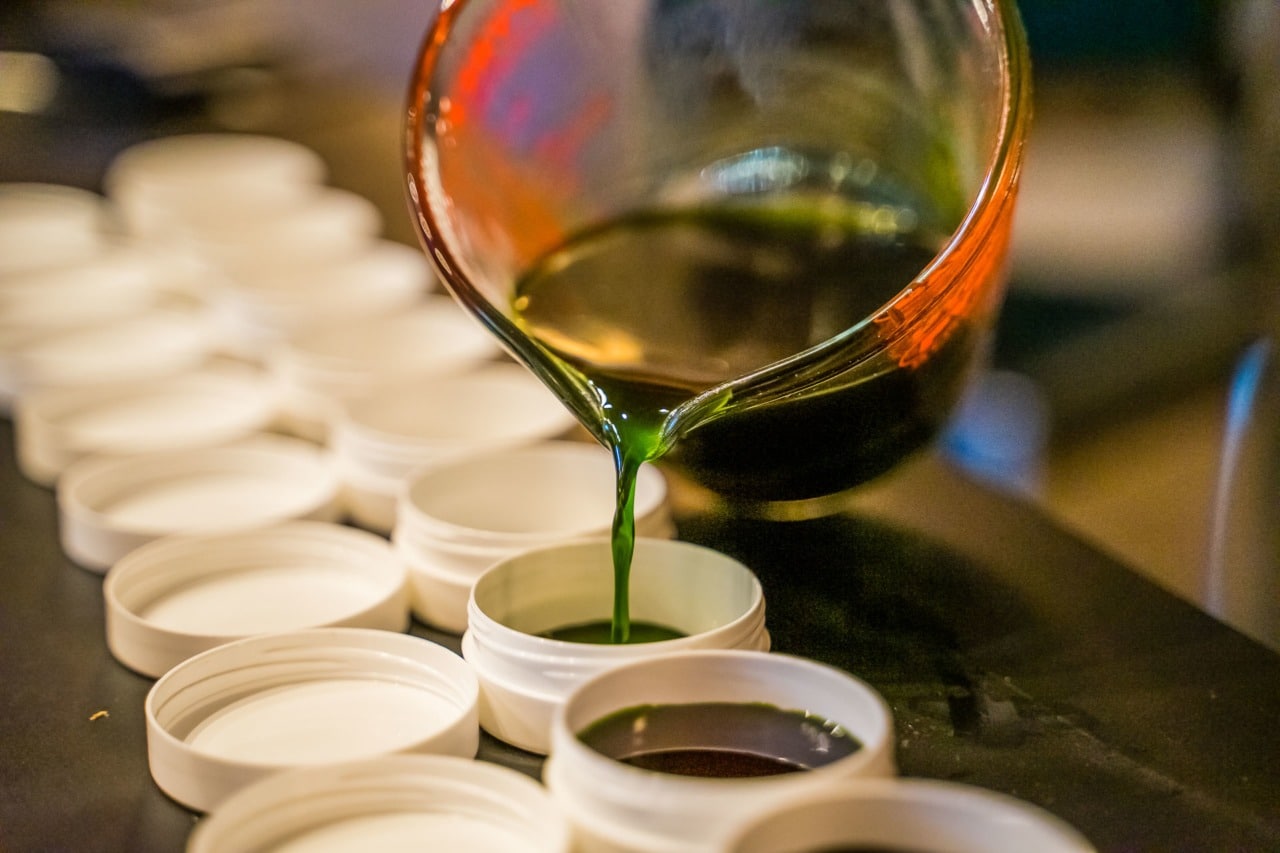
Making a plantain salve
Here’s how to make a smooth plantain salve from an infused oil.
Equipment
- 2 saucepans for a water bath
- 1 Set of scales
- 1 cloth or potato masher
- 1 reusable coffee filter and cloth coffee filter
- 1 thermometer
Ingredients
- 100 mL plantain infused oil
- 12 g Beeswax
- Vitamin E
- Lavender essential oil Or rosemary, thyme
Instructions
- Place the oil in a container and heat it in a water bath.
- Add 12 g of beeswax for every 100 ml of infused oil.
- Stir until the wax has completely melted. Beeswax melts at 62 to 65°C, so it needs to reach that temperature, but no higher, to avoid damaging the active compounds too much.
- Pour into small sterilised glass jars.
- Wait 2–3 minutes, then add 4–6 drops of essential oil from an aromatic plant (lavender, for example) and 8 drops of vitamin E per 100 ml.
- To prevent condensation, put the lids on once the salves have set.
Be creative!
This recipe works for other plants too, of course, and you can have fun mixing infused oils, for example, plantain with pot marigold, Calendula officinalis. I don’t think there are any bad combinations; just make sure the plants you mix are suited to what you want the salve to do.


Medicinal plant days
If you’d like an introduction to using medicinal plants to care for your family, we organise medicinal plant days at our place in Les Pléiades (Switzerland). The morning consists of a foraging walk, followed by an afternoon workshop where we’ll make infused oils, salves, syrups…
30 May
Les Pléiades
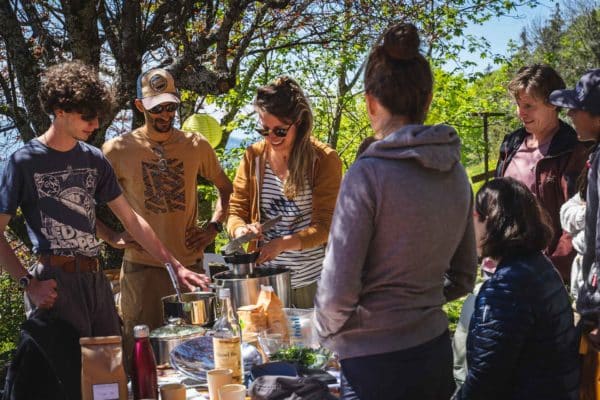
Medicinal plants: botanical walk and workshop on infused oils, salves and syrups
Lally railway station, car park, Blonay, Switzerland.
19 September
Les Pléiades
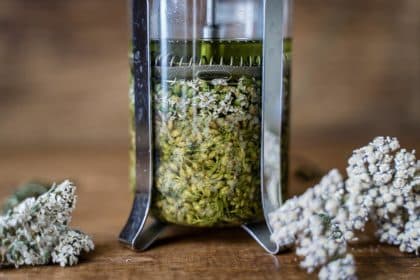
Medicinal plants: workshop on mother tinctures, oxymels, sweets and decoctions
Lally railway station, car park, Blonay, Switzerland.
No events found.
Références
[1] Samuelsen AB. The traditional uses, chemical constituents and biological activities of Plantago major L.A review. J Ethnopharmacol. 2000;71:1–21.
[2] Reina E, Al-Shibani N, Allam E, Gregson KS, Kowolik M, Windsor LJ. The Effects of Plantago major on the Activation of the Neutrophil Respiratory Burst. J Tradit Complement Med. 2013;3:268–72.
[3] Gomez-Flores R, Calderon CL, Scheibel LW, Tamez-Guerra P, Rodriguez-Padilla C, Tamez-Guerra R, Weber RJ. Immunoenhancing properties of Plantago major leaf extract. Phytother Res. 2000;14:617–22.
The information given here may not be sufficient to identify or use a plant safely. Remember: if in doubt, leave it out! Seek advice from a professional guide, buy good reference books and use photo-based plant identification apps with discernment. We regularly run courses on edible, medicinal and poisonous wild plants.



77 comments
✍️ Leave a comment






29 November
Les Pléiades
- Marie Mellioret

Making a Christmas star Sold Out
Lally railway station, car park, Blonay, Switzerland.
04 April
La Sarraz
- Michaël Berthoud

Wild edible and medicinal spring plants in La Sarraz
La Sarraz football pitches car park. Route de Cossonay.
10 April
Les Pléiades
- Michaël Berthoud

Natural incense stick-making workshop
Lally railway station, car park, Blonay, Switzerland.
No events found.
Thanks for this recipe, it’s brilliant! I have so much plantain in my garden and I love using it in all sorts of ways???? Have a lovely summer!
Author
Have a lovely summer too, and have fun with your plantain!
You say dried plantain, but how much do we need?
And can we pick fresh plantain and dry it?
Author
Hello,
There’s no precise weight: fill your jar with dried plantain, then add just enough oil to cover it.
You can of course pick it yourself and dry it, which is even better. Make sure it’s thoroughly dry! It should be brittle.
Best wishes
Michaël
Brilliant recipe! The children loved it, and it was a great way to pass the time during lockdown!
Thank you!
Author
Well, I’m glad it was useful to you! I’m not surprised the children enjoyed it… making a green potion 😉
Hello
I love this article, thank you.
It says dried plantain; would fresh plantain work for an oil infusion too, or does it absolutely have to be dried?
Thanks in advance.
Author
Hello Astrid,
Very good question, thank you. I’ll add a paragraph to the article to answer it!
Michaël
Hello,
I had a quick question about salves… This one in particular, as it’s the one I’m interested in.
Have you ever tried replacing beeswax with anything else?
I was thinking of cocoa butter and coconut oil in particular, which also solidify when cool.
They’re found in quite a few commercial cosmetics, but do they really offer any benefit in a salve?
Admittedly, they’re less ‘natural’ than beeswax, but I wondered whether you had any thoughts on these ingredients or experience of using them…
Have a lovely day!
Carine
Author
Hello,
Yes, of course you can use other bases. I've only ever used coconut oil as an addition, though. It gives a better texture. This article gives the simplest version, but you'll find plenty of recipes if you look up natural cosmetics. Here's a version with coconut oil:
For one 30 ml jar:
• 7 g coconut fat
• 20 g olive oil (first cold pressing)
• 4 g beeswax
Hello, which part of the plant do you dry? Which part do you use: the flower, stem or leaves? Thank you.
Author
Hello Aline,
It's the leaves that are dried and used for the infused oil.
Best wishes,
Michaël
Hello
Can you only use ribwort plantain, or can you also use bird's-foot plantain? Is it possible to mix the two? I have plenty of both and can't find any information on the subject.
Thank you
Author
Hello, and thank you for your question.
Bird’s plantain is another name for greater plantain (Plantago lanceolata). You will still find it called that in books. Ribwort plantain and greater plantain can be used in the same way, both in cooking and in remedies (the two have almost the same properties).
Best wishes
Michaël
Hello, and thank you for your recipes.
I have a question about the plantain salve. Where can I find vitamin E?
What form does it come in?
Thank you for your reply.
Kind regards, Jocelyne
Author
Hello,
You can find vitamin E on websites selling cosmetic ingredients. In Switzerland, I think you can also find it at pharmacies and drogueries. It is sold as drops.
https://duckduckgo.com/?t=ffab&q=vitamie+E+achat&atb=v224-1&ia=web
Best wishes
Michaël
Hello, I had a recipe for plantain salve that didn’t say to dry the plantain before using it, so I washed it, put it in olive oil and kept the jar in the dark. The recipe said to leave the plantain to infuse for six weeks, but I didn’t have time to prepare the salve until ten weeks had passed. When I opened the jar, there was a strong smell, and I’m wondering whether that’s normal. Is there a risk it’s gone off? I have no idea what it should smell like. I’d appreciate your opinion. Thank you.
Author
Hello,
You’ll find all sorts of salve recipes. In your case, it isn’t normal for the jar to have a strong smell, as plantain isn’t aromatic. Is the smell unpleasant?
When using a fresh plant, remember that it contains an average of 80% water. If water gets into the oil, the oil will go rancid more quickly. That’s why I recommend drying plants before making infused oils. Washing the plants has also added a little more moisture. If you pick good, clean leaves, there’s no need to wash them, as you’ll be straining the oil at the end anyway. And normally, if you use a fresh plant, you need to siphon off the oil to remove the water that collects at the bottom of the jar.
You also need to make sure the plants stay submerged in the oil, otherwise they’ll rot.
I hope that helps.
Best wishes,
Michaël
Hello,
I’m going to give it a try, but I have a small doubt, and as it takes a month to infuse, I wouldn’t want to make a mistake.
Should I seal the jar tightly before wrapping it in paper, or simply cover it with a cloth to prevent contamination while letting it ‘breathe’?
Thank you for your reply.
Émilie.
Author
Hello Emilie,
Well done, your intuition is right! If the plant is dry, there’s no moisture, so sealing the jar tightly and opening it from time to time to stir works perfectly. But if the plant is fresh or damp, it’s better to leave the jar open and cover it with a cloth or paper so it can breathe. This is especially important if you put it in the sun.
Best wishes,
Michaël
Hello,
I have no idea how to measure a litre of dried plantain?
Thank you for everything you share.
Author
Hello Elisabeth,
I put 1 L just to give a quantity. The idea is to use the same volume of plant material as oil.
Best wishes,
Michaël
Thanks for the reply. We'll give it a try…
Fan oven with the door ajar, at 70°C, with the leaves laid out on the rack and turned just once.
(I tried putting them in a delicates laundry bag in the tumble dryer too. It works, but it takes longer.)
Thank you!
Author
Hello Dimitri,
Thank you for sharing your experience. Yes, you can use the oven with the door ajar to speed things up. Ideally, the temperature inside should be no higher than 30–40°C.
Best wishes,
Michaël
Thanks, Michaël.
It's amazing how much the oil-to-wax ratios for a balm vary online. By weight, the ratio ranges from 2:1 to 10:1!
I was lucky enough to find beeswax from hive cappings. The balm is much lighter in colour, though that doesn't mean it's any better 🙂
I had another question: is the vitamin E there for its antioxidant action, to stop the oil going rancid? Have you ever tried using vitamin A (retinol) for that?
Author
Hello,
Yes, recipes vary quite a bit! As for vitamin E, yes, it’s for its antioxidant action (preventing rancidity), while essential oils are useful for their antimicrobial action. I’ve never used vitamin A, so I don’t know much about it. Have you tried it?
No, but I’ll give it a go next time.
Dear Mr Berthoud,
I currently have eczema that I’d like to try treating with plantain. When I was little, I used to chew the leaves and apply them to insect bites, and I remember how incredibly effective they were. But I need to make a salve very quickly. Do you know a way to make an effective salve without a maceration stage? Perhaps I could finely chop and crush the fresh leaves and mix them directly into a firmer fat, such as shea butter? I realise maceration would probably be more effective, but do you think I could get some benefit simply by mixing the fat and leaves? I can’t wait because my eczema is very troublesome…
Thank you in advance for taking the time to read my message, and thank you for sharing all your knowledge! Kind regards
Author
Hello Amandine,
If you need something straight away, you can use the fresh leaves as a poultice (crush the leaves with a pestle and mortar and hold them against the skin with a bandage).
Alternatively, there’s an alcohol-intermediary maceration method that lets you make an infused oil in a few hours using dried plantain and 96% alcohol: https://www.altheaprovence.com/macerat-huileux/
That will provide relief, but it certainly won’t cure you. You’ll need to consult a naturopath or herbalist to find the cause of your eczema (allergy, diet, stress…) and address it.
Get well soon!
Michaël
Hello Michaël, and thank you for your quick reply! However, it’s vulvar eczema, so applying poultices with bandages is a bit difficult, and I think the alcohol-based extract would be too irritating for a mucous membrane! It’s eczema caused by stress, and the stressful period is far from over, so while I wait for it to pass, I’ll try the fresh leaves… Thanks again, and have a lovely day!
Author
Ah, OK!
Just so you know, the oil infusion made using alcohol is still very much oil-based. Alcohol is used to make it, but it contains almost none. I’m an environmentalist, not a doctor, so I’m sorry I can’t really help you any further.
Good luck!
Hello Amandine,
You could always try Maria Trében’s recipe:
250 g of coconut oil or shea butter, or a mixture of 125 g of each,
a few large handfuls of finely chopped plantain.
Melt the fat over a very low heat in a large pan until it starts to simmer gently. Add the plantain a little at a time to stop the mixture bubbling up, stir well and leave over a low heat for 2 or 3 minutes. Remove from the heat and leave to infuse until the next day, about 24 hours. The next day, reheat over a very low heat, stirring. As soon as the fat has melted, strain, squeezing out all the liquid from the plants. Put into jars until needed.
You can replace the fat with organic olive oil.
Hello, I'd like to know whether I should include the leaf stalks with the plantain leaves, and what to do with the flowers once they've gone to seed. Thank you.
Author
Hello Denise,
You can include the leaf and its petiole (stalk). You can eat the inflorescence while they're still black; once dry, they're not particularly worth eating.
Have a lovely day
Michaël
Hello!
I tried the recipe with fresh flowers (OK, I'll dry them first next time!;-)), and the top went mouldy, while the rest “seems” fine! Can I just remove the top and keep the rest of the flowers and the oil? They've been macerating for two weeks?!
I don't know what yarrow flower-infused oil is supposed to smell like, so I can't tell whether mine is all right?!
Many thanks for your help!
Author
Hello,
Yes, if you use fresh plant material, you do need to make sure everything stays below the surface of the oil ^^ A cafetière is useful for this.
I'm not quite sure what to advise without seeing it. It's happened to me too, and I had to throw the whole lot away. You could keep what you've made, start again with dried flowers and compare the two results. That way, you'll know whether the first batch has gone off. That's how you learn ^^
All the best
Michaël
Thanks so much for your reply! 🙂
I put a plate on top of the plant material and oil, which were in a mixing bowl, so that all the plant material stayed submerged beneath the oil, and that worked too.
Author
A very good idea! 👍
Thanks so much for the tip! 😉
Hello, can we combine plants in the infused oil, for example plantain and spruce (they have similar properties), with the spruce adding fragrance too?
Author
Hello Cédrik,
Yes, you can combine plants. You can either put them together in the oil, or make separate infused oils and mix them afterwards (which I recommend more, as it lets you make the blends you want).
Michaël
Hello,
Thanks for this recipe, which I think I’ll try with my little ones. As I’m getting my supplies, and especially trying to find the right container, I’m wondering whether a salve is liquid or solid. I see there’s beeswax – that’s to solidify it, I think?
Also, how long does the salve keep? With vitamin E, is it six months, if I remember correctly?
Thank you.
Have a good evening.
Author
Hello Gata,
The salve is solid. It’s oil solidified with beeswax.
With the preservatives, you can keep it for about 2 years; it’s stable.
Six months is for creams with a water-based formulation.
Happy experimenting!
Michaël
Hello 😊
My maceration is nearly finished. I used plantain that I dried myself. It doesn’t smell of anything in particular and hasn’t gone mouldy, but unlike yours, it has kept the colour of the olive oil (even though the leaves are just below the surface of the oil) … Do you think that’s normal? Will my infused oil still be effective?
Thank you for your recipes!!!
Author
Hello Anaïs,
Thank you for your message. Yes, it’s normal for yours to be less dark, because the photo was taken during a workshop and we used a different method (alcohol-assisted oil infusion). I’ll add a note to make that clearer.
You’ve almost certainly made yours successfully and can use it!
Best wishes,
Michaël
Hello
Do you know whether the amount of essential oils is suitable for a five-year-old child?
Thank you very much!
Author
Hello Marjorie,
That’s a very good question. You can use Lavandula angustifolia with children without any contraindications.
Michaël
Hello,
Thank you for this very interesting recipe. I made my first salve, and it turned out well. Very effective for stinging nettle stings and itching (from mosquitoes). The whole family is delighted.
I've also had good feedback. Some people found it more effective than shop-bought creams.
I just left out the essential oil and vitamin E. It may not keep as long, but so far it hasn't changed. That's not too serious, is it?
Just one question: can you harvest plantain in advance and keep it dried, or is it better to use it freshly dried? Thanks.
Laurent
Author
Hello Laurent,
Thank you for your feedback. I'm glad to hear it's useful to you!
As for preservatives, since this recipe contains only oil and beeswax, it keeps well anyway. Preservatives help limit rancidity.
You can also use plantain that was dried some time ago. In general, it is not advisable to store and use a dried plant for more than a year.
Best wishes,
Michaël
Hello,
Thanks for the clarification.
Laurent
Hello, and thank you for the recipe.
I’ve just made my salve. I hope the high temperatures haven’t caused my infused oil to lose its active compounds!
Can this salve be kept in the fridge?
Author
Hello Nathalie,
Do you mean the heatwave? I don’t think those temperatures are high enough to affect your preparation.
You can keep it in the fridge, but it isn’t necessary unless it’s 40°C and the salve starts to run ^^
Michaël
Hello
Thank you for all this valuable information 🙂
I made an infused oil with plantain a month ago using olive oil, but the colour hasn’t changed … is that normal?
Thank you
Alexia
Author
Hello Alexia,
Yes, that’s normal. The photo is from a workshop where we use a method involving alcohol, which gives a greener result than maceration. If you’ve left it to macerate for a month, it’s probably fine!
Best wishes,
Michaël
Hello,
We made our salves and gave them away, and everyone is delighted. Thank you so much.
I have another question: do you do anything with the plantain after it has been macerated and strained? (The leaves, which are now oily.) They’re still in the jar we used for maceration, and I don’t want to throw them away. Perhaps it’s a silly question 😅 but I’d love to find another use for them 😊.
Have a lovely day
Lilou Gata
It’s not silly at all. In fact, it’s a very sensible question and a concern that ought to become second nature.
Author
Hello Lilou,
Thank you, that’s a very good question. From a medicinal point of view, they’re no longer particularly useful, as some of the active compounds have passed into the oil.
I’d never found a use for them, but Dida’s suggestion below sounds great! One to try!
Best wishes,
Michaël
Hello,
Personally, I make “crisps” with the oily leaves.
Place your leaves on a baking tray lined with baking parchment.
Put them in the oven at 140°C, turning them from time to time.
As for the time, it depends, so I couldn’t say for sure; the average is 1/2 to 3/4 of an hour. Keep an eye on it.
Very good in a salad.
Author
Hello Dida,
Thank you for your suggestion; it sounds like a very good idea to try!
Best wishes,
Michaël
Can the flower buds be used to make the infused oil?
Author
Hello, we’ve never used them this way, but it should be possible; they’re very mucilaginous. You could give it a try and let us know how it goes!
Hello,
I’ve just made my annual batch of jars. A quick question: should I put the lids on straight away or let the salve cool first? Thanks.
Hello
What do you mean by 1 L of dried plant material? How much would that be in grams?
Thank you
Author
Hello,
Yes, it’s advisable to put the lids on while the jars are still warm to prevent condensation.
Author
Hello Ombelyne,
In this recipe, we don't weigh anything. You simply fill your container and cover it with oil. So if your jar holds 1L, you have 1L of plantain and 1L of oil.
Hello,
I've been very interested in plants and how to use them to care for myself since I was little. Your recipes will definitely help me get started!!!
A thousand thanks
Author
Hello Martine,
Thank you for your message! We're glad if it helps ^^
I'm going to make the recipe and try it for my eczema.
I hope it works.
Author
Hello, and thank you for your message,
It will help soothe irritation, but it won't ‘treat’ eczema in the way cortisone does, and certainly not in the way a thorough investigation of its causes can. Do let us know how you get on.
Hello!
A quick question: my macerated oil has turned green, but not as green as in your photo (my plantain had been dried within the two months before maceration, so it was fairly fresh, and there was no mould). I didn't use too much oil, either. Is this normal? Thanks in advance for your reply, and thanks also for all your recipes and advice!
Author
Hello Audrey,
Thank you for your question. Yes, that's normal. That photo was taken at one of our workshops, where we made a macerated oil using alcohol as an intermediary, which extracts more chlorophyll. That's why it's darker than yours. I'll add a photo of a macerated oil made using the standard method so it better matches the text.
Have a lovely day
Hello! I've only just seen your reply… Thank you so much for clarifying, Michaël; that's reassuring about my preparation. Thanks again for all your recipes and advice. It's wonderful to keep the knowledge of our ancestors alive! Best wishes for 2026.
Author
Thank you for your message, Audrey! Best wishes to you too for 2026 😊
Hello,
First of all, a big thank you for these recipes, which I can’t wait to try, as plantain works wonders on mosquito bites, and I’m their favourite target 😁.
I hope the summer of 2026 ends less ‘heatedly’ than it began!
Happy foraging to you. 👋
Author
Thank you for your feedback 😊
And I’m glad the recipe was useful to you!
Happy foraging to you too 🌿