



Log in
Meadowsweet and seasonal fruit tart
Michaël Berthoud
/
19 July 2022
There’s a truly wonderful plant for flavouring sweet treats. This dessert, infused with the delicate summer flowers of meadowsweet, will surely win over more than a few people. It’s certainly won us over!
Meadowsweet, Filipendula ulmaria, is the queen of summer, too. Its flowers are so fragrant that you can use them in countless ways: dried, fresh, infused, mixed into batter, in drinks, in desserts… In short, there’s no shortage of possibilities!
The first step is to gather meadowsweet flowers. Don’t leave it too late; pick them when they are half in flower and half still in white bud. Avoid the parts that have already set fruit; you can recognise them by their little green, spiral-shaped fruits. So be selective about what you pick.
To find out whether it grows near you, take a look at InfoFlora (CH) or Telabotanica (FR)!
We’ve also written an article on how to identify it, so do take a look!

Then spread your harvest out flat for a while, outside if possible, so the little creatures can escape. There are always plenty of tiny flies and beetles tucked away in the flowers, and they’ll need to find somewhere else to shelter.
In this recipe, we’ve used dried flowers because we love this plant and it grows abundantly near us. Drying it means we can use it all year round. But you can also use it fresh: the flavour is slightly different, but just as delicious!
How do you make a meadowsweet dessert?
To make a delicious meadowsweet dessert, we infuse the plant in milk or cream. In our experience, this brings out the most flavour. We’ll use this infusion to make a tart.
So, once you’ve infused your cream or milk, you have a base you can use to make all sorts of other desserts!
- Custards
- All kinds of tarts
- Ice creams
- Cakes
- Soft sponge cakes
- And so on.
This recipe is part of our online course on wild edible plants!

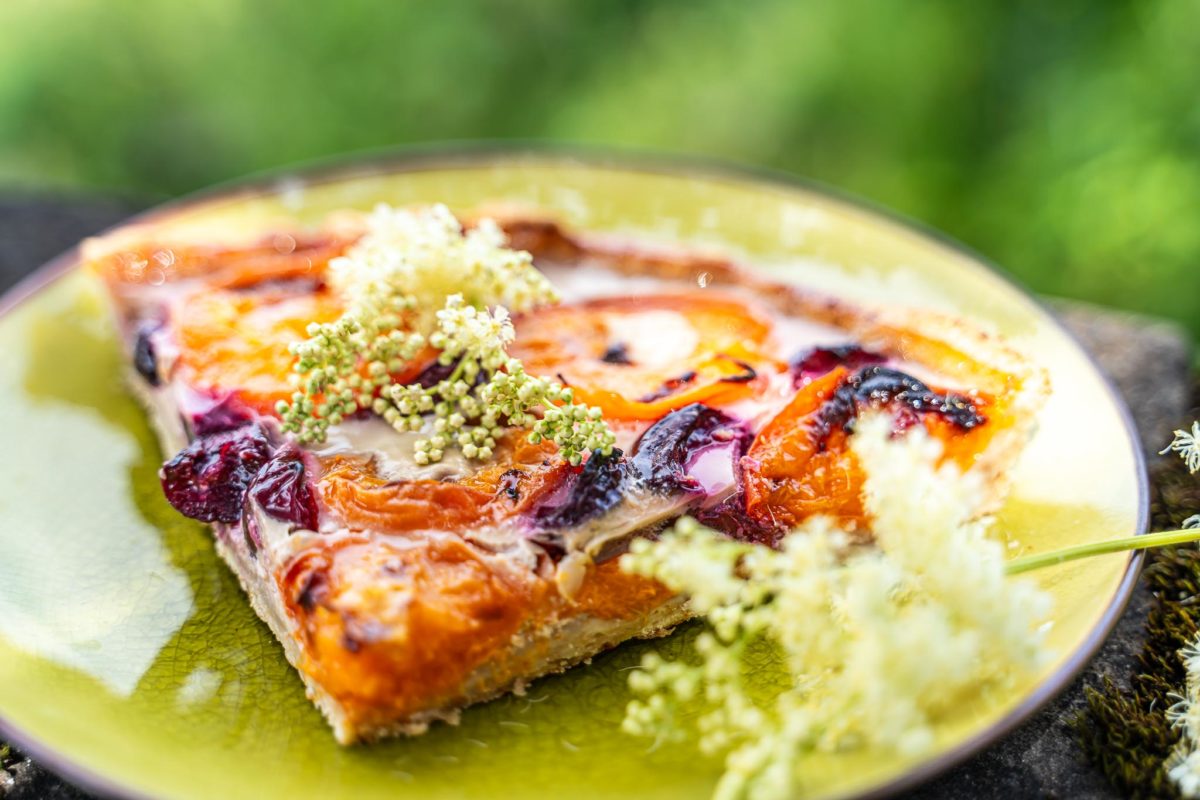

Meadowsweet and seasonal fruit tart
This dessert infused with meadowsweet’s delicate summer flowers and served with seasonal fruit, is sure to win over more than a few people.
Servings 8 people
Ingredients
Sweet shortcrust pastry
- 200 g Plain flour
- 2 tbsp Dried, crumbled meadowsweet flowers
- 1 tsp Salt
- 100 g Butter
- 70 mL Water
Tart
- 10 g Dried meadowsweet flowers About 25 small inflorescences, 3-4cm long
- 700 g Redcurrants (called raisinet in French-speaking Switzerland), cherries, apricots, etc…
- 250 g Single cream or milk
- 1 egg
- 1 tsp Cornflour (Corn starch)
- 50 g Sugar if the fruit is tart; otherwise, 20g is enough
- 1 tsp Lemon juice (optional)
Instructions
Making the pastry
- Mix the salt and meadowsweet flowers into the flour.
- Add the butter in pieces and rub it into the flour with your fingertips.
- Once you’ve rubbed in the butter, add the water and bring the dough together into a ball.
Making the tart
- Preheat the oven to 220 °C. Line a tart tin with the sweet shortcrust pastry and prick the base with a fork. Bake the pastry case for 10 minutes.
- When it comes out of the oven, dust the tart base with flour and sugar.
- In a saucepan, gently heat the cream with the meadowsweet flowers.
- As soon as it is hot (steaming, around 60°C, no higher), turn off the heat, cover with cling film and leave to infuse for 20 min.
- Strain.
- Mix the cooled cream with the cornflour, sugar, egg and lemon juice.
- Arrange the redcurrants or other fruit on the pastry base and pour the filling over them. Bake for 35 to 45 min on the bottom shelf of the oven.



2 comments
✍️ Leave a comment






29 November
Les Pléiades
- Marie Mellioret

Making a Christmas star Sold Out
Lally railway station, car park, Blonay, Switzerland.
04 April
La Sarraz
- Michaël Berthoud

Wild edible and medicinal spring plants in La Sarraz
La Sarraz football pitches car park. Route de Cossonay.
10 April
Les Pléiades
- Michaël Berthoud

Natural incense stick-making workshop
Lally railway station, car park, Blonay, Switzerland.
No events found.
You’re wonderful!!!!
Keep it up, and more besides!!!!
Author
Oh, thank you so much, Antoinette ^^