



Log in
Sweet vernal grass (Anthoxanthum odoratum): an edible and overlooked plant
Michaël Berthoud
/
10 May 2024
Sweet vernal grass is a little grass worth seeking out. Its fragrant hay offers discerning foragers a lovely vanilla scent, both gentle and powerful, that can be used to flavour many dishes.
Sweet vernal grass
Fragrant hay
Scientific name: Anthoxanthum odoratum L.
Family: Poaceae (grasses)
Foraging: fruits from September to November, roots in autumn and winter
Parts used: stem with its leaves and spikes
Habitats: pastures, meadows, fens
Flowering: April to June
⚠️ Precautions: Sweet vernal grass contains coumarins that call for certain precautions. See the notes at the end of the article.
Sweet vernal grass is a wild plant in the Poaceae family: in other words, a grass. It is very common in meadows and pastures. In fact, it is the third most frequently recorded plant on InfoFlora (a Swiss botany centre), occurring in more than 90% of the country (93% of 5 × 5 km grid squares) [1]! This means it can thrive in a wide range of ecological conditions. It is also found across much of the world, from the United States to New Zealand, where it is frequently invasive [10].
Distribution map of sweet vernal grass, Anthoxantum odoratum [10]. The dots do not show exact locations: they are generally placed at the centre of a grid square. The plant may therefore be found anywhere around a dot. This map is useful for seeing the species’ overall distribution.
Despite being so widespread, it remains little known to the general public and among foragers. An online or YouTube search soon proves disappointing for anyone wanting to learn more about this plant and use it.
Sweet vernal grass is a grass, and members of this family are not foraging staples: most have no distinctive flavour and offer little substance. They are also difficult to identify.
Sweet vernal grass is an exception: along with sweet woodruff and melilots, it is one of our three main plants containing coumarin. Coumarin is a molecule that gives foods a delicious vanilla flavour.

How to identify sweet vernal grass
To identify sweet vernal grass, you will need a good field guide, as well as websites such as Infoflora or TelaBotanica. Here are a few tips.
It flowers relatively early in the season, in spring, usually before other grasses, before the grass grows very tall. So don’t wait too long to look for it.

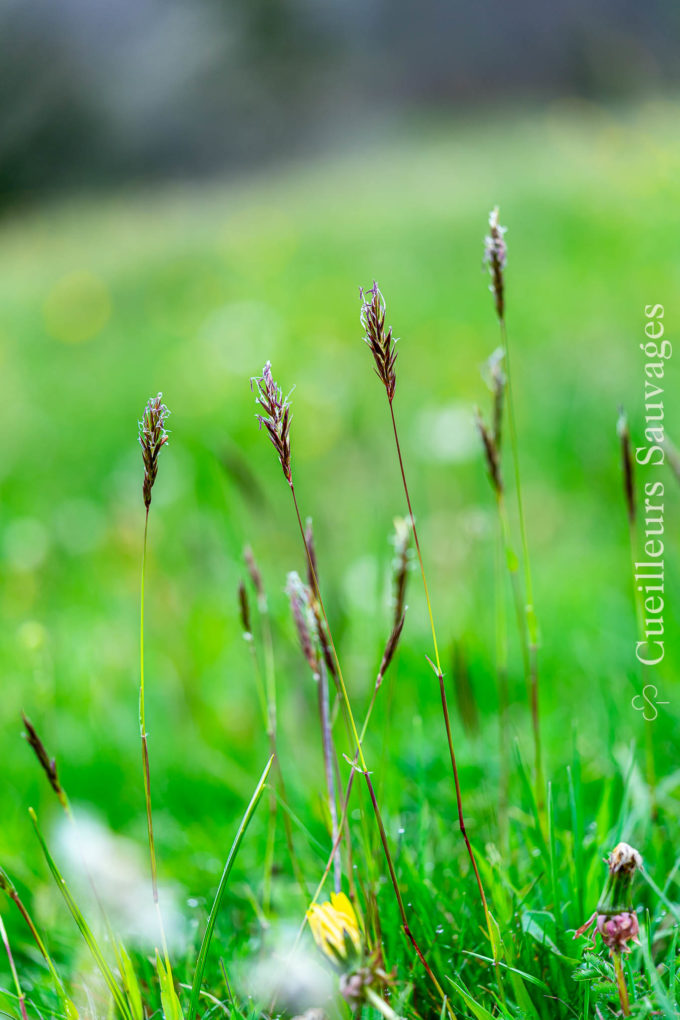
Grasses have flowers arranged in spikelets, often clustered into spikes (spikes of spikelets). In sweet vernal grass, they form a panicle instead, which is essentially a cluster of clusters. Each spikelet sits at the end of a small branch called a pedicel. These are so short that you can barely see them, but they are long enough to give the panicle a bristly appearance.
This inflorescence is less dense than in other grasses and is often tinged with purple. The stamens form little purple, chromosome-shaped satellites orbiting the inflorescence. You will also see small white filaments that add to its tousled appearance. These are the stigmas of the female flowers.
The leaves on the stem are small, measuring 3 to 7 mm across. They have a distinctive feature: a small notch on either side of the leaf blade. At the base of the leaf, the ligule is hairy.
Finally, you’ll notice that its stem is bent and that the bend is usually purple (except when the plant is young).

Similar species
There are a few toxic grasses, such as darnel, Lolium temulentum, which is rare in France and Switzerland, and the more common golden oat-grass, Trisetum flavescens (not cultivated oats). The former has spikes that can reach 30 cm in length [8], while the latter has a panicle that can reach 20 cm [6]. In both cases, the inflorescence is much longer than that of sweet vernal grass, which measures 2 to 8 cm [9].


Cooking with sweet vernal grass
Sweet vernal grass can be gathered from when it first appears in March until June or July, depending on altitude and region. We gather it in spring, before the first mowing or before the livestock arrive. It is so abundant that gathering it is not normally a problem.
That coumarin scent is a delight. Out in the countryside, pick a stem of sweet vernal grass, put it in your mouth and chew it: you’ll taste a delicious vanilla flavour. You can use this plant, like sweet woodruff or melilot, to flavour your dishes or fill them with its fragrance.

You can use the whole plant: stem, leaves and inflorescences, fresh or dried. An easy and effective way to cook with it is in a foil parcel. A handful, roughly chopped so you can remove it afterwards, is enough. Potatoes cooked in foil with sweet vernal grass are a real taste sensation. Likewise, you can flavour or even smoke meat with this delicious fragrant hay, either at the bottom of the pan or directly on the embers.

The smoke it gives off will leave no one indifferent! You can also use it as natural incense, as Indigenous peoples of North America do with sweetgrass.
Finally, you can use it to flavour all sorts of drinks and desserts, just as you would sweet woodruff: May wine, crème brûlée, panna cotta and so on.
Sweet vernal grass, foin d’odeur and herbe à bison: are they the same?
Among the grasses, there is another plant containing coumarin whose name sometimes causes confusion.
Hierochloe odorata, known in French as herbe à bison or foin d’odeur, is a plant found in North America and Eurasia, but further north than Switzerland and France (northern Germany, Scandinavia and Siberia)[2]. It is used to make Żubrówka vodka and as incense by some Indigenous peoples of the Americas.
Toxicity of sweet vernal grass
As with all plants containing coumarins, there is some toxicity. We have written an article with more details on the toxicity of plants containing coumarins.
As with melilot, cases of livestock poisoning have been reported. Under certain circumstances (ensiling and wrapping hay), fungal contamination (Aspergillus) can convert the coumarin in sweet vernal grass and melilot into dicoumarol, an anticoagulant [3]. Most cases occur in the United States and Great Britain, and one case has been reported in Australia, where livestock were fed wrapped hay containing more than 90% sweet vernal grass.
We have found no cases of poisoning in humans, but we will take certain precautions nonetheless (see below).
As for the fresh or properly dried plant, there are reports of possible toxicity from coumarin taken in high doses.
Here are the recommendations:
- Discard any coumarin-containing plant that has turned black during drying: sweet woodruff, melilots, sweet vernal grass, lady's bedstraw, hedge bedstraw…
- Make sure you dry sweet woodruff at a temperature below 50 °C.
- Avoid culinary fermentations involving Aspergillus fungi, such as miso. For example, sweet vernal grass miso should be avoided.
Coumarin-containing plants should be avoided [4, 18, 19]:
- You have circulatory problems or are taking anticoagulants.
- You have liver problems.
- You are pregnant.
As this plant is little used and poorly documented, we recommend consuming it in moderation and avoiding large quantities, particularly in drinks.
The information given here may not be sufficient to identify or use a plant safely. Remember: if in doubt, leave it out! Seek advice from a professional guide, buy good reference books and use photo-based plant identification apps with discernment. We regularly run courses on edible, medicinal and poisonous wild plants.
Références
[1] FloraCH, Le magazine botanique suisse, N°19, Édition spéciale 2024, page 5.
[2] GBIF, Hierochloe odorata (L.) P.Beauv. Consulté le 7 mai 2024.
[3] Jean Bruneton. Pharmacognosie, Phytochimie, Plantes médicinales. 2016. Lavoisier Tec & Doc.
[4] Runciman DJ, Lee AM, Reed KF, Walsh JR. Dicoumarol toxicity in cattle associated with ingestion of silage containing sweet vernal grass (Anthoxanthum odoratum). Aust Vet J. 2002 Jan-Feb;80(1-2):28-32. doi: 10.1111/j.1751-0813.2002.tb12041.x. PMID: 12180874.
[5] B.G Lake, Coumarin Metabolism, Toxicity and Carcinogenicity: Relevance for Human Risk Assessment, Food and Chemical Toxicology, Volume 37, Issue 4, April 1999, Pages 423-453
[6] Trisetum flavescens (L.) P. Beauv., © 2022, Konrad Lauber – Flora Helvetica – Haupt Verlag
[7] Anthoxanthum odoratum, TelaBotanica.
[8] Lolium temulentum L. InfoFlora
[9] Anthoxanthum odoratum aggr. InfoFlora
[10] GBIF, Flouve odorante (Anthoxanthum odoratum L. Consulté le 7 mai 2024.
[11] Photo de Lolium temulentum L. Yoan Martin.









29 November
Les Pléiades
- Marie Mellioret

Making a Christmas star Sold Out
Lally railway station, car park, Blonay, Switzerland.
04 April
La Sarraz
- Michaël Berthoud

Wild edible and medicinal spring plants in La Sarraz
La Sarraz football pitches car park. Route de Cossonay.
10 April
Les Pléiades
- Michaël Berthoud

Natural incense stick-making workshop
Lally railway station, car park, Blonay, Switzerland.
No events found.