



Log in
Masterwort (Peucedanum ostruthium): history, foraging and cooking
Michaël Berthoud
/
8 August 2021
Masterwort is an edible and medicinal plant that grows in the Alps, with a surprising, peppery scent. Recognised and valued during the Renaissance, it is now mainly known in a few mountain valleys and among more adventurous cooks. We take a look at how to forage for it, cook with it and use it medicinally.
Masterwort
Peucedanum ostruthium (InfoFlora, TelaBotanica)Family: Apiaceae
Flowering: June–August
Habitat: Mountains, damp slopes
Altitude: 0-2200 m
Abundance: Locally abundant
Parts used: Roots, leaves, fruits
Uses: Smoking, marinades, wines and liqueurs, desserts…
Medicinal properties: Digestive, beneficial for the respiratory system, anti-inflammatory
⚠️ Precautions: Masterwort contains photosensitising furanocoumarins that can cause side effects (see the toxicity notes).
I remember my first encounter with masterwort in the Vaud Prealps one lovely June very well. I had read its name in various books on medicinal plants. A name like that is hard to forget, and it had intrigued me from the start. I was looking forward to finding it, and I was amazed by its intriguing, surprising scent.
There are few resources or practical guides to this plant, how to forage for it and how to cook with it. You have to seek out the information in books and specialist publications and talk to cooks, who hold it in high regard. Then you have to experiment. There is probably still much to discover, so do share your experiences in the comments!
How to identify masterwort
Masterwort grows on steep, damp slopes in mid-altitude mountain areas and in avalanche gullies. This is a water- and nutrient-rich habitat that phytosociologists, specialists in ‘plant communities’, call tall-herb vegetation. It is characterised by foliage that densely covers the ground and relatively little vertical growth. The plants generally have large leaves, creating a cool, damp microclimate and soils with intense biological activity. The vegetation is therefore luxuriant.
Masterwort is thus a typically Alpine mountain plant. There is no point looking for it in the lowlands. It also grows in the Pyrenees and in northern Europe, including Sweden.
Alongside masterwort, you will find numerous adenostyles, chervils and buttercups, all with broad leaves. The spring flowering is magnificent, with a profusion of pink flowers (alliary-leaved adenostyle, Adenostyles alliariae) and purple ones (alpine blue-sow-thistle, Cicerbita alpina).
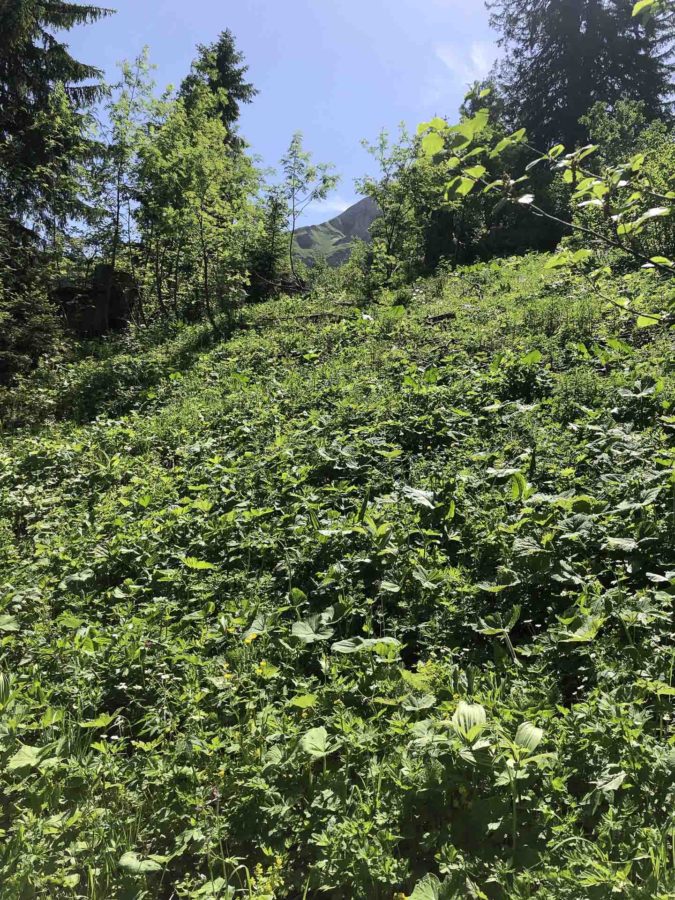
The leaves are divided into three parts, each divided into three again: they therefore have 9 toothed, hairless leaflets. The white flowers are arranged in umbels and umbellets and appear in July and August. Beneath each umbellet, you can see 3 small leaves pointing in the same direction, called ‘bracteoles’ (see the photos below). This is reminiscent of fool's parsley (Aethusa cynapium), which, I can reassure you, does not grow at these altitudes.


To be sure of your identification, there’s nothing like getting your hands in the soil and seeing what the roots look like. The rhizomes are large, fleshy and swollen, and a yellowish sap oozes from them and stains your fingers. After just a few minutes, it dries, oxidises and turns brown.


Possible confusion
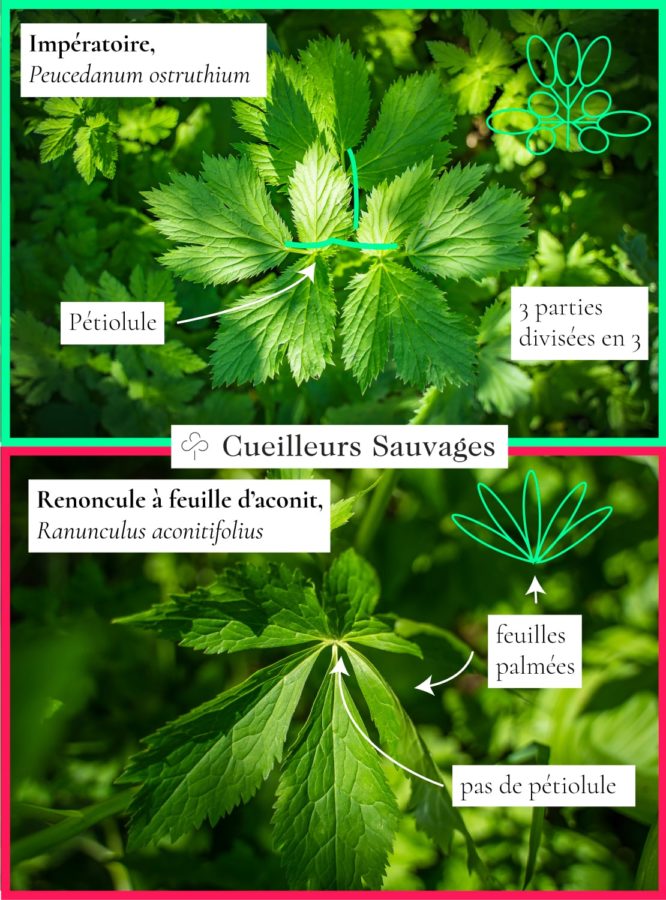
Masterwort can be confused with poisonous plants. As far as I know, this is mainly the case with buttercups such as white-flowered buttercup, Ranunculus platanifolius, which can grow in the same habitat, and aconite-leaved buttercup, Ranunculus aconitifolius. These two buttercups look very similar, so there is not necessarily any need to distinguish between them.
However, take care, because you do need to distinguish them from masterwort. This is easy when they are in flower, as their flowers are not arranged in umbels, but it becomes more difficult before flowering because the leaves look very similar. If you look closely, though, you will notice that the buttercup’s leaflets are joined together, whereas in masterwort a short stalk, called a petiolule, separates the segments.
History and traditional properties of masterwort
According to Fournier, the first definite mention of masterwort may have been by Hildegarde de Binden in the 12th century, under the names Ostrucion and Astrantia [1]. Before that, its history is difficult to trace. Botany was less precise then than it is today, so the exact identity of some species has been lost. Also according to Fournier, Peucedanum comes from the Greek Peuké, meaning ‘pine’, and refers to the resinous smell of its root. Dioscoride, a Greek physician of the 1st century AD, mentions a Peukedanon. It could well be masterwort, but nothing is certain.
In any case, it was long considered a panacea, like angelica, and was even compared to ginseng. The French name Impératoire speaks volumes… Its German name Meisterwurz and English name Masterwort, meaning ‘master root’, also attest to the esteem in which it was held. From the 15th to the 19th century, it was recommended for diabetes, hysteria, fevers, tumours of the spleen and hay fever; powder made from its roots was considered a divine remedy. It was also used for digestive disorders and respiratory ailments. Although native to the Alps, it was commonly planted in lowland gardens.

Outside its natural habitat, masterwort has been forgotten since the Renaissance. Yet its use has continued in some Alpine valleys, such as the Val d’Anniviers. Sabine Brüschweiler shares many fascinating accounts in her thesis on the uses of medicinal plants in this region[2].
We learn that this plant was (and still is) considered sacred, probably because of the benefits it provides. It was very often used for fumigation in cramped mountain chalets, either burned or placed on a soapstone stove. According to tradition and the accounts recorded, the smoke from burning its roots is said to have purifying properties; it was used to cleanse the air during harsh winters.
The fumigation was even used to treat open wounds and urinary tract infections: people sat 2 to 3 times a day over a bucket containing a smouldering root. The leaves were drunk as herbal teas (fresh or dried) for pneumonia and used in baths for bone fractures. Worn as a pendant around the neck, it was used to prevent respiratory diseases.
“Every year, when we butchered the animals, Mum would keep a piece of lard as a remedy. She made poultices. She took some wrapping paper, spread lard on it, grated dried masterwort roots over it and added a little eau de Cologne. She warmed the whole thing a little on the soapstone stove and applied one poultice to the front and one to the back, over the lungs. Then she put unscoured wool over them. It was to stop us getting tuberculosis or pneumonia […] She always kept masterwort roots for when we had a cough.” (Account collected by S. Bruschweiler in the Val d’Anniviers).[2]
Scientific findings
Despite many other accounts like this one, masterwort is hardly used today. The PubMed database returns only 15 results (in 2021), compared with 610 for stinging nettle!
It does, however, contain a few studies suggesting interesting properties. One molecule seems to be of particular interest to researchers: ostruthin. This active compound may have beneficial properties in the treatment of cardiovascular diseases, Alzheimer’s disease and certain bacterial infections[3]. Its anti-inflammatory properties also appear promising[4].
Today, masterwort is mainly recommended for treating digestive problems: cramps, bloating, gas and difficult digestion…
In her master’s thesis on masterwort, Camille Amedea Brioschi compiled a particularly interesting table comparing the plant’s traditional uses with the pharmacological effects studied in modern research [5]. These findings, some of which come from in vitro or animal studies, do not necessarily constitute evidence of effectiveness in humans.
| According to folk medicine | According to modern pharmacological studies |
|---|---|
| Cardiovascular | Cardiovascular |
| Stimulates blood circulation | Effect on vascular smooth muscle cell proliferation; calcium antagonist activity: cardiovascular diseases |
| Dermatological | |
| Promotes wound healing; anti-inflammatory; disinfectant | |
| Tonic | Tonic |
| Strengthens the immune system; diaphoretic | Immunomodulatory and anti-inflammatory activity; antiphlogistic and antipyretic |
| Nervous system | Nervous system |
| Calming; general strengthening; headaches | Treatment of Alzheimer’s disease. Treatment of epilepsy and other neurodegenerative diseases. |
| Gastrointestinal | Other |
| Digestion; heartburn; colic | Antibiotic activity Antifungal activity |
| Ear, nose and throat | |
| Colds; coughs; bronchitis; lung diseases |
Precautions
Masterwort contains furanocoumarins that may cause photosensitivity. People with sensitive skin should therefore take care to wear gloves when harvesting it, to avoid getting the sap on skin exposed to the sun, which could cause burns or itching.
The amounts of coumarins in traditional masterwort drinks may be sufficient to produce biological effects when consumed[6]. We have already observed someone feeling unwell after drinking the liqueur. Consumption should therefore be moderate.
Harvesting masterwort responsibly
As always, follow the principles of sustainable foraging. Harvest only where the plant is abundant; you should be able to leave 80 to 90% of the population in place. Take only what you need. This is particularly important when harvesting roots.
The roots are harvested before or after flowering, so before June or from September onwards. Foraging in spring is easier because the leaves are visible, whereas by autumn they will have disappeared. You then have to rely on the dry stems to identify the plant, which is more difficult because they can easily be confused with those of buttercups. I therefore recommend harvesting in spring to begin with.
The leaves are also harvested before flowering, and the flowers in summer, from June to August depending on the region.

How do you cook with masterwort?
Masterwort has a distinctive flavour, both bitter and peppery, and it’s one of my favourites! But it takes some getting used to, as its bitterness makes it tricky to cook with.
I mainly use the roots. Masterwort can be prepared in the same way as wild angelica, which we’ve already covered. It is traditionally used to flavour certain cheeses, as well as liqueurs and wines. Simply steep a handful of roots in 1 L of alcohol (vodka, wine…) for 1 to 2 weeks. Add sugar to taste, and that’s it. The result will surprise you! If it is too strong (bitter and peppery), you can dilute it with more of the alcohol you used.

Masterwort liqueur
Here’s an easy recipe for masterwort liqueur made with the roots and vodka.
But take care: this drink is ‘potent’ and isn’t for everyone. Listen to your body and drink it in moderation.
You can flavour various desserts with masterwort, such as crème brûlée and ice cream. The secret to avoiding bitterness is to steep a small amount of roots in the milk for just a few minutes (5–6 min). That way, the subtle aroma is extracted, but not the bitterness, which comes out with more heat!
As you’ve gathered, the key is to keep the bitterness down. To do this, you can dry the roots, grind them and place them in the bottom of a saucepan. You can then smoke ingredients such as meat and potatoes, which will cook in the masterwort smoke. The result is surprising and very tasty.


Another technique is to make a marinade by mixing it with salt, then using it to marinate meat. Be sure to rinse the meat with water afterwards to remove any root particles that would make your dish bitter.
You can also use the leaves, which are aromatic but bitter too. They can be cooked as a vegetable or dried and used like the roots.
If you have any recipes, please share them in the comments!
Yvon Roduit, a reader of the blog, shares how he uses it:
We use the leaves to add depth and flavour to our salads. A little leaf added to vegetable soup enhances its flavour in place of lovage. Similarly, a quarter of a leaf will give a long-cooked stew a lovely flavour (preferably beef or game).
The fruits are used in the same way as the roots. Harvesting them has the advantage of not killing the plant, but you will need many more to obtain an equivalent weight.
Find all these recipes in detail in my book, “54 plantes sauvages comestibles de Suisse romande et France Voisine”.
54 edible wild plants
Our book on wild plants, with a foreword by Anne-Sophie Pic, is available in bookshops and online!
Inside, you’ll find plenty of foraging tips and recipes to suit every taste!
Références
- [1] Fournier, Dictionnaire des plantes médicinales et vénéneuses de France, Omnibus, 2010.
- [2] Sabine Brüschweiler, Plantes et Savoirs des Alpes, L’Exemple du Val d’Anniviers, Éditions Monographic, 2008.
- [3] McCardell, Jessica & Héritier, Julien & Simonnet, Xavier & Carlen, Christoph. (2016). Peucedanum ostruthium (L.) Koch: Morphological and phytochemical variability of twelve accessions from the Swiss alpine region. Julius-Kühn-Archiv. 10.5073/jka.2016.453.043.
- [4] Zwirchmayr J, Grienke U, Hummelbrunner S, et al. A Biochemometric Approach for the Identification of In Vitro Anti-Inflammatory Constituents in Masterwort. Biomolecules. 2020;10(5):679. Published 2020 Apr 28. doi:10.3390/biom10050679
- [5] Camille Amedea Brioschi, Botanical and ethnobotanical studies in Peucedanum ostruthium (Apiaceae) from the upper Saastal: Variability of morphology and coumarin components, and use as a medicinal plant, University of Zürich Institute of Systematic and Evolutionary Botany, July 2020
- [6] Vogl, S., Zehl, M., Picker, P., Urban, E., Wawrosch, C., Reznicek, G., … & Kopp, B. (2011). Identification and quantification of coumarins in Peucedanum ostruthium (L.) Koch by HPLC-DAD and HPLC-DAD-MS. Journal of agricultural and food chemistry, 59(9), 4371-4377.



8 comments
✍️ Leave a comment






29 November
Les Pléiades
- Marie Mellioret

Making a Christmas star Sold Out
Lally railway station, car park, Blonay, Switzerland.
04 April
La Sarraz
- Michaël Berthoud

Wild edible and medicinal spring plants in La Sarraz
La Sarraz football pitches car park. Route de Cossonay.
10 April
Les Pléiades
- Michaël Berthoud

Natural incense stick-making workshop
Lally railway station, car park, Blonay, Switzerland.
No events found.
Hello! Thanks for sharing this! I knew of the plant, but only made its ‘official’ acquaintance this year. I knew it could be used as a poultice, but wasn’t very sure whether it was edible. I think it was your article in a magazine that convinced me it was, so I’ve been able to get to know it better..;). Personally, since it grows right on my doorstep, I use the leaves in spring (only the leaves for now, but if I have time, I might dry some seeds to use as a seasoning): a few finely chopped leaves in salads, or cooked with other spring vegetables in quiches,… I also dry the leaves for herbal teas.
Author
Hello Laeticia,
Thank you for your comment and for sharing your experience. How lucky to have it growing right on your doorstep ^^ Aren’t the leaves too bitter in salads?
Best wishes,
Michaël
Hello Michaël, sorry for the delay in replying; I didn’t get a notification of your response. So no, they aren’t too bitter, less so than some others, I find, but they certainly aren’t the only ingredient in the salad or quiche (and I’m used to the taste of greens;)). I sometimes put some on a slice of bread when I’m pottering about outside (very young, light green leaves), often with a leaf of lady’s mantle growing nearby or some chives, and even then it isn’t too bitter. I haven’t had a chance to taste the root yet.
Author
Great, thanks for letting me know! ^^
Michaël
When my husband, now 92, was young, he used to gather roots in the Italian Alps to earn a little money for a herbalist, but he never thought to ask what they were used for… a shame.
Do you have any idea?
Author
Hello Forano,
Thank you for your message. It’s hard to say: it was mainly used for digestive and respiratory problems. But I couldn’t guess what that herbalist used it for… every valley in the Alps had, or still has, its own remedies.
Best wishes,
Michaël
Hello, we use the leaves to add depth and aroma to our salads. A little leaf improves the flavour of a vegetable soup in place of Maggi seasoning. Likewise, a quarter of a leaf will lend a lovely aroma to a meat stew cooked slowly for a long time (preferably beef or game). Those are a few of our culinary experiences. Yvon
Author
Hello Yvon,
Thank you for sharing; that sounds wonderful and makes me want to try it!
Best wishes,
Michaël