



Log in
Norway spruce lemonade: the winter recipe from the “King of the Mountains”
Michaël Berthoud
/
23 January 2026
Winter in the mountains often makes it seem as though nature is asleep and there is nothing left to forage. Yet it is the ideal season to explore conifers, particularly Norway spruce (Picea abies), often called “sapin rouge” in French.
Today, we invite you to make a simple, refreshing forest lemonade inspired by your winter walks. We love conifer-based drinks. We’ve written about them several times before.
How to identify Norway spruce correctly
Norway spruce is the most abundant tree in Switzerland[1] and the fifth or sixth most abundant in France[2], making it easy to find. Before you reach for your secateurs, it is crucial to know how to identify it correctly to avoid confusion, particularly with yew (Taxus baccata), a highly toxic conifer.
Here are the key features for identifying Norway spruce:
- The needles feel prickly to the touch.
- They grow all around the shoot, like a bottle brush.
- They are attached to the shoot by a small projection on the shoot.
- The female cones hang down at maturity.


By contrast, yew has flat, non-prickly needles arranged in a single plane (like a comb), and seeds partly enclosed by a red, fleshy covering called an aril.
If in doubt, follow the forager’s golden rule: leave it alone. You can read our detailed blog article on the risks of confusing fir with yew.

Harvesting with care
Although Norway spruce is abundant, we always make sure to harvest sparingly and with respect for the tree. You’ll only need a few small sprigs for this recipe. Use secateurs to make a clean cut that will heal easily.
In Switzerland, harvesting small quantities of Norway spruce branches is tolerated, provided the tree is not harmed. Be sure to use clean, sharp secateurs.
Why sugar and maceration time matter
For this lemonade, we suggest adding sugar from the start: 20 g per litre. It’s not just for sweetness: in our experience, sweetened water extracts the flavours better.
The sugar would therefore help draw aromatic and mineral substances from the needles into the water, making for a more fragrant drink. Before I realised this, I was convinced that Norway spruce lemonade didn’t work, unlike silver fir lemonade.
But I’d tested the fir with sugar and the Norway spruce without it, which had skewed my judgement!

Each conifer also needs a different maceration time: 2 days for fir, compared with 4 for Norway spruce. Experiment to find the right length of time for the species growing near you!
This lemonade is a ‘living’ drink to be enjoyed on the day it is made, as it does not keep for long. It is not fizzy, because we are not trying to ferment it.
However, the sugar and the small amount of yeast present on the branches could cause it to start fermenting if the maceration lasts too long (more than 4 days). As this fermentation is spontaneous and uncontrolled, the flavour will probably not be pleasant.
For longer-term storage, it would need to undergo controlled fermentation, a process we could cover in a future article if you are interested.

Want to learn more?
If you would like to deepen your knowledge of wild edible plants, we offer in-person courses in Switzerland as well as comprehensive online courses.
Happy foraging, everyone!
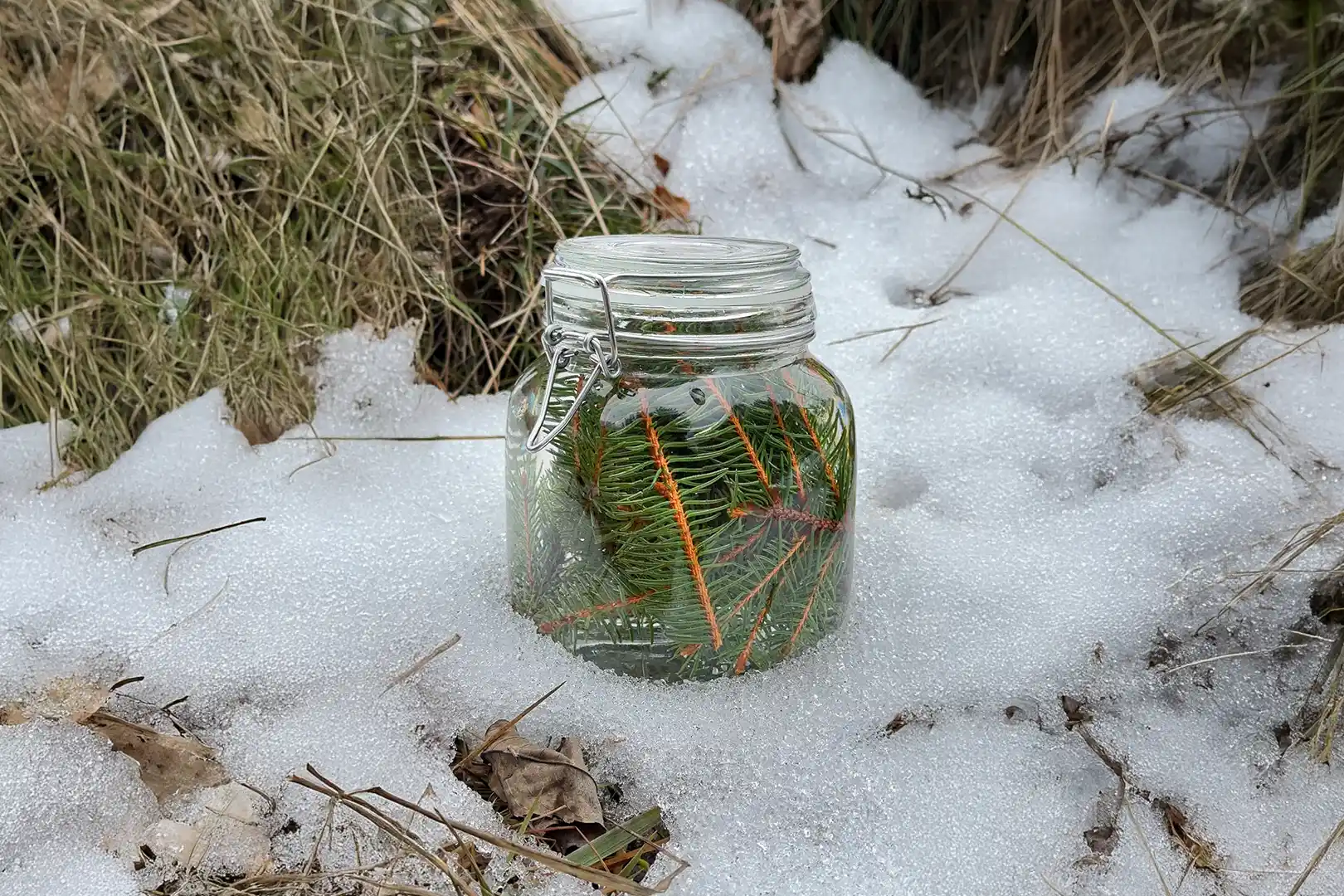
Norway spruce lemonade
This recipe uses a cold infusion. Unlike a traditional infusion, it captures the delicate flavours of the needles without the bitterness that can develop when they are heated.
Servings 1 L
Equipment
- A large 1L jar
Ingredients
- A few freshly cut Norway spruce twigs About 1/2 to 3/4 of the volume of water
- 1 L Water
- 1/4 Lemon for freshness
- 20 g Sugar per litre of water
Instructions
- Fill the jar: place your Norway spruce sprigs in the jar and fill it with water. Add the lemon and sugar.
- Maceration: Leave to macerate at a cool room temperature (or in a cellar) for 4 days.
- To serve: Strain and enjoy.
Notes
If you use other conifers, such as Douglas fir or silver fir, reduce the maceration time, as their flavours infuse more quickly.
Références
[1] WSL, Rapport forestier 2025: Vue d’ensemble de la forêt suisse
[2] Parlement Européen: France: la situation forestière actuelle : aperçu du contexte et appréciation des principales contraintes



6 comments
✍️ Leave a comment






29 November
Les Pléiades
- Marie Mellioret

Making a Christmas star Sold Out
Lally railway station, car park, Blonay, Switzerland.
04 April
La Sarraz
- Michaël Berthoud

Wild edible and medicinal spring plants in La Sarraz
La Sarraz football pitches car park. Route de Cossonay.
10 April
Les Pléiades
- Michaël Berthoud

Natural incense stick-making workshop
Lally railway station, car park, Blonay, Switzerland.
No events found.
To forage responsibly, I take care never to pick the needles at the tips of the branches, because I once read that doing so could hinder the branch’s subsequent growth.
Personally, after trying silver fir and then Norway spruce, I’ve become a devoted fan of Douglas fir. To make it fizzy, I add shop-bought raisins and stop the process when they rise to the surface.
Author
Hello, and thank you for your comment. Yes, you can avoid cutting the side branches; either way, the branch will grow back from one side or the other. But the most important thing is not to cut the leading shoot of a young tree, as this would limit the tree’s overall growth.
Douglas fir maceration really is a must 😋
Thank you for your explanations.
Can you use the tender young shoots, please?
Or do the older ones have more flavour?
Also, for a lemonade, I’d quite like it to be fizzy. 😁
So do I just leave it longer, or do I need to add something?
Thanks in advance for your advice.
Author
My pleasure ^^
Yes, you can use the young shoots! I think they'll have more flavour, but you'd have to compare them ^^
Fermentation is a bit more complicated than that, because there are no yeasts on Norway spruce branches. So you need to add some (kefir, ginger, a starter culture) and use more sugar. Here's one option using a liquid starter culture: https://cueilleurs-sauvages.ch/blog/limonade-fermentee-aux-baies-de-genievre/
Otherwise, ginger lemonades are easy to make because they contain plenty of yeasts.
You say to add the lemon, but could you please clarify whether you mean slices, pieces, with or without the peel, or just the juice?
Thank you, and have a good day.
Author
Any of those will work ^^ I generally use ¼ of a lemon with the peel per litre. But you can also use just the juice if you like.