



Log in
Monkshood, one of Europe’s most toxic plants
Michaël Berthoud
/
30 September 2019
Monkshood is one of those plants that catch the eye. Its large, deep-violet flowers are a striking sight among the Alpine pastures. Grazing animals generally leave it untouched, and with good reason: it is one of Europe’s most toxic plants!
Monkshood
Also known in French as “casque de Jupiter”
Scientific name: Aconitum napellus
Family: Ranunculaceae
Flowering: June to August, sometimes later depending on altitude
Habitat: meadows, pastures
Altitude: 1 500 to 3 000 m in Alpine pastures; it is also found lower down
Toxicity: all parts of the plant are highly toxic.
Botany
How to recognise monkshood
Fortunately, this plant is easy to recognise when it is in flower. Its leaves are palmate, dark green and divided into fairly narrow, wavy segments.
It is mainly the flowers that make it recognisable, even from a distance. They are a very deep violet and shaped like a Roman helmet. If you look at a flower from the side, you will see that its uppermost part forms the helmet. The flowers later produce follicles, small dry fruits that open along one side to release their seeds. These are pointed and have a rather devilish appearance that does not make you want to eat them.
The name “monkshood” covers several subspecies that look alike and share these general characteristics [1].


Habitat
This is a mountain plant found particularly in the Western Alps. It grows in alpine pastures with soils rich in organic matter, at altitudes of 1,500 to 3,000 m, but also lower down, in damp meadows. The InfoFlora map shows many records in the Swiss Alps [1]. In France, the records shown on the Tela Botanica map below are more scattered [2].


Toxicity of monkshood
Monkshood belongs to the Ranunculaceae family, many members of which are toxic. To learn more about toxic plants, read our article on 12 toxic wild plants to know.
It is one of the most toxic plants in our European flora: 2 to 4 g of root may be enough to cause death [3]. This is an approximate range, not a threshold below which there is no danger. The leaves can also cause fatal poisoning [4].
The plant contains several toxic substances, including aconitine, which disrupts electrical signals in the nerves and heart. After ingestion, tingling may be felt around the mouth, then in the hands and feet. Nausea or vomiting may occur. The main danger is that the heart may beat so irregularly that it can no longer circulate blood [5].
In Switzerland, if you think you have swallowed monkshood, call Tox Info Suisse immediately on 145, even if you have no symptoms. Do not induce vomiting. If the person loses consciousness or is not breathing normally, call 144 [6].
Monkshood or molopospermum: how can you tell them apart?
It is therefore a plant worth knowing, even though it is easy to identify when in flower. There is a risk of confusing monkshood with molopospermum (Molopospermum peloponnesiacum). It belongs to the Apiaceae family, and its young shoots are traditionally eaten in the Pyrenees [4].
The two plants look most alike at harvest time: their leaves are deeply divided and neither has flowered yet. In June 2018, in the Pyrénées-Orientales, a hiker thought he had picked molopospermum leaves. He had in fact eaten monkshood leaves. The first symptoms appeared within an hour, and he died from the poisoning [4].
On a fully opened leaf, look at where the main divisions of the leaf begin, rather than how finely cut they are at their tips:
| What to look for | Molopospermum | Monkshood |
|---|---|---|
| The whole leaf | The leaves are pinnate: an axis runs through the leaf from base to tip. The divisions branch off either side of this axis at different points and divide again. The leaf looks like a large fern frond. | At the end of the leaf stalk, five to seven main divisions fan out from the same point. Each then divides into narrow segments. This is called a palmate leaf. |
| The flowers, later in the season | Numerous small, pale flowers are grouped in umbels: their stalks radiate from a single point, like the ribs of an umbrella. | The flowers, usually blue-violet, are arranged in a cluster along the stem. Each has a hood. |
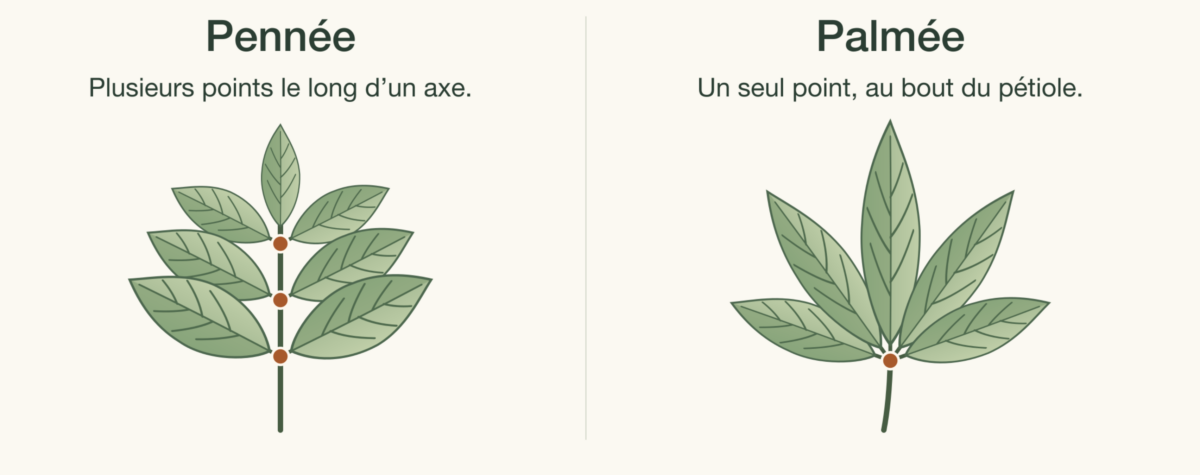
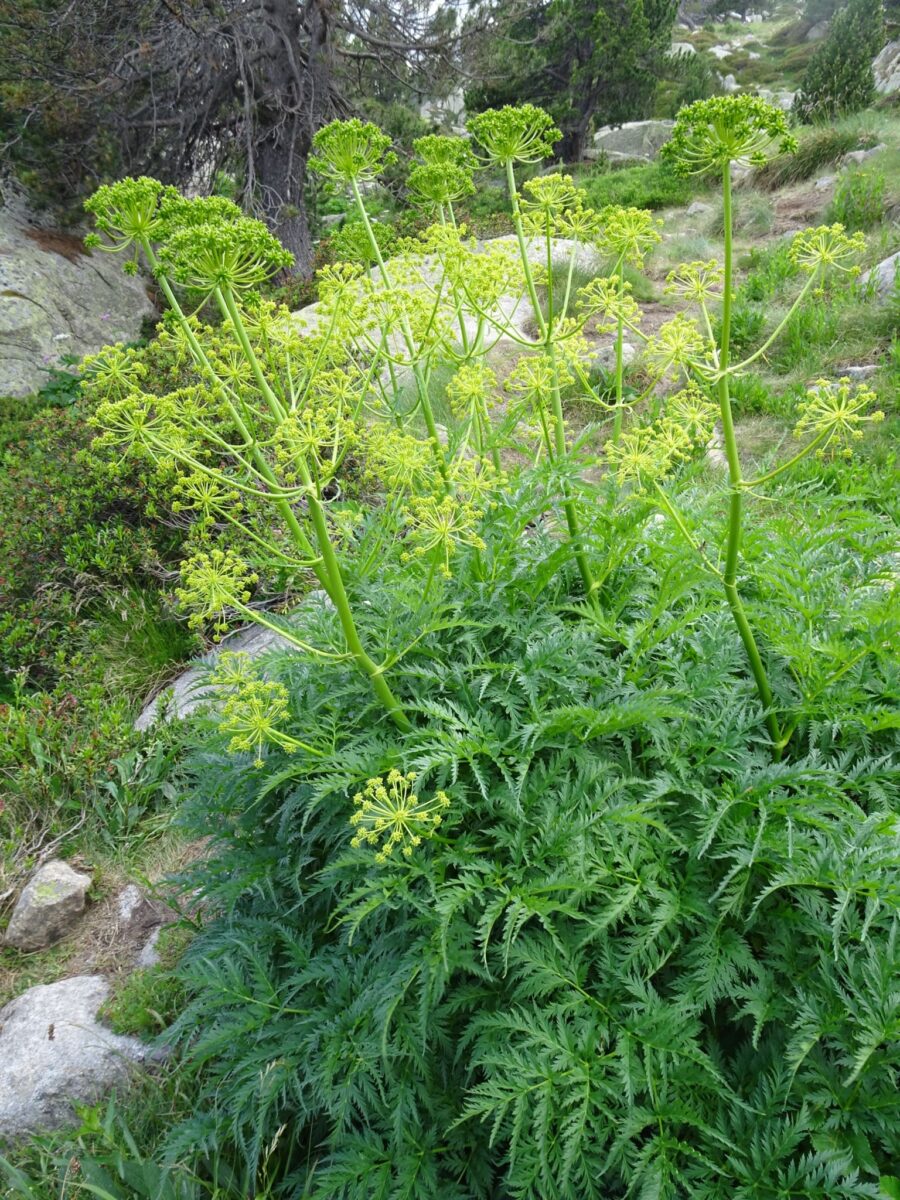

The InfoFlora photos allow you to compare monkshood leaves and flowers with those of molopospermum [1] [7]. If the leaves are still folded and you cannot see how they divide, leave the shoots where they are. Come back when the plants are flowering to learn to recognise them both. Never taste a shoot to settle a doubt.
A historical case: horseradish with roast meat
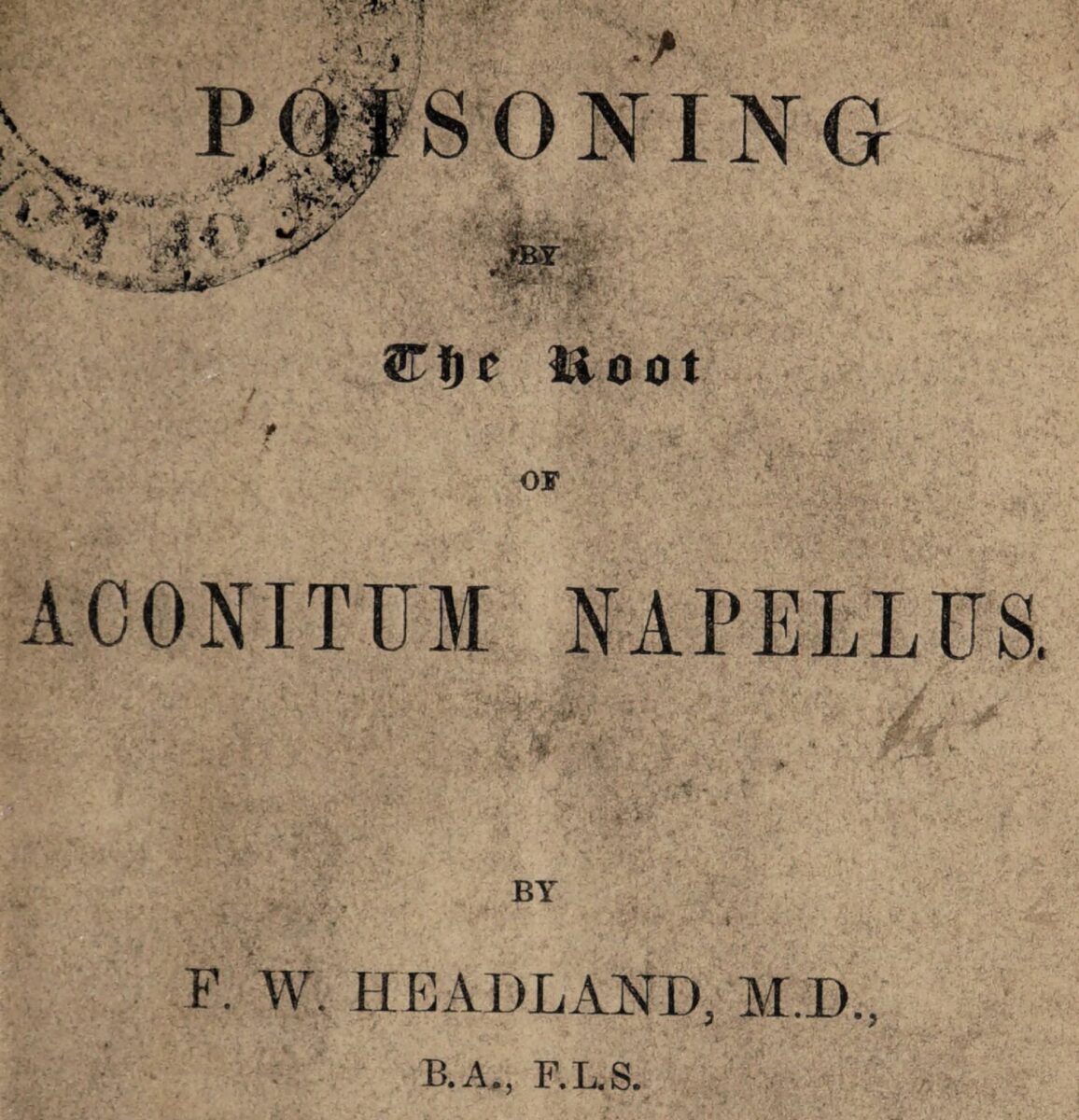
In 1856, in Dingwall, Scotland, three diners died after a meal. Monkshood root had been mistaken for horseradish, which was grated to accompany roast meat. A few weeks later, the British physician Frederick William Headland presented the incident to the Medical Society of London. He brought specimens and drawings of both roots so that his colleagues could compare them [8].
Historical medicinal uses of monkshood
And, as is often said, the dose makes the poison. In the past, this plant was used in highly diluted tinctures. In the 19th century, doctors prescribed it particularly for neuralgia, pain that follows the course of a nerve. Monkshood preparations were also applied to the skin for sciatica and rheumatic pain. The dose used to relieve pain was very close to the dose that causes poisoning. These are historical uses: do not make a tincture or a rub from the plant [9].
Today, monkshood is also used in homeopathy. The French Pharmacopoeia describes how the mother tincture is prepared and tested [10]. This monograph concerns the quality of the preparation; it does not demonstrate its effectiveness against pain.
Should we be afraid of it?
As with all highly toxic plants, you simply need to know how to recognise them so you no longer need to fear them!
If you would like to learn to recognise plants before picking them, we offer an online course on foraging for wild plants. Using eight edible plants, we show you in videos which details to look for on the leaves and flowers, then how to check your identification using a flora. One chapter is devoted to the risks of foraging, particularly poisonous plants.
Références
[1] InfoFlora. Aconitum napellus. Flora Helvetica, 2018.
[2] Tela Botanica. Carte de répartition de l’aconit napel en France, reproduite dans cet article.
[3] Université Grenoble Alpes, sous la direction de V. Danel. Aconit : fiche toxicologique, 2019.
[4] Anses. Confusion entre plantes comestibles et toxiques : gare aux ressemblances !, Vigil’Anses, n° 8, juin 2019.
[5] Tuinema R. M. et coll. Intoxicatie met blauwe monnikskap (Aconitum napellus). Nederlands Tijdschrift voor Geneeskunde, 2009, 153:A387.
[6] Tox Info Suisse. Premiers secours en cas d’intoxication.
[7] InfoFlora. Molopospermum peloponnesiacum. Flora Helvetica, 2018.
[8] Headland F. W. On Poisoning by the Root of Aconitum Napellus, 1856. Exemplaire numérisé par la Wellcome Collection.
[9] Programme international sur la sécurité des substances chimiques (IPCS). Aconitum napellus spp., Poisons Information Monograph 007, révision de 1994.
[10] Pharmacopée française. Aconit napel pour préparations homéopathiques, 2009.



2 comments
✍️ Leave a comment






29 November
Les Pléiades
- Marie Mellioret

Making a Christmas star Sold Out
Lally railway station, car park, Blonay, Switzerland.
04 April
La Sarraz
- Michaël Berthoud

Wild edible and medicinal spring plants in La Sarraz
La Sarraz football pitches car park. Route de Cossonay.
10 April
Les Pléiades
- Michaël Berthoud

Natural incense stick-making workshop
Lally railway station, car park, Blonay, Switzerland.
No events found.
A well-known herbalist in Toulouse wrote that this plant was very useful for lowering urea levels in people of a fuller build.
Author
Hello Jean-Claude,
Monkshood is used in homoeopathy, like many other poisonous plants. Perhaps that is the use he was referring to? Although it was used in its unprocessed form in the past, monkshood must never be used without a medical prescription, as it is extremely dangerous.
Best wishes,
Michaël