



Log in
Harvesting and using meadowsweet (Filipendula ulmaria)
Michaël Berthoud
/
19 July 2022
Meadowsweet is one of our favourite wild edible plants. We use it in all sorts of ways throughout the year. Here, we share our experience.
Meadowsweet (also known in French as ulmaire or fausse spirée)
Filipendula ulmaria (InfoFlora, TelaBotanica)Family Rosaceae
Flowering July–August
Habitat Wet meadows, ditches, edges of marshes
Altitude 0–1700 m
Abundance Locally abundant
Parts used Leaves and flowers
Uses Flavours drinks and desserts
Botany
Meadowsweet belongs to the Rosaceae family. This is a large botanical family that also includes many edible fruit trees: hawthorn, blackthorn, pear, apple…
Where can you find meadowsweet?
Meadowsweet is easy to find. It is common throughout Switzerland and France, apart from the south of France. In fact, it is abundant across almost all of Eurasia and has been introduced to the United States of America [2].

However, you need to look in the right places, as it indicates particular soil conditions. It grows only in areas with fluctuating moisture levels. You will generally find it on clay soils that hold water like a sponge, at the edges of marshes, in hollows, damp meadows and depressions… So don’t look for it among rocks.
It also needs light. It tolerates partial shade well, but not the darkness of woodland undergrowth.

How to identify meadowsweet
If you are not familiar with it yet, the easiest thing is to wait until July or August, when it flowers. Its flowers are clustered in corymbs that look like fluffy tufts or little white clouds. Because it grows in colonies, it is easy to spot from a distance.
Here are the main features to look for. Read through them all and see if you can spot them in the pictures.
Leaves
- Compound leaves with 2–5 pairs of doubly toothed leaflets
- Small leaflets between the larger ones
- Leaf rachis and stem often purple
- Larger terminal leaflet, usually divided into three, like a maple leaf
Flowers
- Flowers clustered in corymbs with branches of unequal length, resembling little white clouds or fluffy tufts
- Five small, off-white petals, 3–5 mm long
- Nectar-rich and fragrant
Fruits
- Spiral-shaped fruits


Possible confusion
There is little risk of confusing it with another plant, and doing so is harmless. It is most likely to be mistaken for other edible plants in the same family with compound leaves, small leaflets between the larger ones and a larger terminal leaflet, such as common agrimony, Agrimonia eupatoria, and water avens, Geum rivale. Once it is in flower, it will be difficult to mistake it for either.
Uses
Harvesting meadowsweet responsibly
The most commonly used parts are the flowers, harvested between June and September depending on the region. You still need to keep an eye on them and not wait too long. Harvest them when half are in white bud and the other half are open, as in the photo above. If you wait longer, part of the inflorescence will already have flowered and you will lose some of your harvest.
You can also harvest the leaves before flowering. In this case, use the midrib after removing the green parts.
Finally, the roots, though very rarely used, are aromatic if harvested in autumn. They have a scent reminiscent of cloves. They can be used to make sauce bases and stocks…
It is an abundant perennial, so you can harvest a generous amount without reducing its population. As always, take only 10-20 % and make sure there is no sign that you have been there.

Cooking with meadowsweet
Cooking with meadowsweet is easy! First, you can use it fresh or dried. The taste and smell differ slightly because salicylic acid forms during drying, but both are excellent!
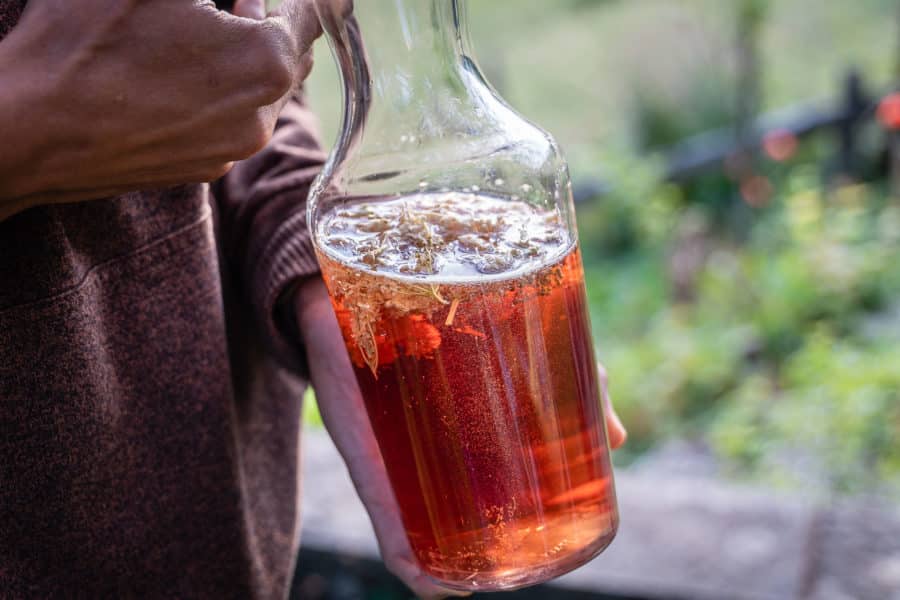
It is mainly used as an infusion or a cold infusion; the resulting liquid can then be used to flavour a drink or dessert. You can also use it as a powder mixed into flour, for example.
The important thing is not to heat it above 60 °C, so that it does not lose its medicinal properties, which would be a shame!
Here are a few ideas:
- Tarts
- Crèmes brûlées
- Panna cottas
- Ice creams
- Cakes
- Herbal tea
- Wines
- Lemonades
- Kefir
Discover the meadowsweet recipes we have published so far

Crispy apple roses flavoured with rose hip and meadowsweet syrup
These crispy apple roses, delicately flavoured with rose hip and meadowsweet syrup, are as beautiful as they are delicious.

Meadowsweet anti-wrinkle herbal tea recipe
Meadowsweet is an excellent plant for making homemade cosmetics, such as this anti-wrinkle treatment.

Raw meadowsweet chocolate
Here’s a recipe for meadowsweet chocolate that will delight chocolate lovers

If you would like to learn more about cooking with meadowsweet, our online course on foraging for wild edible plants includes a 30-minute lesson on this plant and 20 delicious recipes!






Medicinal properties

Meadowsweet has long been used in medicine. In the classic works I have consulted, I have mainly found references to its diuretic and draining properties, but its properties go well beyond these, and many have been scientifically validated.
It is best known for its salicylic acid content, but it contains a whole host of other active compounds. This molecule, also found in willow, was acetylated in 1893 by a Swiss chemist at Bayer and then synthesised industrially, giving rise to a well-known medicine: aspirin!
The letter a stands for acetyl and spir for spiral, a nod to the shape of the plant’s fruit. I find it remarkable that such a common plant can have such an important place in the history of medicine…
Here are its recognised properties, as described in Dr Lorrain’s excellent book[1] :
Diuretic, anti-inflammatory and analgesic
- It is used to relieve joint pain (arthritis, gout) and to promote drainage (cellulite, obesity).
Astringent
- It is used to wash wounds thanks to its cleansing properties, and also as an antidiarrhoeal.
Immunomodulatory, antibacterial and fever-reducing
- A useful plant for winter illnesses: respiratory illnesses, flu and colds; active against Staphylococcus aureus and E. coli
Antioxidant and cytoprotective
- It scavenges free radicals
- It may be useful in certain cancers
- It can be used to limit the side effects of chemotherapy
Contraindications
Because it contains salicylates and increases uterine tone, meadowsweet is not recommended for children with a fever, children under 12, or pregnant and breastfeeding women[1].
What about you?
We’d love to know: does meadowsweet grow near you, and what are your favourite recipes using it?

54 edible wild plants
Our book on wild plants, with a foreword by Anne-Sophie Pic, is available in bookshops and online!
Inside, you’ll find plenty of foraging tips and recipes to suit every taste!
Références
[1] Lorrain, Éric. Grand Manuel de phytothérapie. Dunod, 2019.
[2] Carte de répartition de Filipendula ulmaria, GBIF, 2020-2025



6 comments
✍️ Leave a comment






29 November
Les Pléiades
- Marie Mellioret

Making a Christmas star Sold Out
Lally railway station, car park, Blonay, Switzerland.
04 April
La Sarraz
- Michaël Berthoud

Wild edible and medicinal spring plants in La Sarraz
La Sarraz football pitches car park. Route de Cossonay.
10 April
Les Pléiades
- Michaël Berthoud

Natural incense stick-making workshop
Lally railway station, car park, Blonay, Switzerland.
No events found.
Hello
Thank you for this article. I can’t wait to discover this plant with its many benefits. Thank you for your advice and your very thorough articles.
Happy foraging 🌾🌼🌸🌻🌿🌱
Author
Thank you, we hope you make some lovely discoveries ^^
I planted one in my garden and, to my great surprise, it took and seems to be thriving. I make sure to keep the soil moist and cool. I don’t know, though, whether it will spread on its own…
Author
Hello Carine,
If it’s happy there and you give it room, there’s a good chance it will spread!
Best wishes,
Michaël
Thank you for your article. But which part of the plant can be used: the leaves, flowers or roots?
Author
Hello Régine,
Good question. You're right, it wasn't even clearly stated 😅. Almost every part can be used. We've updated the article in the ‘Uses’ section.