



Log in
Floral caraway shortbread biscuits«
Michaël Berthoud
/
14 August 2024
This summer, we’ve been inspired by the seasonal flowers and plants around us, especially caraway, which we’ve used in treats for our summer drinks, like these delicious caraway biscuits. There’s nothing like a creative burst of colour and flavour to brighten up the holidays.
Caraway is a fantastic plant because every part is edible, from the root to its little fruits, though the latter are the most commonly used. It’s a fairly inconspicuous member of the Apiaceae, typical of hay meadows and pastures, most often found in the mountains, where it can grow at altitudes of up to 2000 m.
Identifying and foraging for caraway
Among the Apiaceae, caraway is relatively easy to recognise once you know the cross trick. We explained it in our article on identifying caraway. This trick helps distinguish it from hemlock and fool’s parsley, as well as from most other members of the Apiaceae, whether toxic or edible. Caraway fruits also smell similar to cumin, but smell alone is not enough to identify them with certainty.
Although I’ve personally never seen caraway growing among toxic plants (as they have different ecological requirements), it’s still useful to know these distinguishing features.

Don’t take it all!
For harvesting, choose a meadow or pasture where caraway is abundant. Generally, you can start harvesting in early summer, depending on the region, and continue in July and August at higher altitudes.
Caraway is generally a biennial plant; it isn’t perennial. Harvesting too much can quickly cause its population to decline. We learnt this the hard way near our home: we took too much from a pasture, and the caraway population declined. After noticing this, we sowed ¾ of our harvest to ‘return’ the seeds we’d taken in excess. We’ve only just done this, so we don’t yet know whether it will work.
We thought it worth sharing this experience with you, as it shows that the principles of responsible foraging, such as ‘take no more than 10–30%’, are useful and even essential.


Caraway is not threatened in Switzerland, and it’s abundant in the surrounding pastures, so there’s no cause for concern.
Although it isn’t protected in France either, it is threatened and endangered in some regions: Midi-Pyrénées, Picardie, Bourgogne, Champagne-Ardenne… It’s best to check the Status tab on the INPN website to see whether this applies near you and avoid harvesting it if necessary. We explain in detail how to carry out these checks in our forthcoming online course, which will be available soon!
Creative workshop: decorating our caraway biscuits
To make your caraway biscuits more festive, have fun decorating them with all kinds of flowers, on your own or with your children. Once you’ve picked your flowers, keep them in water until you’re ready to use them. You can remove the stems and put the flowers in a small dish of water, as shown in the video.
Let your creativity run free and make little floral works of art ^^


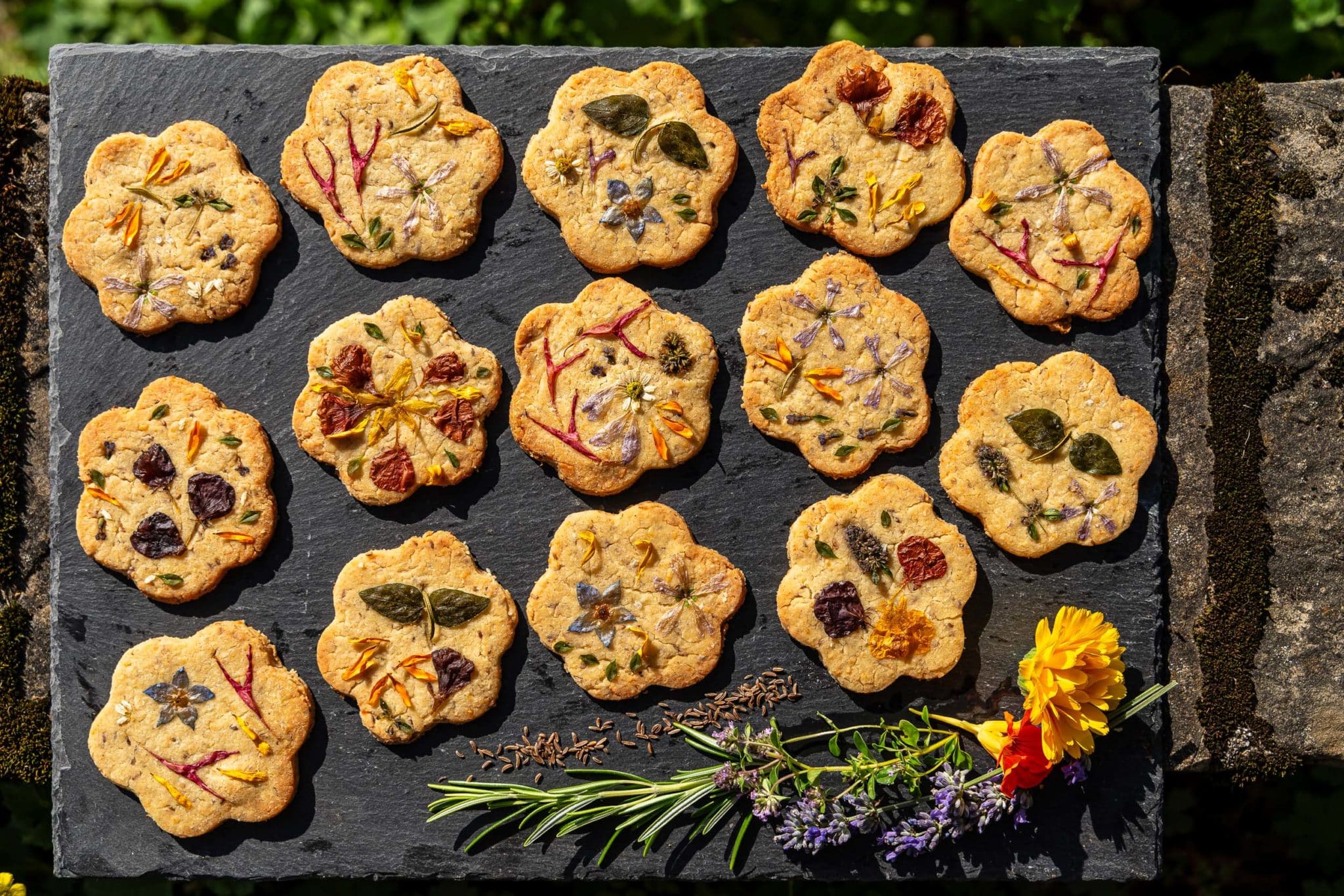
Floral caraway seed savoury biscuits
Equipment
- 1 Blender or mortar
- Cookie cutters
Ingredients
Ingredients for 15 savoury biscuits
- 180 g of white flour
- 70 g of butter
- 45 g of olive oil
- 1/2 tsp Salt
- 50 g of finely grated Parmesan or Gruyère
- 1 egg
- 1 tbsp of dried caraway seeds
- fleur de sel thyme, rosemary, edible flowers (marigolds, thyme, rosemary, oregano, fennel, chamomile, lavender, mallow, nasturtiums, bee balm, pot marigold…)
Instructions
- Gather the caraway seeds, dry them and grind them with a pestle and mortar or in a blender.
- Put the grated cheese, salt, caraway, butter, olive oil and egg in a bowl and mix well until creamy.
- Add the flour and mix until combined.
- Chill the dough for 30 min and, meanwhile, go and gather some edible flowers for decoration.
- Preheat the oven to 200°C.
- Roll out the dough to about 5 mm thick. You can make any shapes you like; just keep the biscuits fairly thin.When you gather up the scraps of dough to cut out more shapes with the cookie cutter, make sure you press them firmly into a ball with your hands to bring the dough back together before rolling it out again. Otherwise, the biscuits may crumble.
- Sprinkle with fleur de sel, herbs and flowers, using baking parchment to press them into the dough. Let your creativity run wild!
- Bake for 13–15 min in the middle of an oven preheated to 200°C (fan-assisted oven: 180°C). They should be golden.
- Leave to cool on a wire rack, and don’t touch them until they are cold.Then enjoy them with an aperitif!
Notes
Do not use a different flour, or the biscuits may crumble.









29 November
Les Pléiades
- Marie Mellioret

Making a Christmas star Sold Out
Lally railway station, car park, Blonay, Switzerland.
04 April
La Sarraz
- Michaël Berthoud

Wild edible and medicinal spring plants in La Sarraz
La Sarraz football pitches car park. Route de Cossonay.
10 April
Les Pléiades
- Michaël Berthoud

Natural incense stick-making workshop
Lally railway station, car park, Blonay, Switzerland.
No events found.