



Log in
Caraway: foraging and uses
Michaël Berthoud
/
5 August 2019
A small member of the Apiaceae found in mountain meadows, caraway (Carum carvi) has nothing to envy in spices from faraway countries. This plant is every bit as interesting in the kitchen as cumin, whose French name it also bears. It is also very abundant in the Alps… Discover how to recognise it!
Caraway
French name: cumin des prés
Scientific name Carum carvi
Family Apiaceae (formerly Umbelliferae)
Flowering May–August
Habitat Meadows, pastures
Altitude Up to 2200 m
Abundance Locally abundant
Parts used Roots, leaves and fruits
Fruit harvest July–August
How to recognise caraway
Caraway, Carum carvi, is a white-flowered plant in the Apiaceae family (formerly Umbelliferae). Within this family, it is one of the plants with finely divided leaves. The leaves are described as two to three times pinnate. The segments are slender and taper to a point (acuminate). The leaves remain fairly small, around twenty centimetres long, and easily blend in with the surrounding vegetation. It is therefore an inconspicuous plant, somewhat easier to find when it is flowering or fruiting.

Its stem is cylindrical and marked with fine grooves. It turns reddish during and after flowering, which can help you recognise it among the surrounding grasses, which are generally taller.
The fruits resemble fennel fruits but are more rounded. They are green at first, then turn brown as they dry.


The cross-shaped clue
There is a useful clue for distinguishing it from other members of the Apiaceae, including poisonous ones. If you look at the small divisions on either side of the main axis, you will see a small tuft of leaves forming a forked cross. This little tuft is characteristic of caraway and helps distinguish it from most other members of the Apiaceae, whether poisonous or edible.

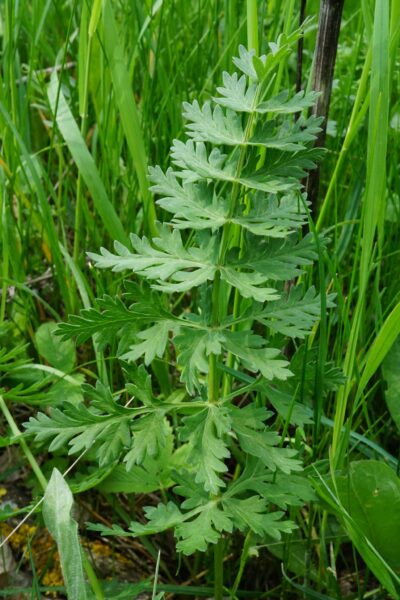
Moon carrot (Seseli libanotis) also has a small tuft in the same place. This member of the Apiaceae also has a small cross where the leaf segments join the rachis. Its leaves are broader, however, with a slightly glaucous underside. When flowering, it can be distinguished by its umbels with numerous rays (20 to 40) and many bracts, whereas caraway umbels generally have no bracts [8, 10].
Moon carrot grows in dry, sunny places, mainly on calcareous soils. In Switzerland, it is found in the Jura, the Prealps and the Alps, among other places [8]. In France, it is found in the Jura, the Alps, the Pyrenees, the Massif Central and the Vosges, among other places [9]. It particularly favours rocky grassland and dry woodland edges, unlike caraway, which grows mainly in meadows and pastures [8, 10].
Where to find caraway in Switzerland and France
Infoflora tells us that caraway is common and not protected in Switzerland. Look closely at the map: notice that it is less widespread on the Swiss Plateau. It is abundant at mid-altitudes, in pastures and fertile meadows where livestock have enriched the soil with organic matter over the centuries.

In France, it is found mainly in the east of the country. It is almost absent from the Atlantic and Mediterranean coasts. It is not protected (except in overseas territories), but it is nevertheless threatened and endangered in some regions (Midi-Pyrénées, Picardie, Bourgogne, Champagne-Ardenne…). It is best to check the INPN’s Status tab to see whether this applies near you and avoid harvesting it if so. We explain how to carry out these checks in detail in our online course.

Possible confusion
According to Couplan (Guide Delachaux des plantes comestibles et toxiques), it can be confused with spignel, Meum athamanticum. However, spignel is very rare in Switzerland. In France, it is found mainly in the Massif Central.
Beginners may confuse caraway with yarrow, whose leaves are also finely divided. There is no danger, as yarrow is edible too. Its leaves are more elongated and no more than 3.5 cm wide, whereas caraway leaves are more triangular.
As for the risk of confusing it with hemlocks, some of which are very dangerous, this seems low to us because they grow in different habitats. In any case, the tuft of hairs provides a way to tell them apart, since hemlocks do not have it (see image below).
I have personally never seen caraway growing next to another deadly poisonous member of the Apiaceae. That does not mean it cannot happen, but the risk seems limited to me.
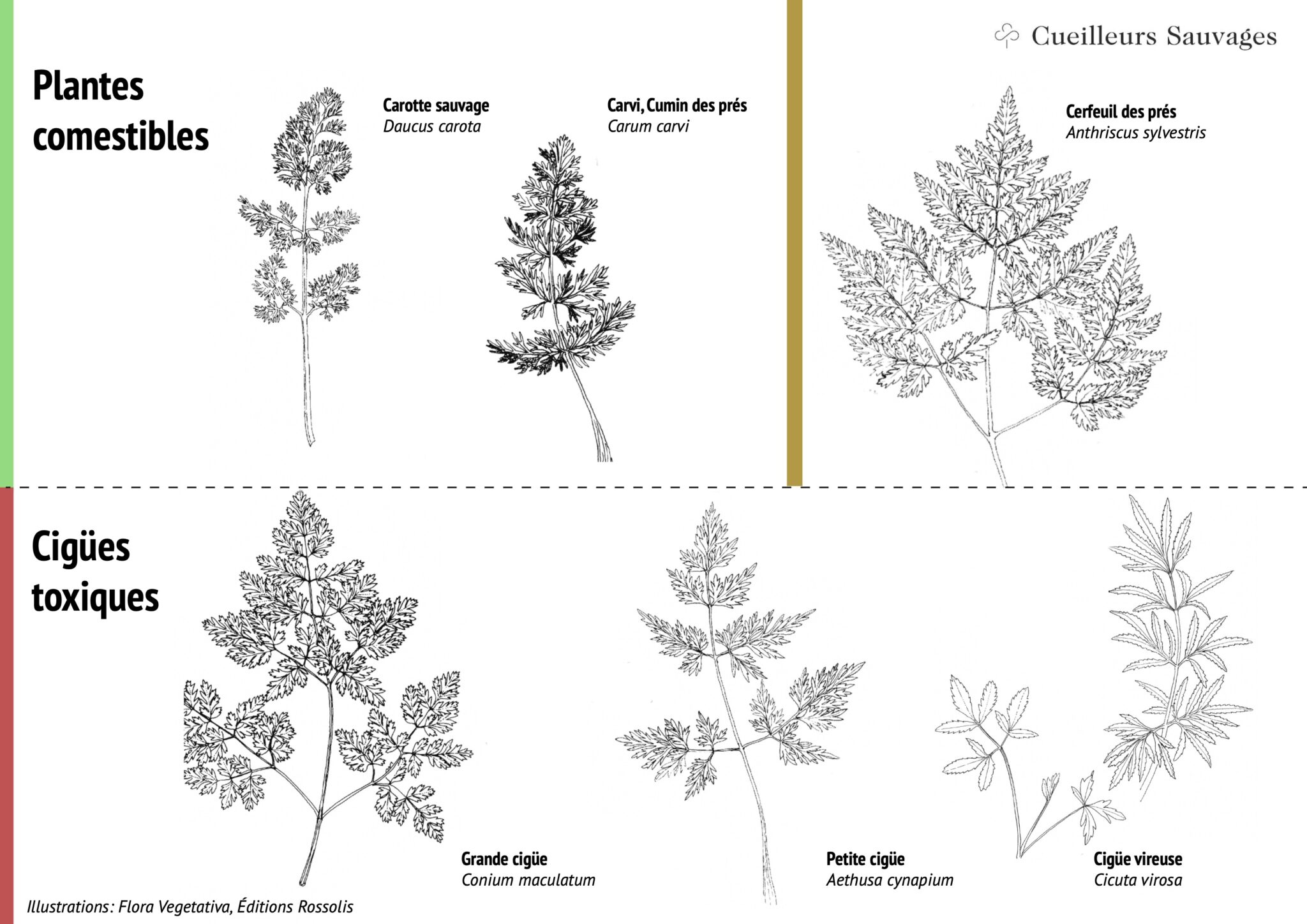
Identifying caraway in the field
The information I share here comes from my experience, which I pass on in the field during courses on wild edible and medicinal plants. If you’re unsure or would like to improve your skills, come along: I run courses regularly.

Harvesting and cooking with caraway
Its fruits are the part most commonly used. They are intensely aromatic and reminiscent of cumin, which you almost certainly have in your kitchen. So why not give caraway a try?
You can harvest the fruits while they are still green, when they have a slight citrus flavour as well, or wait until they are dry for a flavour closer to cumin.
Harvesting begins in July and continues until August, depending on the region and altitude. Don’t forget the rules of sustainable foraging: do not harvest more than 1/4 of a plant population.
But don’t wait too long, because cows love it! It’s surely one of the secrets behind the incomparable flavour of Alpine cheeses.
You can use these fruits in the same way as cumin, as a seasoning in stews, for example, or in this delicious shortbread recipe:
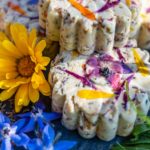
Caraway butter with edible flowers
Add a floral, fragrant touch to your table with this caraway butter decorated with edible flowers. Perfect alongside a meal or as an unusual appetiser, it combines herbal and floral flavours for a result that is as delicious as it is visually appealing.

The roots and leaves are edible too. The roots can be eaten in the same way as wild carrot, and the leaves as a vegetable. I must admit I haven’t used either of them yet.

Medicinal properties of caraway
According to Fournier, it was already known to some prehistoric peoples in Europe, but was unknown to the first great figures of herbal medicine (Dioscoride, Pline, etc.). It reappeared in the Middle Ages, though without becoming a particularly important medicinal plant. It was used for digestive complaints, flatulence, diarrhoea, loss of appetite and fevers [1]. In traditional Iranian medicine, it was also used for epilepsy [2].
More recent studies have revealed antimicrobial, antidiabetic, diuretic, anti-ulcerogenic, lipid-lowering and kidney-protective properties [3, 4, 5, 6].
Carum carvi is also being studied for its bioenhancing properties, meaning it is used to increase the effectiveness of other plants or medicines [7].
The information given here may not be sufficient to identify or use a plant safely. Remember: if in doubt, leave it out! Seek advice from a professional guide, buy good reference books and use photo-based plant identification apps with discernment. We regularly run courses on edible, medicinal and poisonous wild plants.

Références
[1] Fournier, Dictionnaire des plantes médicinales et vénéneuses de France
[2] Mirheidar H. Carum carvi. Application of Plants in Prevention and Treatment of Illnesses. Tehran: Office of Islamic Culture Publications; 1992.
[3] Antibacterial activity of Cuminum cyminum L. and Carum carvi L. essential oils. Iacobellis NS, Lo Cantore P, Capasso F, Senatore FJ Agric Food Chem. 2005 Jan 12; 53(1):57-61.
[4] Caraway and caper: potential anti-hyperglycaemic plants in diabetic rats. Eddouks M, Lemhadri A, Michel JBJ Ethnopharmacol. 2004 Sep; 94(1):143-8.[5] Diuretic activity of the aqueous extracts of Carum carvi and Tanacetum vulgare in normal rats.Lahlou S, Tahraoui A, Israili Z, Lyoussi BJ Ethnopharmacol. 2007 Apr 4; 110(3):458-63.
[6] The reno-protective effect of aqueous extract of Carum carvi (black zeera) seeds in streptozotocin induced diabetic nephropathy in rodents. Sadiq S, Nagi AH, Shahzad M, Zia ASaudi J Kidney Dis Transpl. 2010 Nov; 21(6):1058-65.
[7] Effect of Carum carvi, a herbal bioenhancer on pharmacokinetics of antitubercular drugs: A study in healthy human volunteers. Choudhary N, Khajuria V, Gillani ZH, Tandon VR, Arora E. Perspect Clin Res. 2014 Apr;5(2):80-4. doi: 10.4103/2229-3485.128027
[8] InfoFlora — Seseli libanotis : description et répartition suisse
[9] Conservatoire botanique de Bourgogne-Franche-Comté — répartition française
[10] Open Flora — comparaison morphologique avec Carum carvi









29 November
Les Pléiades
- Marie Mellioret

Making a Christmas star Sold Out
Lally railway station, car park, Blonay, Switzerland.
04 April
La Sarraz
- Michaël Berthoud

Wild edible and medicinal spring plants in La Sarraz
La Sarraz football pitches car park. Route de Cossonay.
10 April
Les Pléiades
- Michaël Berthoud

Natural incense stick-making workshop
Lally railway station, car park, Blonay, Switzerland.
No events found.