



Log in
Infusion “Ricola” for sore throats
Michaël Berthoud
/
11 November 2023
To help you through winter gently, we’re sharing a recipe for a soothing winter infusion for the chest, inspired by the famous Ricola sweet.
A few days ago, I developed a slight cough. Nothing serious, but still bothersome, especially at night. Unable to sleep, I rummaged through my cupboards for something to bring me relief and soothe my throat, and realised that, even though it was November, I hadn’t yet prepared for winter. In the end, a simple Ricola herbal sweet calmed my cough and helped me through the night.
That made me think it would be interesting to look at which medicinal plants it contains and make a winter infusion with them.
I should point out that this article isn’t sponsored: it simply comes from a personal interest.
After looking at the yellow sweet’s website, I discovered that it’s made from 13 plants and that I already had some of them. But I was missing others I’d never used, such as heath speedwell and burnet-saxifrage. I was eager to discover them, and a visit to my local herbalist’s shop allowed me to buy them. Although some of my supplies are wild-foraged, you can find all 13 plants at a herbalist’s shop or pharmacy.
So let’s look at the 13 plants in the Ricola blend and their properties. As they have many properties, I’ll mention only those I think are useful for coughs and during winter.

The 13 plants in Ricola sweets for sore throats
Yarrow, Achillea millefolium

Yarrow is best known for its haemostatic properties – its ability to stop bleeding – particularly in some menstrual problems such as heavy periods.
It isn’t a plant particularly known for treating coughs, at least from what I’ve found. For our purposes, I think it will mainly be its antispasmodic, antiseptic and diaphoretic properties that will be useful in our blend.
Part used: flowers.
Common lady's mantle, Alchemilla vulgaris
This is another plant used for women's health (menopause and painful periods). Like yarrow, it is not particularly well known for sore throats, but has recognised anti-inflammatory, antispasmodic, antiviral and antimicrobial properties.
Burnet-saxifrage, Pimpinella saxifraga
Ricola's website is not very clear, as it refers to “pimprenelle, Pimpinella saxifraga”. In French, however, “pimprenelle” generally refers to plants of the genus Sanguisorba, which belong to a different family. So, to avoid confusion, I will call it “petit boucage” (burnet-saxifrage).
Burnet-saxifrage is not a particularly well-known or widely used medicinal plant, it seems to me. There are very few scientific studies on it (8 on PubMed), none of them on its use in herbal medicine. There is a study of its antibacterial properties, but it concerns cheese preservation!
So we will turn instead to folk medicine. Abbé Kunzle was already mentioning it as a remedy for hoarseness in the 18th century. It is also said to be antispasmodic, beneficial for the chest, tonic and fever-reducing.
Part used: roots.
Marsh-mallow, Althaea officinalis

Here is an excellent medicinal plant for winter: it is one of the richest in mucilage and therefore one of the most soothing. Its roots or flowers will give our blend properties that soothe inflamed mucous membranes.
If you use the roots, be sure to grind them before adding them to the blend for better extraction (since you would normally make a decoction), and shake the blend well before use, as the roots will settle at the bottom of the jar. For simplicity, you can use the flowers.
Parts used: root or flowers.
White horehound, Marrubium vulgare

White horehound has been renowned since antiquity for treating coughs thanks to its expectorant properties. It therefore helps clear mucus from the airways in cases of chesty coughs.
But be warned: it is a very bitter plant! So use a small amount (a quarter less than the other plants), ideally with sugar. Without sugar, you will still taste it. As some people in our household cannot stand bitterness at all, we simply leave it out of the blend and replace it with fir buds.
Part used: leaves
Common mallow, Malva sylvestris
Mallows, like marsh-mallow (they belong to the Malvaceae), are also classic winter herbs; they are very soothing. What’s more, their beautiful violet flowers give herbal teas a gorgeous blue colour.
You can use other wild mallow species instead.
Part used: flowers.

Peppermint, Mentha x piperita
Known as a digestive aid, peppermint has antispasmodic and antiseptic properties, making it useful for coughs and for our Ricola infusion. It also adds a pleasant freshness to the blend. To achieve the same effect as the sweet, you will need to use four times as much as the other plants.
Parts used: leaves and flowers.

Plantain lanceolate, Plantago lanceolata
It is one of the most interesting medicinal herbs, as it is both very common and useful. plantain has anti-inflammatory, antiseptic and soothing properties, making it a well-known ally in winter. It may help soothe an irritated throat.
Part used: leaves.
Cowslip, Primula veris
Cowslip has expectorant and antispasmodic properties. It is frequently added to herbal tea blends for the chest. The roots or flowers are used.
Be careful if you use the roots: they smell pleasant, but they are bitter! We add them in small quantities (four times less than the other plants) and only if we sweeten the mixture. To avoid the bitterness, you can use the flowers, which have a very mild flavour.
You can also use other wild primroses instead, such as the common primrose.
Parts used: roots or flowers.
Common sage, Salvia officinalis
Anyone with a hoarse throat will be familiar with sage. Astringent and antiseptic on the mucous membranes, it is used for colds, coughs, flu and so on. It is also a tonic that helps restore the body's energy and warm it up.
Part used: leaves.
Common elder, Sambucus nigra

The two parts of common elder most often used in herbal medicine are the flowers and berries; in our Ricola infusion, it is the flowers that are used.
Their high mucilage content gives them soothing properties, and they are also diaphoretic. Common elder is traditionally used for coughs and fever.
Part used: flowers.
Common thyme, Thymus officinalis
Thyme has many properties that are useful in a winter infusion. It’s a firm favourite, and we always keep a large jar of it to see us through the winter. Thyme is antiseptic, expectorant and cough-suppressing, and has a very pleasant flavour too. It’s a tonic herb that can be mildly stimulating, depending on the dose.
You can replace it with wild thyme, which has the same properties, though they seem to be less pronounced.
Part used: leaves.
Heath speedwell, Veronica officinalis

Heath speedwell is an unassuming little plant found in woods and meadows. It is an expectorant plant with antibacterial properties. Speedwells have received little scientific study so far (PubMed lists just 19 studies in total…), but they are traditionally used to treat coughs.
Parts used: leaves and flowers.
Upcoming courses on medicinal plants
30 May
Les Pléiades
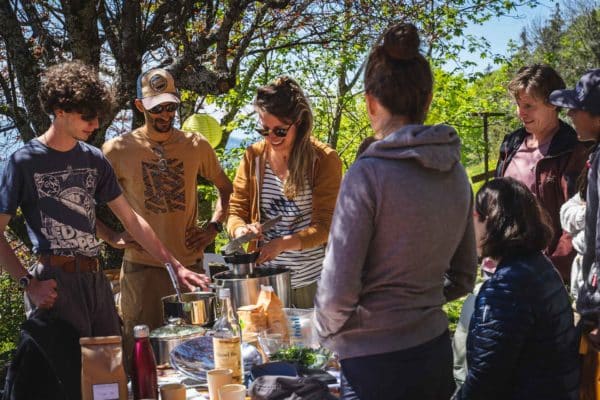
Medicinal plants: botanical walk and workshop on infused oils, salves and syrups
Lally railway station, car park, Blonay, Switzerland.
19 September
Les Pléiades
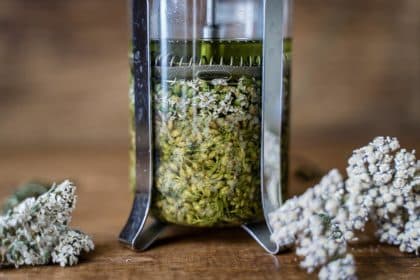
Medicinal plants: workshop on mother tinctures, oxymels, sweets and decoctions
Lally railway station, car park, Blonay, Switzerland.
No events found.
Medicinal properties of the Ricola blend
Having looked into all these plants, we find a gentle blend of properties relevant to winter illnesses:
- Expectorant: to help bring up mucus
- Soothing: for dry coughs
- Antibacterial / antiviral: for infections
- Cough-suppressing / antispasmodic: to reduce the cough reflex
- Sudorific / diaphoretic: to help combat fever
The Ricola blend therefore seems to cover a bit of everything. Thirteen plants is a lot for an infusion blend. This herbal tea will therefore have a more general effect than a specific one.
I haven’t yet had the chance to try it on a proper cough, so its effectiveness still needs to be confirmed. For now, we drink it at home as a preventive infusion a few times a week, and we’re delighted with it. Sweetened with honey, it tastes very much like the original sweet, but it’s delicious without sugar too.

Making the Ricola winter blend
The idea was to create an infusion blend with the properties of the sweet, but also its flavour! To start with, I mixed equal parts of each plant to see how it turned out. It was interesting, but a strong bitterness spoiled it.
After several unsuccessful attempts, I taste the plants I didn’t know individually. That’s what I should have done from the start, but I’m impatient by nature ^^. I realise that primrose root and white horehound are very bitter, so I need to use less of them. The blend also lacks freshness, so I’ll need to increase the amount of mint.
Using a quarter as much white horehound and primrose root, and three to four times as much mint as the other plants, we get something close to the original Ricola! But we still need to add honey, otherwise the bitterness comes through…
Since we drink our herbal teas without sweetener, we leave out the primrose root and white horehound altogether. Next spring, I’ll gather primrose flowers instead of roots. As for the white horehound, we replace it with fir buds, whose infusion is also very good for winter.
This time, we’ve got it. We like our blend, and we have a big jar of it to see us through the winter! By the way, if you haven’t read it yet, discover 4 tips for getting the most out of an infusion.
Of course, you don’t have to use all these plants… If that seems like too much, use this recipe as a starting point for discovering them gradually.

Infusion Ricola for sore throats
Inspired by the famous Ricola sweet, this recipe for a soothing winter infusion to ease coughs will help you through the colder months. infusion.
Servings 1 Jar
Equipment
- 1 half-litre jar
- 1 mixing bowl
- (1 precision scale)
Ingredients
- 2 g Yarrow, Achillea millefolium
- 2 g Lady's mantle, Alchemilla vulgaris
- 2 g Burnet-saxifrage, Pimpinella saxifraga
- 2 g Marsh-mallow, Althaea officinalis Ground roots or flowers
- 2 g Mallow, Malva sylvestris Flower
- 6 g Mint, Mentha x piperita Leaves
- 2 g Plantain, Plantago lanceolata
- 2 g Primrose, Primula veris flowers or 0.5g of roots (bitter!)
- 2 g Silver fir as a replacement for bitter white horehound
- 2 g Sage, Salvia officinalis
- 2 g Common elder, Sambucus nigra Flowers
- 2 g Thyme, Thymus officinalis
- 2 g Speedwell, Veronica officinalis
Instructions
- Weigh each plant using a precision scale. If you don’t have one, measure by volume with a tablespoon (where it says 2 g, use 1 tablespoon). Volume is not exactly equivalent to weight, but the result should be much the same.
- Combine all the herbs in a mixing bowl and stir well.
- Store the mixture in a large half-litre jar.
- Heat water to 80°C (just below boiling).
- Infuse 1 tbsp of the mixture per cup (or 6 g/L) for 10–15 minutes.
Références
- Dr Claudine Lui, 250 remèdes naturels à faire soi-même, Terre Vivante.
- Dr Eric Lorrain, Grand manuel de phytothérapie, Dunod.
- Dictionnaire des plantes médicinales et vénéneuses de France, Fournier, Omnibus.
- A modern Herbal, Volume II, Grieve, Edition Dover.
- Donald G. Barceloux, Medical Toxicology of Natural Substances : Foods, Fungi, Medicinal Herbs, Plants, and Venomous Animals, John Wiley & Sons, 2008, p. 421
- Bernard Boullard, Plantes médicinales du monde : croyances et réalités, De Boeck Secundair, 2001 (ISBN 9782843711176), p. 8
- Mocan A, Vodnar DC, Vlase L, Crișan O, Gheldiu AM, Crișan G. Phytochemical Characterization of Veronica officinalis L., V. teucrium L. and V. orchidea Crantz from Romania and Their Antioxidant and Antimicrobial Properties. Int J Mol Sci. 2015 Sep 3;16(9):21109-27. doi: 10.3390/ijms160921109. PMID: 26404257; PMCID: PMC4613244.
- Pubmed, Recherche sur la véronique officinale. Page consultée le 10.11.23.









29 November
Les Pléiades
- Marie Mellioret

Making a Christmas star Sold Out
Lally railway station, car park, Blonay, Switzerland.
04 April
La Sarraz
- Michaël Berthoud

Wild edible and medicinal spring plants in La Sarraz
La Sarraz football pitches car park. Route de Cossonay.
10 April
Les Pléiades
- Michaël Berthoud

Natural incense stick-making workshop
Lally railway station, car park, Blonay, Switzerland.
No events found.