



Log in
The surprising arrival of poison hemlock in our garden
Michaël Berthoud
/
18 September 2025
Poison hemlock, a highly toxic plant that is rare in Switzerland, has turned up somewhere unexpected: our garden. Follow this botanical adventure to discover how it arrived here and which apps can recognise it.
Table of contents
An unexpected encounter after years of searching
Last spring, as I was observing the plants growing spontaneously in our garden, a small member of the Apiaceae caught my eye. Its finely divided leaves, characteristic of some plants in this family, immediately piqued my curiosity. But this discovery seemed unlikely: I had been searching for this species for years.
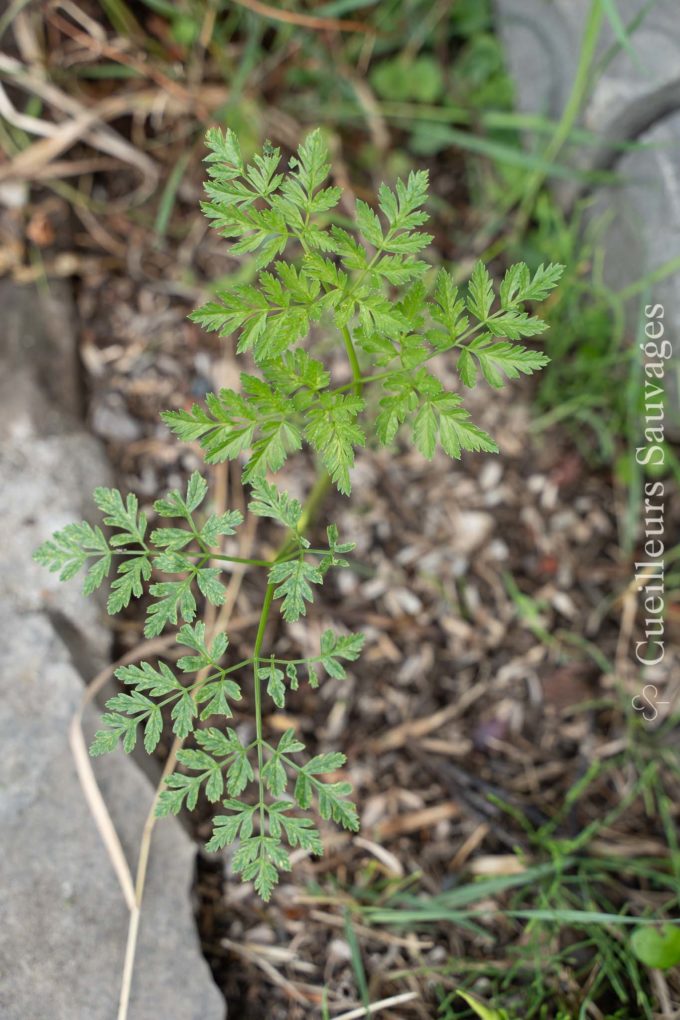
For me, an environmentalist who has taught about wild plants for nine years, this encounter with poison hemlock (Conium maculatum) marks the end of a long search. This plant has particular importance when teaching about dangerous toxic species that people need to know, and its history adds another dimension: used for executions in ancient Greece and Rome, it remains notorious for causing the death of Socrates.
A botanical challenge in the canton of Vaud
My many botanical surveys, carried out with the help of experienced botanists, had proved fruitless. We explored previously known sites without ever finding this species.
This difficulty is due to its rarity in the region: in the canton of Vaud, where I live, poison hemlock is rare and even has protected status [4]. Seeing two plants within a few weeks was therefore remarkable after 18 years of fieldwork.
One of these sightings, at a sorting centre, shows just how rare it is: there had been no record in this botanical grid square since 1966!
The mysterious arrival of poison hemlock at altitude
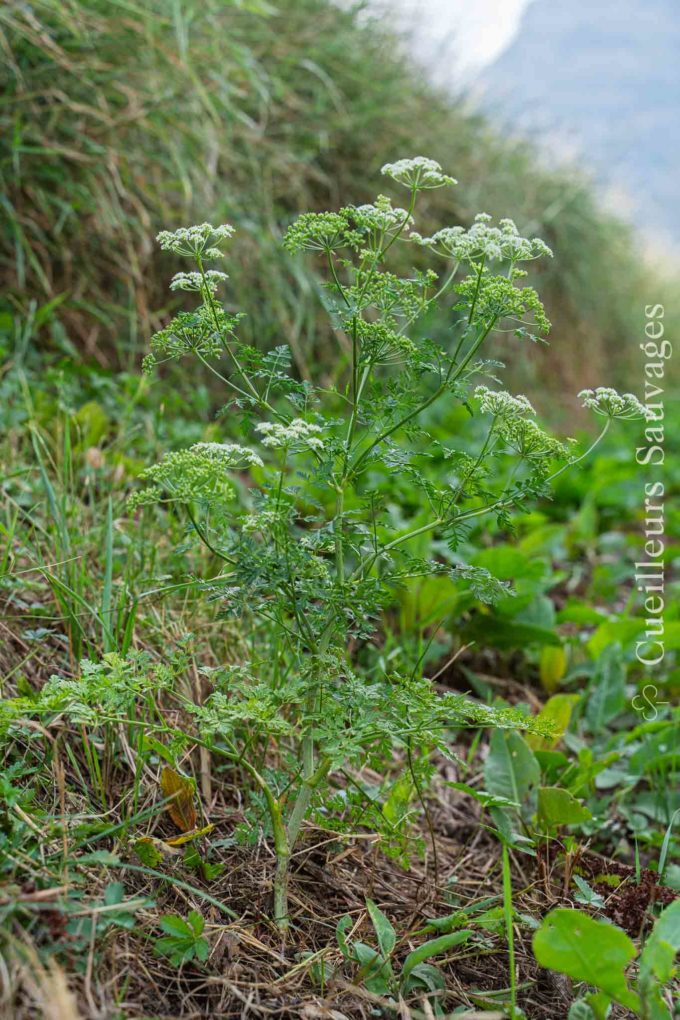
How could this heat-loving plant, adapted to warm lowland climates, have become established in our garden at an altitude of 1200 metres? Several microclimatic factors explain how it took hold:
- Optimal south-facing exposure
- A microclimate equivalent to that at 1000 metres above sea level
- A dry-stone wall that stores heat
- A position against the walls that maximises warmth
How it got here brings another surprise: the seedling grew beneath our bird feeder! This location strongly suggests that the seeds were inadvertently introduced in the birdseed mixes.
This observation illustrates the unpredictable ways species can be introduced into our gardens.

Testing four plant identification apps
Faced with this young seedling, I carried out a comparative test of four plant identification apps. Identifying members of the Apiaceae at this stage remains tricky, even for experienced botanists. Could the apps do better?
Here are the ones we tested:
- Pl@antNet
- Flora Incognita
- Seek
- Florapp
The results varied considerably between apps. Each gave a different result, and only one identified it correctly: Conium maculatum, with a 98% probability.
Plant identification apps and foraging
To be used safely when foraging, the apps need to meet specific requirements:
- Reliable identification of toxic species
- No dangerous misidentifications: identifying a toxic plant as edible is a serious problem.
This test reveals worrying shortcomings, including an incorrect identification as wild chervil (Anthriscus sylvestris), a commonly eaten species. To learn how to use these apps safely, our online course covers everything you need to know about foraging, the correct use of mobile apps and online flora maps.

Flora Incognita: an impressive performance
Flora Incognita stood out for its accuracy in this difficult identification, which is quite impressive. It was the only app able to recognise poison hemlock from a young leaf that was still small (image below), and with high probability. What’s more, I deliberately used a poor-quality photograph, and the leaf was damaged:


This app therefore has several advantages:
- Greater accuracy in our experience: subjectively, I often find it very reliable
- Integration of information on uses and toxicity from the Plants for a Future database
- Information on symptoms and what to do in the event of poisoning
Although Flora Incognita got it right this time, there is no guarantee it will do so next time. This experience highlights the importance of using several apps alongside one another to make identifications safer.
Confirming the identification by observing the plant
An identification made by an app must always be confirmed by observing the plant’s botanical characteristics. Once the plant had developed, I was able to check the reliable distinguishing features and confirm that Flora Incognita had identified it correctly.
We discuss these distinguishing features in detail in our dedicated article on identifying hemlocks.
Here are the four essential features for identifying Conium maculatum more safely at the young-leaf stage, before flowers or fruits appear:
- Distinct purple blotches: present on the petioles and main stem, with clearly defined edges and no gradual shading
- Waxy bloom and glaucous colour: a waxy coating to the touch and a pale bluish-green colour
- Completely hairless surface: no hairs at all on any of the vegetative parts
- Round, hollow petioles: a perfectly round, hollow cross-section, with no groove


The combination of these four characteristics helps with identification. Recognising the plant early is very useful, as foraging generally focuses on young, tender plants.
Toxicity and health precautions
Poison hemlock is extremely toxic. Its piperidine alkaloids, particularly coniine, make it highly dangerous: according to the sources, as little as 0.5 to 6 g could be fatal[3]. Concentrations vary between parts of the plant, with green fruits having the highest levels[1].
Poisoning causes progressive paralysis of the respiratory muscles, which can lead to death by asphyxiation [1].
Preventive measures
- Avoid all direct contact with the plant
- Do not handle it without protective equipment
- Never ingest it, even in tiny amounts
- Avoid touching mucous membranes after handling it
If poisoning is suspected, contact your regional poison control service immediately.
What you think
Our 2023 survey of 150 subscribers shows a high level of awareness of the risk:
- 99% know the species
- 80% express concerns about this plant
- 68% refrain from gathering certain species as a precaution
The plants people are most concerned about confusing with poison hemlock are:
- Wild chervil
- Wild carrot
- Caraway
This caution is entirely justified, as all these species belong to the Apiaceae and have finely divided leaves.
Important update on wild chervil
Recent evidence calls into question the safety of Anthriscus sylvestris leaves. Contrary to traditional information, the aerial parts contain the same toxic compounds as the roots, in varying but significant concentrations. We therefore recommend great caution when consuming this species. We are preparing a comprehensive article on the subject.
Geographical distribution and field surveys
To find out whether it grows near you, the easiest way is to consult plant distribution databases:
- INPN for France
- Info Flora for Switzerland
- GBIF for worldwide maps
Learning the four identifying features we have covered is essential in areas where it may grow.
Lessons from this discovery
This observation illustrates two fundamental principles:
- Nature can still surprise us, even experienced foragers
- Digital tools are a valuable aid, but their results need to be checked
This experience reminds us of the importance of humility in the face of the complexity of the plant world.
The golden rule remains: if in doubt, leave it alone. Responsible foraging requires rigour, caution and respect for ecosystems.
Our field courses in Switzerland incorporate lessons from experiences like this to make foraging ever safer. Explore our training programmes and our online course.
Références
[1] Karakasi MV, Tologkos S, Papadatou V, Raikos N, Lambropoulou M, Pavlidis P, Conium maculatum intoxication: Literature review and case report on hemlock poisoning, Forensic Sci Rev, 2019 Jan;31(1):23-36. PMID: 30594904.
[2] Thienes C, Haley T. Clinical toxicology. 2nd ed. Philadelphia: Lea & Febiger. Philadelphia: Lea & Febiger; 1948. Clinical toxicology. 2nd ed.
[3] Toxiplantes, Grande ciguë
[4] Conium maculatum L., Grande ciguë, consulté le 15.09.25.



2 comments
✍️ Leave a comment






29 November
Les Pléiades
- Marie Mellioret

Making a Christmas star Sold Out
Lally railway station, car park, Blonay, Switzerland.
04 April
La Sarraz
- Michaël Berthoud

Wild edible and medicinal spring plants in La Sarraz
La Sarraz football pitches car park. Route de Cossonay.
10 April
Les Pléiades
- Michaël Berthoud

Natural incense stick-making workshop
Lally railway station, car park, Blonay, Switzerland.
No events found.
Hello. I live in Haute-Savoie (at an altitude of 700 m), at the foot of Le Môle, and I can confirm that poison hemlock is proliferating around here and spreads very readily.
I think sheep may have carried seeds between their hooves (as happens with wild lavender: true lavender in the south of France), or birds may have brought them in (in our garden, we see species appearing that we had never seen before).
As for Conium maculatum, there is a homeopathic remedy by that name, so its active compounds must be used for healing!
Kind regards
V Brakel
Author
Hello Véronique,
Thank you for sharing your observation! ^^
Indeed, species can arrive by many routes.