



Log in
Wild angelica: harvesting and uses
Michaël Berthoud
/
2 November 2018
When walking in the woods near my home, I often have the pleasure of admiring a tall, majestic plant, wild angelica. Standing as tall as a person, with its beautiful white flowers, it looks like a crowned angel: the angel of the woodland.
Wild angelica
Also known in French as angélique des bois and herbe à fièvre
Scientific name: Angelica sylvestris
Family: Apiaceae
Harvest: fruits from September to November, roots in autumn and winter
Parts used: roots, stems, leaves, fruits
Habitats: forests, hedgerows, woodland edges, damp places, fens
Flowering: September, October.
Altitude: up to 2300 m
History
Angelica, the plant that came from angels

Several plants belong to the botanical genus Angelica. The best known is garden angelica, used since the Middle Ages. It is, however, very uncommon in the wild in Switzerland and France.
The plant we are interested in here is wild angelica, Angelica sylvestris, which is much more common. Legend has it that an angel (in some versions, the archangel Raphaël) revealed the properties of these plants to a hermit or a monk. The name Angelica is said to date back to the 10th century.
Angelicas, chiefly garden angelica, have been known since the Middle Ages and cultivated in Scandinavia. In the 14th century, garden angelica was planted in monasteries throughout Europe and used to prevent the plague. Its medicinal use remained common until the 18th century, then gradually gave way to the making of liqueurs.
According to legend, he lived to be 121!
It is said that Annibal Camoux (a former soldier from Marseille) died in 1759 at the venerable age of 121.
His secret? He chewed angelica root every day.
His exceptional longevity may not be historically documented… But even if it is only a legend, it shows just how highly angelica is regarded as a medicinal plant!
Where can you find wild angelica?
There is plenty of wild angelica near my home. I look for it in cool, damp forests of beech and Norway spruce. It also likes the edges of marshes. But take note! Angels love the light: don’t look for it deep in the forest, where it is generally too dark; head instead for the edges of wide forest paths, where the sun’s rays caress the ground.
It is a tall plant whose cylindrical, hollow stem, purple when mature, can reach up to two metres in height. Its small white flowers are arranged in large umbels, just like those of common hogweed, which I have already written about, and its leaves are divided into numerous oval, toothed leaflets.


Possible confusion
The young leaves can be confused with those of ground elder (Aegopodium podagraria), which we have already covered and which grows in the same habitat. Ground elder is also edible and can be distinguished by its smaller size and the absence of small purple spots at the base of the petiolules. While a ground elder leaf has 7-9 leaflets, a wild angelica leaf has several dozen!
The Apiaceae family includes toxic plants such as hemlocks and some chervils, but their leaves are 3 to 4 times pinnate, giving them a more finely divided appearance (see image below). Poison hemlock also has purple blotches, as though ink had been splashed over it. By contrast, wild angelica also has purple on its stems, but in gradations rather than blotches. Finally, hemlock has a foul smell, whereas wild angelica smells pleasant.


Using and harvesting wild angelica
Wild angelica is both aromatic and bitter. It has a distinctive aroma, and personally, I love it! Leaves, roots, stems, fruits… they are all aromatic and can all be used.
Take care! Only harvest the roots and fruits where the plant is abundant! Remember the rules for respectful foraging: leave 3/4 in place.
Leaves
The leaves can be harvested while they are tender and light green. They can be eaten raw when very young, then boiled and eaten as a vegetable. Chefs value them for flavouring dishes, usually meat dishes. They can be harvested almost all year round, as the plant produces new shoots. I harvest leaves until October for chef Anne-Sophie Pic at the Beau-Rivage Palace in Lausanne.


Roots
The roots can be harvested throughout the year, except during flowering (in summer). They will be larger if harvested just before flowering. You can gather a very substantial harvest while sacrificing only a few plants.
Harvest the roots sparingly, and only where the plant is abundant. Unlike picking the leaves, digging up the roots can reduce the plant’s populations.
The root is aromatic, but also very bitter. This is an interesting medicinal property that I’ll discuss below. I use it in cooking to make stock and to cook vegetables or meat in. It is also used to make drinks, usually alcoholic ones: wine, liqueurs… In winter, I make a lovely mulled wine with it. But how can you cook with it without the bitterness spoiling the dish?
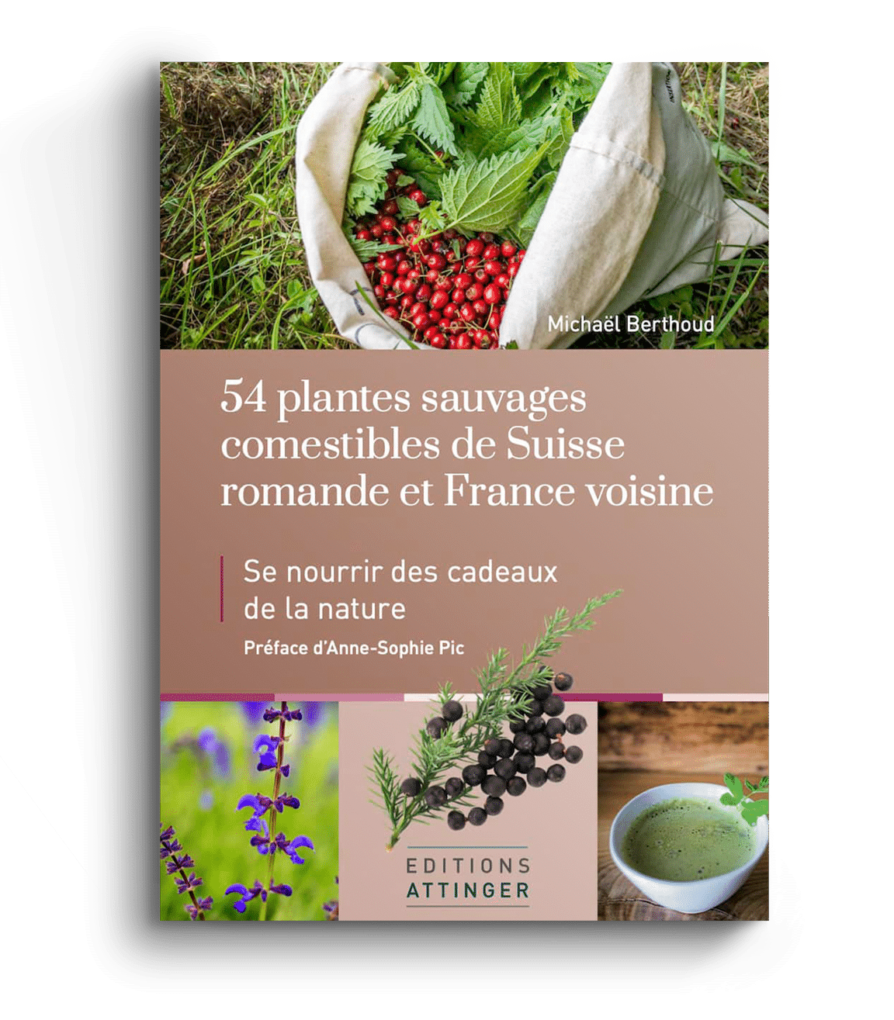
54 edible wild plants
Our book on wild plants, with a foreword by Anne-Sophie Pic, is available in bookshops and online!
Inside, you’ll find plenty of foraging tips and recipes to suit every taste!
It’s simple, really. Just use them in an infusion. Don’t eat the fruits or roots as they are.
In my experience, bitterness begins to develop after 12 min of infusion. Don’t leave them to infuse any longer than that.
Infuse them in a liquid and use that liquid to flavour a dish. Here are some examples:
- Cook vegetables
- Cook meat
- Flavour wine
- Flavour a dessert

Mulled wine with wild angelica
Here’s a recipe for mulled wine with wild angelica to warm you up in the depths of winter. An original aperitif, guaranteed!
Fruits
The fruits are used much like the roots. They can be picked after summer, either while green or once dry, until November in my region. The advantage of picking the fruits is that it doesn’t destroy the whole plant. On the other hand, they are so light that you need to gather a lot to have enough to use. So it always comes back to harvesting only where the plant is abundant. I’m repeating myself, but it’s important!
They can also be used when cooking vegetables and meat, and in desserts. They can be ground to a powder and mixed into the flour for any cake or biscuit recipe, for example.


Medicinal properties of angelica
Wild angelica is thought to have the same properties as garden angelica, although they are somewhat less pronounced. Both are bitter and aromatic: they stimulate the digestive organs and increase the appetite if taken before a meal (as an aperitif), or aid digestion if taken afterwards.
It is traditionally used in cases of general fatigue or during convalescence to restore appetite and get digestion going again. Its diaphoretic and expectorant properties explain its traditional use for chronic bronchitis or nervous asthma. Angelica is also traditionally considered an emmenagogue, meaning it may help bring on menstruation.
To benefit from their medicinal properties, the roots and fruits should be used in infusion or by maceration, not as a decoction, as is customary with roots. Because they contain aromatic compounds, a decoction could destroy them.
A recipe for an aperitif or digestif wine
This method produces a more bitter wine than my mulled wine.
- Macerate 40 g of dried roots or fruits in 1 litre of white wine.
- Add 4 g of cinnamon stick.
- Leave to macerate for 2 weeks, strain and add 40 g of honey.
- Bottle it and enjoy a small liqueur glass before a meal as an aperitif, or afterwards as a digestif.
This wine keeps for about 6 months in a cool place.
Precautions
As with many plants, women who are breastfeeding should avoid it. It may also have a photosensitising effect and should be avoided if you are taking anticoagulants.
Many poisonous plants belong to the same family as angelica. If you stay in woodland, there is no other plant as imposing as wild angelica. As with most plants, it is easier to start looking for it when it is in flower, in September and October, so you can learn to recognise its leaves. You will then be able to find it in any season.
Which angelica should you use?
If you’d like to go foraging, you’ll find wild angelica in our regions (except in the south of France), whereas if you’d rather buy it from a herbalist, you’ll be sold garden angelica.
The information given here may not be sufficient to identify or use a plant safely. Remember: if in doubt, leave it out! Seek advice from a professional guide, buy good reference books and use photo-based plant identification apps with discernment. We regularly run courses on edible, medicinal and poisonous wild plants.
Références
– Marseille (Bouches-du-Rhône ) – xviie siècle – xviiie siècle – Préface de Georges Bergoin, Secrétaire perpétuel de l’Académie de Marseille – Marseille (21Bd Longchamp, 13001) : Comité du vieux Marseille, 2003 –2 vol. (183 p.) : ill., couv. ill. en coul. ; 21 cm – Cahier / Comité du vieux Marseille ; 91, 1–2 – Notice n° : FRBNF38967626 – http://catalogue.bnf.fr/ark:/12148/cb389676269/PUBLIC
– InfoFlora, Angelica sylvestris, www.infoflora.ch
– Paul-Victor Fournier, Dictionnaire des plantes médicinales et vénéneuses de France, Omnibus.
– Dr. Jean Valnet, La phytothérapie, Se Soigner par les plantes, Le livre de Poche, 2001.




12 comments
✍️ Leave a comment






29 November
Les Pléiades
- Marie Mellioret

Making a Christmas star Sold Out
Lally railway station, car park, Blonay, Switzerland.
04 April
La Sarraz
- Michaël Berthoud

Wild edible and medicinal spring plants in La Sarraz
La Sarraz football pitches car park. Route de Cossonay.
10 April
Les Pléiades
- Michaël Berthoud

Natural incense stick-making workshop
Lally railway station, car park, Blonay, Switzerland.
No events found.
I just wanted to share one of the benefits of beautiful angelica with you. My aunt was Algonquin, and she grew it, boiled the root and used it for babies with colic. Have you ever heard of this method?
Author
Hello Francine,
I hadn’t heard of using it with very young children, thank you for sharing 🙂 I also use it for certain abdominal pains, when I’m having trouble digesting food.
Do be careful when using medicinal plants with children, though, and consult their paediatrician, as not everyone is lucky enough to have an experienced aunt 😉
Best wishes,
Michaël
Your page about angelica is wonderful.
And it’s lovely that you’re in Switzerland.
I’ll leave you my contact details
Author
Hello Caroline,
Thank you for your feedback!
Best wishes,
Michaël
You write about plants wonderfully well. Your section is very informative and enjoyable to read, and your recipes make me want to try them. Thank you. I.F.
Author
Hello Isabelle,
Thank you for your feedback; it encourages me to keep going! 🙂
Best wishes,
Michaël
I really enjoyed your article on wild angelica.
I would have liked a short note warning readers not to confuse
angelica with hemlock.
Hemlock has finely divided leaves, and if you
crush a leaf between your fingers, it smells unpleasant.
Author
Hello,
Thank you for the additional information. Yes, hemlock is a dangerous plant. I didn’t mention it because I find the leaves look very different, even though the plants belong to the same family. I’ll add a paragraph about it all the same.
Michaël
Hello,
At last, a very reliable site for identifying wild plants,
I’ve been looking for months and finally found it. Thank you!
Author
Hello,
Thank you! That’s lovely to hear ^^
Great article. While out walking, I was wondering what this member of the Apiaceae was, with fruits that smell so strongly of oranges. Wild angelica, of course... Delighted to find some tips on using it here. Thank you.
Author
Glad to hear you found the article useful 😊