



Log in
Sweet woodruff (Galium odoratum): identification, foraging and cooking
Michaël Berthoud
/
14 May 2018
Sweet woodruff is one of those little springtime gems whose beautiful presence brightens the beech woodland floor in May. Easy to identify and pleasantly fragrant in cooking, it has everything it takes to become a classic wild edible plant.
Sweet woodruff (also known in French as gaillet odorant)
Galium odoratum (L.) Scop.
Family: Rubiaceae
Parts used: leaves and flowers
Foraging: (April)–May–(June)
⚠️ Precautions: sweet woodruff contains coumarins that require some precautions. See the notes at the end of the article.

Distribution and habitats
As the map below shows, sweet woodruff is a Eurasian plant whose centre of distribution lies in Germany, Belgium and Switzerland. It is therefore common in many parts of Europe. The Infoflora (CH) and TelaBotanica (FR) websites provide detailed maps for Switzerland and France. This plant is also native to Japan and Korea and has been introduced to North America [16].
It grows mainly beneath beech trees, occasionally among a few conifers. Beech is one of the most abundant trees in Europe at mid-altitudes. It is also one of the most majestic. Is that why sweet woodruff was once called Mater silvarum, the mother of the woods?
So, to find it, a spring walk in the woods is in order.
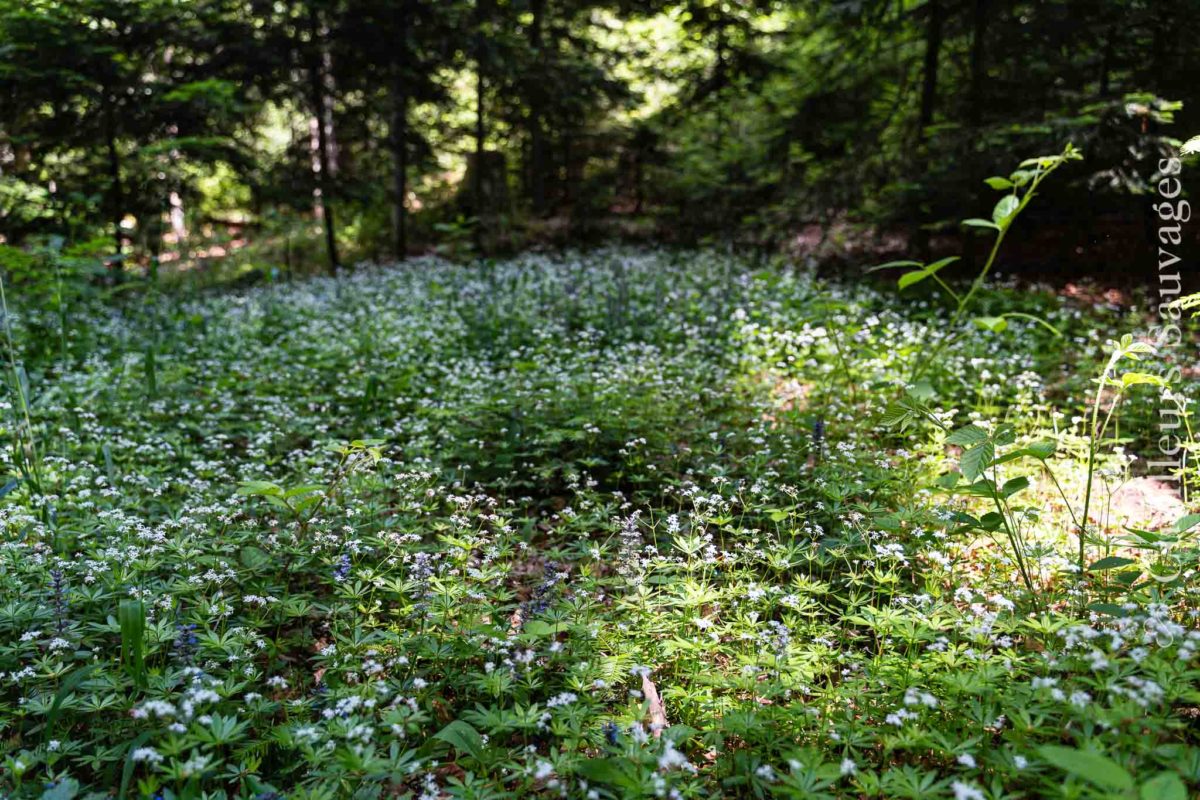
Identifying sweet woodruff, Galium odoratum
From the second half of spring onwards, take a walk through these woods, which are neither too dry nor too damp. You have a good chance of spotting a colony of delicate-looking little plants, no more than 10 to 30 cm tall, with leaves arranged in whorls (see photo below). In other words, 6 to 8 slender, elongated leaves form a circle around the stem.
Bend down to pick one and roll the stem between your fingers. The stem is square! Another identifying feature: its subtly scented flowers have 4 small white petals. They appear in May or June, depending on the region.
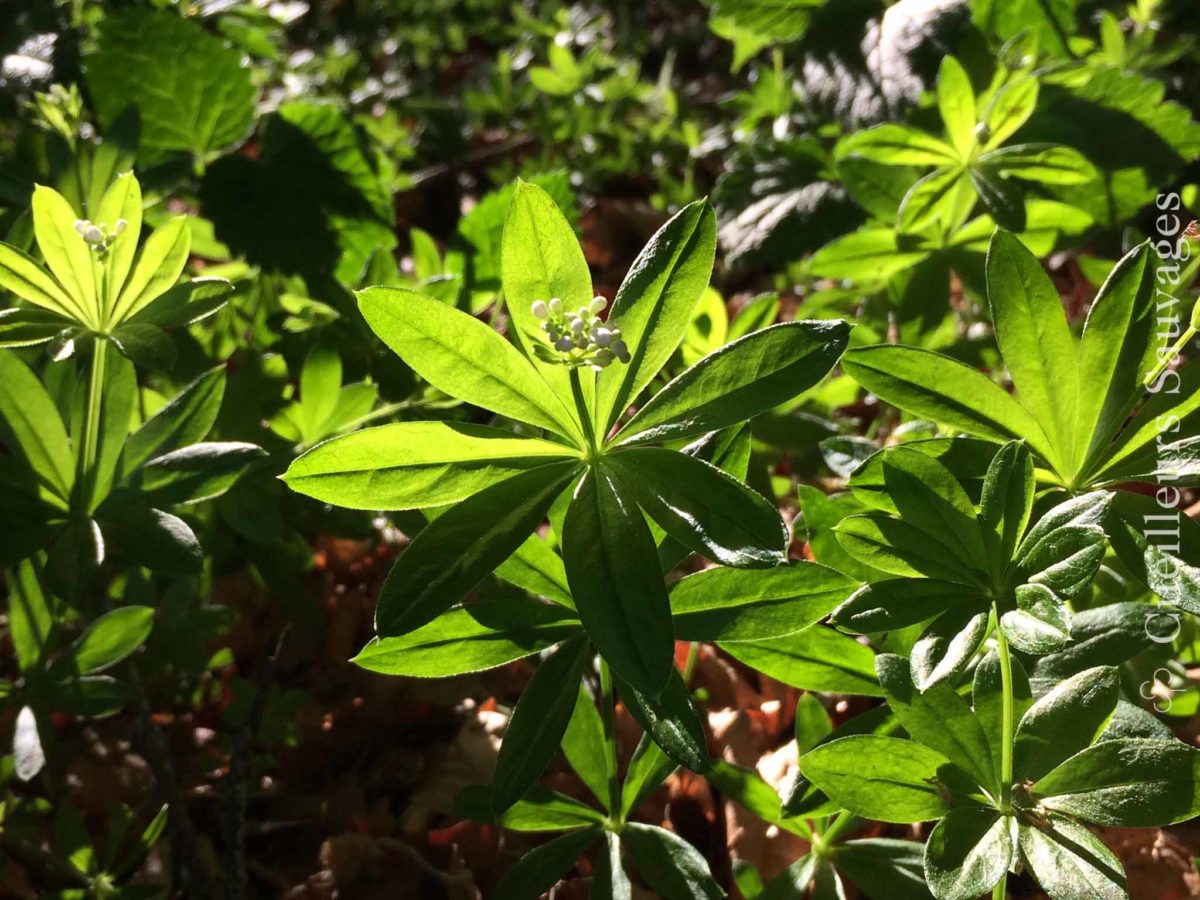
Possible confusion
If I stick to these criteria and stay beneath the beech trees, I know there is no risk of confusing it with a poisonous plant. However, other plants in the same family grow in our regions, including:
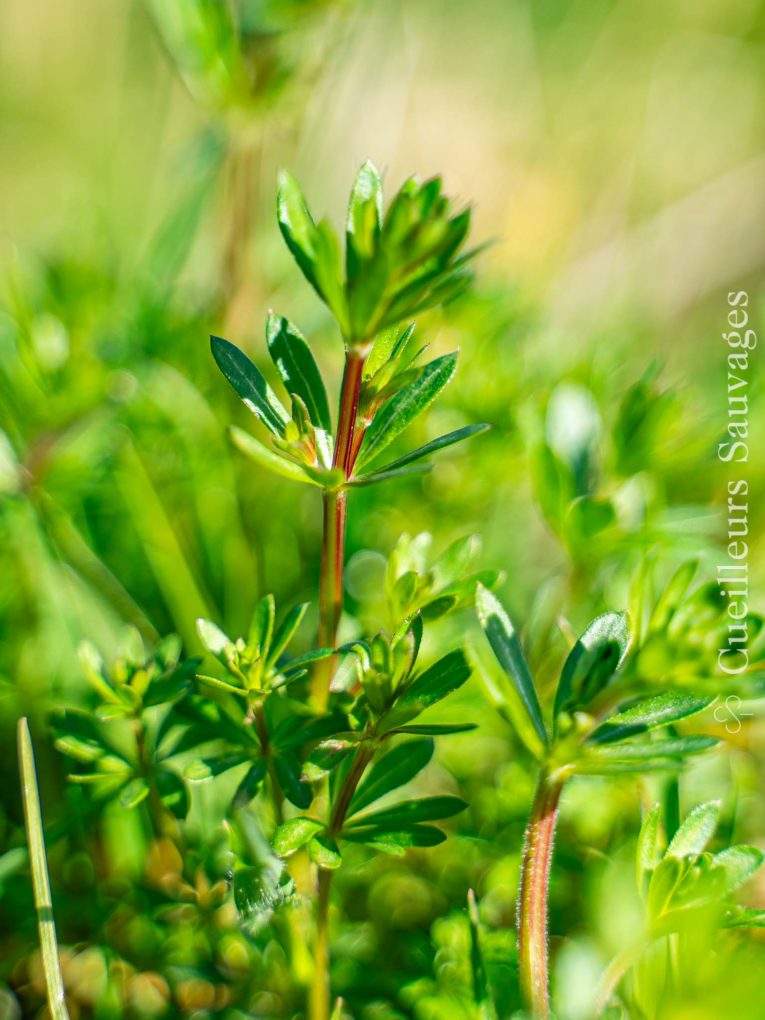
- Wood bedstraw (Galium sylvaticum): probably the one that most closely resembles sweet woodruff; it also grows in woodland. Its stems branch repeatedly.
- Hedge bedstraw (Galium mollugo): grows in sunny places.
- Cleavers (Galium aparine): can grow near sweet woodruff, but has a very rough texture, hence its name.


Foraging sweet woodruff responsibly
Which part should you harvest?
When I was starting out, I was taught to harvest sweet woodruff before it flowered. I did so until I realised that other people harvest it while it is in flower, or even afterwards. So there is no hard-and-fast rule.
But is there a better way? I’m not sure, as that would take several tests. These days, my experience tells me it’s best to harvest it when the flowers appear, while they are still in bud or have just opened. If you dry fully open flowers, the petals will fall off and you’ll lose part of the plant.

The harvest season varies according to your region (latitude and altitude) and the year. It begins roughly in late April or early May (for flowers that have just opened). The window for harvesting is therefore quite short.
As always, harvest where the plant is abundant! If you haven’t already, I suggest you read the guidelines for foraging responsibly and respecting nature.
A fragile plant
Sweet woodruff is a fragile plant with shallow roots. Trampling harms it, but that is nothing compared with the soil compaction caused by forestry machinery. You can often see tractor tracks running through patches of it, and it no longer grows where the machinery has passed.
The French association of professional foragers offers several harvesting recommendations, which we summarise here:
- Leave a substantial proportion of the plants in place.
- Harvest only one or two whorls of leaves (the plant will regrow better).
- Harvest here and there, rather than all in one place.
- Do not pull up the plants, as their roots are shallow.
54 edible wild plants
Our book on wild plants, with a foreword by Anne-Sophie Pic, is available in bookshops and online!
Inside, you’ll find plenty of foraging tips and recipes to suit every taste!
Cooking with sweet woodruff
Sweet woodruff is one of our coumarin-containing plants. This fragrant compound gives your creations a slightly vanilla-like flavour. Its scent is similar to that of tonka bean and melilot. Sweet woodruff was well known to Germanic peoples, who used it to make alcoholic drinks. The famous Maitrank (May wine) is a delicious drink made by macerating the plant in a sweet white wine (see recipe below). It is a traditional May drink, first recorded in writing in 854! It is traditional in Alsace, Belgium, Luxembourg and Germany, where every family has its own recipe. It has calming and digestive properties.
However, this coumarin scent is not present at every stage of use, which can be confusing. It is normal for the fresh or dried plant to have almost no scent.
Here is a summary of what happens:
- Fresh plant: grassy scent, sometimes with a slight hint of coumarin.
- Fresh flowers: honey-like scent.
- Wilted plant or plant in a dehydrator: strong release of coumarins!
- Completely dried plant: faint coumarin scent.
- Infused or macerated plant: the coumarin aroma finally infuses your dish.

This plant is used in a infusion or maceration to extract its aroma, which goes well with sweet flavours. That is why sweet woodruff wines are often sweet and why the plant features in many desserts. The liquid can be wine, water, vinegar, cream… in short, anything goes. Here are a few ideas:
- May wine
- Crèmes brûlées
- Panna cotta
- Ice creams
- Lemonades
- Herbal teas
- Floral waters
Sweet woodruff can be used fresh or dried, depending on the recipe. Most recipes call for drying it first:
- Fresh: cold infusion in wine (May wine) or water (floral water).
- Dried: all other recipes call for drying it first, such as infusions in milk for ice creams and crèmes brûlées, for example.

May wine with sweet woodruff
Here’s a simple recipe for sweet woodruff May wine!
Servings 1 L
Ingredients
- 20 stems of fresh sweet woodruff
- 1 L of sweet wine (Gewürztraminer or Malvoisie)
Instructions
- Harvest sweet woodruff when the flowers are still in bud or have just opened.
- Place the whole stems, with their leaves and flowers, in the wine. It is normal for the fresh plants to turn black in the liquid. They must remain submerged in the wine, otherwise they may go mouldy.
- Leave to infuse for at least four days at room temperature. Taste it! Depending on the strength of the aroma of your harvest and the amount of plant material, you can leave it to infuse for up to several weeks.For example, you can use half as much (1 stem) and leave it to infuse for twice as long.
- Strain through a reusable coffee filter and bottle.
Notes
- Store in a cool place and drink within a year.
Medicinal properties of sweet woodruff
Sweet woodruff is not the best-known medicinal plant. Nevertheless, it has properties used in folk medicine and has been the subject of some interesting studies.
The aerial parts, leaves and flowers, are traditionally used to treat nervous agitation, jaundice, haemorrhoids and circulatory problems. Crushed leaves have been used to speed wound healing[1,2], and this use has been confirmed by studies showing an anti-inflammatory effect in animals, as well as an ability to speed the healing of second-degree burns[3].
Its antiseptic properties in the urinary tract help it counter congestion of the liver and spleen. Held against the forehead, the leaves are said to soothe migraines[7].
At home, sweet woodruff makes a good evening herbal tea, as it is traditionally used to calm and aid digestion. It is therefore used for sleep problems and mild insomnia, to ease stress and anxiety, and to relieve minor digestive complaints[6-7].
Toxicity of sweet woodruff
Sweet woodruff has some toxicity because it contains coumarins. For more details, we recommend reading our article on the toxicity of plants containing coumarins.
At the quantities normally used in cooking, the risk appears limited, but caution is needed in certain situations.
Here are the recommendations:
- Discard any coumarin-containing plant that has turned black during drying: sweet woodruff, melilot, sweet vernal grass, lady's bedstraw, hedge bedstraw…
- Make sure to dry sweet woodruff at a temperature below 50 °C.
- Avoid culinary fermentations involving fungi of the Aspergillus type, such as miso. For example, sweet woodruff miso should be avoided.
Coumarin-containing plants should be avoided[4, 18, 19]:
- You have circulatory problems or are taking anticoagulants.
- You have liver problems.
- You are pregnant.
Recommended amounts, based on data on coumarin toxicity:
- 7 g of fresh flowers is considered a safe quantity for human consumption (for a 70 kg adult) [15].
This last recommendation applies to medicinal use.
How should sweet woodruff be dried?
Sweet woodruff should therefore be dried in a dry place out of the sun, at below 55 °C, as we have seen.
If your surroundings are humid, drying it in an oven or dehydrator is safer, at the lowest temperature: 30–35 °C.
In our experience, the aroma does not develop well if the sweet woodruff has not been dried properly. Make sure it does not get damp. Its aroma reaches its peak after just a few days of drying, when the sweet woodruff has wilted but is not yet completely dry. This is the best time to use it!
Here is what a harvest that has turned black looks like. If in doubt, discard it, even though it is probably not dangerous.

The information given here may not be sufficient to identify or use a plant safely. Remember: if in doubt, leave it out! Seek advice from a professional guide, buy good reference books and use photo-based plant identification apps with discernment. We regularly run courses on edible, medicinal and poisonous wild plants.
Références
[1] Gruenwald, J., Brendler, T., & Jaenicke, C. (2007). PDR for herbal medicines. Thomson, Reuters.
[2] Soltani, A. (2005). Encyclopedia of traditional medicine herbal. Tehran: Arjmand.
[3] Kahkeshani N, Farahanikia B, Mahdaviani P, et al. Antioxidant and burn healing potential of Galium odoratum extracts. Res Pharm Sci.
2013;8(3):197‐203.
[4] Chevallier. A. The Encyclopedia of Medicinal Plants Dorling Kindersley. London 1996 ISBN 9-780751-303148
[5] https://fr.wikipedia.org/wiki/Galium_odoratum
[6] Dr Jean Valnet, La Phytothérapie, Le livre de Poche.
[7] Paul-Victor Fournier, Dictionnaire des plantes médicinales et vénéneuses de France, Omnibus.
[8] Couplan et E. Styner, Les plantes sauvages comestibles et toxiques, Delachaux et Niestlé.
[9] Cazin, Traité des plantes médicinales, 1868, Aspérule odorante.
[10] Christophe Bernard, Vins médicinaux et élixirs, La Source de Vie.
[11] B.G Lake, Coumarin Metabolism, Toxicity and Carcinogenicity: Relevance for Human Risk Assessment, Food and Chemical Toxicology, Volume 37, Issue 4, April 1999, Pages 423-453
[12] Williamson, E. M., Drug interactions between herbal and prescription medicines., Drug safety, Drug interactions between herbal and prescription medicines.
[13] Pitaro M, Croce N, Gallo V, Arienzo A, Salvatore G, Antonini G. Coumarin-Induced Hepatotoxicity: A Narrative Review. Molecules. 2022 Dec 19;27(24):9063. doi: 10.3390/molecules27249063. PMID: 36558195; PMCID: PMC9783661.
[14] Bye A, King HK., The Biosynthesis of 4-Hydroxycoumarin and Dicoumarol by Aspergillus fumigatus Fresenius. Biochem J. 1970 Apr;117(2):237-45. doi: 10.1042/bj1170237. PMID: 4192639; PMCID: PMC1178855.
[15] Egebjerg MM, Olesen PT, Eriksen FD, Ravn-Haren G, Bredsdorff L, Pilegaard K. Are wild and cultivated flowers served in restaurants or sold by local producers in Denmark safe for the consumer? Food Chem Toxicol. 2018 Oct;120:129-142. doi: 10.1016/j.fct.2018.07.007. Epub 2018 Jul 5. PMID: 29981787.
[16] Galium odoratum (L.) Scop., Plant of the Wolrd Online, Kew Garden.
[17] L’ASPÉRULE ODORANTE. Livret technique dе cueillette, Association française des professionnels de la Cueillette de plantes sauvages, Version 1 – Décembre 2024
[18] Hegheș, S., Voștinaru, O., Mogoșan, C., Miere, D., Iuga, C., & Filip, L., Safety Profile of Nutraceuticals Rich in Coumarins: An Update, Frontiers in Pharmacology, 2022. 13. https://doi.org/10.3389/fphar.2022.803338.
[19] Najmanová, I., Doseděl, M., Hrdina, R., Anzenbacher, P., Filipský, T., Říha, M., & Mladěnka, P. , Cardiovascular effects of coumarins besides their antioxidant activity, Current topics in medicinal chemistry, 2015; 15 9. https://doi.org/10.2174/1568026615666150220112437.



22 comments
✍️ Leave a comment






29 November
Les Pléiades
- Marie Mellioret

Making a Christmas star Sold Out
Lally railway station, car park, Blonay, Switzerland.
04 April
La Sarraz
- Michaël Berthoud

Wild edible and medicinal spring plants in La Sarraz
La Sarraz football pitches car park. Route de Cossonay.
10 April
Les Pléiades
- Michaël Berthoud

Natural incense stick-making workshop
Lally railway station, car park, Blonay, Switzerland.
No events found.
Hello, and thank you for your very thorough article.
When you say sweet woodruff turns black, do you have a photo? I’m drying some at the moment, and certain parts (really tiny ones) are turning black. Not all of it, just a few little flower buds that have closed up again.
Is there any risk?
Thank you very much.
Author
Hello,
Unfortunately, I don’t have any photos to show you. But if the whole plant turns black, something has gone wrong with the drying. If it’s just a few parts, I don’t think it’s a problem.
Hello Léa and Michael.
I’m concerned about the same thing at the moment. As I can’t gather enough of the plant here in the Belgian Ardennes, I ordered some from Amazon (specifically France-Herboristerie). The product I received looks too dark, grey/black, to have been dried properly, although it smells quite good. I’ve photographed the difference between the sweet woodruff I bought and the batch I dried myself. I’d like to know what you think. The difference is striking. Can I drink the herbal tea I bought? How can I attach the photo to show you? I’ve put it on Fbook as my profile photo: can you see it?
Author
Hello Eva,
I understand your concern. Unfortunately, I can't take responsibility for telling you whether it's safe to eat from a photo… it's too difficult to judge. What matters is that it isn't black.
If you buy from Amazon, make sure the seller is reputable. They must be a qualified herbalist or a medicinal plant grower.
I'd avoid resellers and buy directly from herbalists' websites instead. Plenty of reputable ones sell online.
Michaël
Can children have it?
Author
Hello,
Yes, it's fine for children.
Best regards
Michaël
Thank you very much for your reply, Michael. The problem is that it's very difficult to distinguish between growers and resellers. I know it's a delicate matter for you, but could you possibly name two or three? I'm sure it would help a lot of people. You wouldn't be advising against anyone in particular, just stating things that are true and common knowledge (though not to me, as I know nothing about this). Since you're not a public institution, a little bit of promotion shouldn't be forbidden… I hope. Kind regards, Eva
Author
Yes, I know it isn't easy to find good herbalists… I'm happy to recommend products or people I know. As I live in Switzerland, the ones I know may not be useful to you: Aries and Roggen.
For France, one name that comes up often is Herboristerie du Valmont, but I've never tried them. https://www.herboristerieduvalmont.com/
That gives me the idea of running a survey sometime to find out readers' favourite herbalists! If I do, I'll let you know the results through the newsletter!
Michaël
Many thanks, Michaël. I've checked for Switzerland: Aries accepts online orders. I still need to see whether they ship abroad…:-)))
Author
My pleasure ^^ They're more expensive, but their quality is the best I know.
Hello, I’ve made sweet woodruff syrup twice. The first time it was rather yellow, like elderflower cordial; the second time it was more of a pale green. Do you know why the colour was different, given that I used the same recipe? Many thanks and best wishes, Ruth
Author
Hello Ruth,
I can’t explain it. Perhaps there was a difference in the soil, the drying, or when you harvested it…? The amount of sugar and the heating temperature also affect the colour of the syrup, which gets darker with heat (for some plants).
Michaël
Hello Ruth,
I’d be very interested in the recipe, please, as I’m also looking to make syrup (for a change from the classic sweet woodruff liqueur made with fruit schnapps, which is typical of my part of the Moselle region).
Did you use fresh or dried flowers?
How many? And how much water and sugar?
How long did you leave it to infusion? Hot or cold?
I’ve seen that Germans add lemon during infusion, and even citric acid (to help preserve it)…
Thank you!
Author
Hello Ruth,
That’s an idea for a future article. There are several ways to make it. But to keep things simple, you can start with a cold infusion of a generous amount of fresh sweet woodruff. Fill a jar with leaves and flowers, cover with water and leave to infuse for 4–5 days, until the flavour is quite pronounced. Strain, add an equal weight of sugar, heat to no more than 50°C, then fill sterilised bottles right to the brim to create a vacuum.
Start without lemon so you can get to know the flavour; you can add some later. I never add a preservative. If the syrup is bottled hot, it keeps well.
To help it keep even longer, add more sugar (see the article on rose hip syrup).
Best wishes,
Michaël
Hello, is it possible to eat this flower fresh? I’d like to decorate a cake with a few fresh, edible white flowers.
Author
Hello,
Yes, the flowers are edible. You can use them as a decoration or infusion, for example.
Michaël
Hello,
For the second year running, I’ve made sweet woodruff wine. But this year, the fresh flowers I left to macerate in 35% alcohol turned black. It smells fine, but I’m concerned. Do you know whether dicoumarol could form during maceration, if there are too many flowers for the amount of alcohol, for example? The flowers were only just covered.
Thank you for your reply.
Vincent
Author
Hello,
Unfortunately, I can’t give you a proper answer. I don’t know whether dicoumarol also forms when the plant is macerated in liquids… Next time I make some, I’ll watch what happens to the leaves and see.
Best wishes,
Michaël
Good evening. The recipe for ‘the herbal tea that will help you sleep’ says: To make a calming infusion, steep 30 to 50 g of leaves or flowering tops, without boiling, for less than 10 minutes. Drink 3 cups a day.
It doesn’t say how much water to steep the sweet woodruff in, or whether the plant should be dried or fresh. Also, 50 g is almost twice as much as 30 g!
Could you be more specific, please?
Thank you in advance for your answers,
Dalila,
Author
Hello Dalila,
Thank you for your message. Unless otherwise stated, dosages are always based on dried weight. These dosages come from traditional authors: Cazins, Fournier, Valnet… So there are indeed considerable differences between them. This is also because each person’s physique and constitution need to be taken into account.
To keep it simple, you can use one tablespoon per cup for an infusion, then adjust the amount gradually.
Hello,
This August, the sweet woodruff in my garden is putting out new, light green shoots.
Would it be sensible or dangerous to harvest them for use in various preparations (including Maitrank)?
Thank you.
Best wishes.
Bernard Schmit
Author
Hello Bernard,
I’ve never seen it put out new shoots like that, so I don’t have an answer to your question. But it would be very interesting to try it and let us know how you get on ^^ We could update the article with your experience!
Michaël