



Log in
Wood avens: foraging and uses
Michaël Berthoud
/
21 May 2019
I’m walking through these woods I know so well. I come across a hairy, irregularly shaped leaf… Yes, that’s it! Wood avens, the plant of Saint Benedict, which medieval priests used in their exorcism rituals… It hides a little treasure underground: its roots have a lovely clove scent.
Wood avens
Also known in French as herbe bénite and herbe de Saint-Benoît
Scientific name: Geum urbanum
Family: Rosaceae
Flowering: May–August
Habitat: Edges of woodland paths, bushes
Altitude: up to 2200 m
Abundance: abundant and common
Parts used: roots and leaves
Harvest time: April to May for the leaves; late May for the roots, just before flowering.
History
A blessed plant, then forgotten…
I like looking into the etymology of plant names because it tells us their history: the French name “benoîte” comes from “bénite”, meaning “blessed”, and alludes to the plant’s beneficial properties. By association, it came to be called “Herbe de Saint-Benoît” (Saint Benedict’s herb). It was highly prized in the Middle Ages for its stimulant, wound-healing and calming properties. Priests even used it in their exorcism rituals. The root was burnt on charcoal: if it burnt normally, the ritual had worked. Otherwise, the root would start to moan!
Unfortunately for us, it gradually fell into obscurity…
Botany
Wood avens belongs to the Rosaceae family. Its stem is branched and can grow up to 90 cm tall. Its leaves are irregularly divided into several leaflets, the terminal one being divided into three and much larger than the others.

In May, five small yellow flowers begin to appear. By August, their stigmas will have developed into small hooked bristles that cling to animals’ fur and walkers’ socks. I’m sure you know which plant I mean now! This is a strategy for dispersing seeds. Since plants cannot move, they have had to be ingenious to reproduce and spread into new habitats…
It isn’t easy to recognise wood avens from its leaves alone. That will come with practice. At first, I recommend waiting until you can look for its little balls of bristles, which come apart in your hands. Once you find some, take a good look at the leaves and come back in spring to see if you can spot the plant before it flowers!
There are other species of avens, including water avens (found near wetlands) and Geum sylvaticum (typical of the Pyrenees and southern France).
Where to find wood avens
It likes woodland near inhabited areas
Every plant has its preferences. Wood avens likes deciduous woodland with cool soils rich in organic matter. It copes fairly well with a lack of light. Like common hogweed, which can also be found in woodland, I generally come across it along paths that are a little brighter than the woodland floor. So I look for woodland paths with very little foot traffic, to avoid pollution and dog fouling. Although it likes woodland, it is often found near homes, hence the “urban” part of its French name, in contrast to its relative water avens, which grows in habitats further from inhabited areas.


Harvesting wood avens
A European plant with a clove scent
According to Roques, a 16th-century French doctor and botanist, roots grown in dry, sandy, well-exposed ground should be harvested in June and July. Personally, though, I dig up the roots just before flowering begins in late May. On the Swiss plain, the ideal time is therefore May or autumn, in September–October.
It is possible that the ideal time to harvest it varies by region, but when I harvest it in summer, it doesn’t have that lovely clove scent…
It is the rootlets (the small roots) that give off this scent. You will need a good quantity, so harvest only where the plant is abundant and leave 75 % of the population untouched.
Clean the roots and leave them to dry in the open air. The scent can sometimes disappear during drying. In that case, the drying was probably done under poor conditions.
Cooking with wood avens
Wood avens can be used like cloves, which is handy! Well, its flavour is actually a little less intense. Still, you can steep it or burn it to flavour all kinds of dishes. Here are a few examples:
- Steep it in milk to make desserts such as panna cotta and crème brûlée
- Steep it in milk to make chai tea
- Steep it in wine to make mulled wine
- Grind and burn it to smoke meat
- Burn it to make incense

Wood Avens Chai Tea
This wild wood avens chai tea recipe will transport you to Asia without leaving Europe!

Possible confusion
It can be confused with other plants in the genus Geum, such as water avens, whose flowers are bell-shaped, drooping and brownish. Both are edible.
Medicinal properties
Wood avens contains the same aromatic compound as cloves, called eugenol. It is a tonic, astringent, sudorific, febrifuge and vulnerary (it helps wounds heal). You could almost call it a pharmacy in its own right!
Since ancient times, it has been used as a decoction to relieve gastrointestinal and liver conditions and to treat haemorrhoids and diarrhoea. infusion is also used for rheumatism and fever.
Nowadays, it is mainly used to stimulate sluggish digestion, for example in older people or those recovering from illness. Like cloves, this plant is traditionally used for dental problems…
How to use wood avens
Fournier recommends a infusion made with 60 to 100 g of dried root per litre of water, or 30 to 60 g of fresh root. Valnet recommends 60 g per litre, without specifying whether he means fresh or dried plant material.
Personally, I’ve never tried these concentrations, which come from older authors, but they seem high to me. In general, anything over 30 g per litre makes an infusion or a decoction quite a challenge to drink, though of course it depends on the plant.
Bear in mind, too, that to harvest 100 g of wood avens roots, you’ll have to pull up quite a few plants. If it’s an occasional harvest for a recipe, that may be fine. But if you’re making a digestive infusion regularly, the foraging sites will soon be depleted.
I don’t think wood avens is the easiest plant to use in herbal medicine, at least for self-medication, or the best suited to sustainable foraging.
For a infusion intended for well-being, perhaps less potent than those recommended by these authors but with a full, rich flavour, you could use:
- 1 tsp of dried, ground roots per cup = 1.5 g per cup ≈ 5 g of dried roots per litre
Bear in mind that there are other wild plants that aid digestion and are easier to use, such as ground ivy.
Here are two recipes we found in the works of these authors nonetheless.
Wood avens decoction for gingivitis
Simmer 30 g of roots in 1 L of water for half an hour. Use it as a gargle; this decoction will firm and strengthen your gums [2].
Wood avens wine to aid digestion
You can also enjoy its wide-ranging properties by drinking it with a meal as a wine.
Steep 30 to 60 g of dried roots per litre of wine for 8 days; drink 2 glasses a day before meals to aid digestion [1].
The information given here may not be sufficient to identify or use a plant safely. Remember: if in doubt, leave it out! Seek advice from a professional guide, buy good reference books and use photo-based plant identification apps with discernment. We regularly run courses on edible, medicinal and poisonous wild plants.
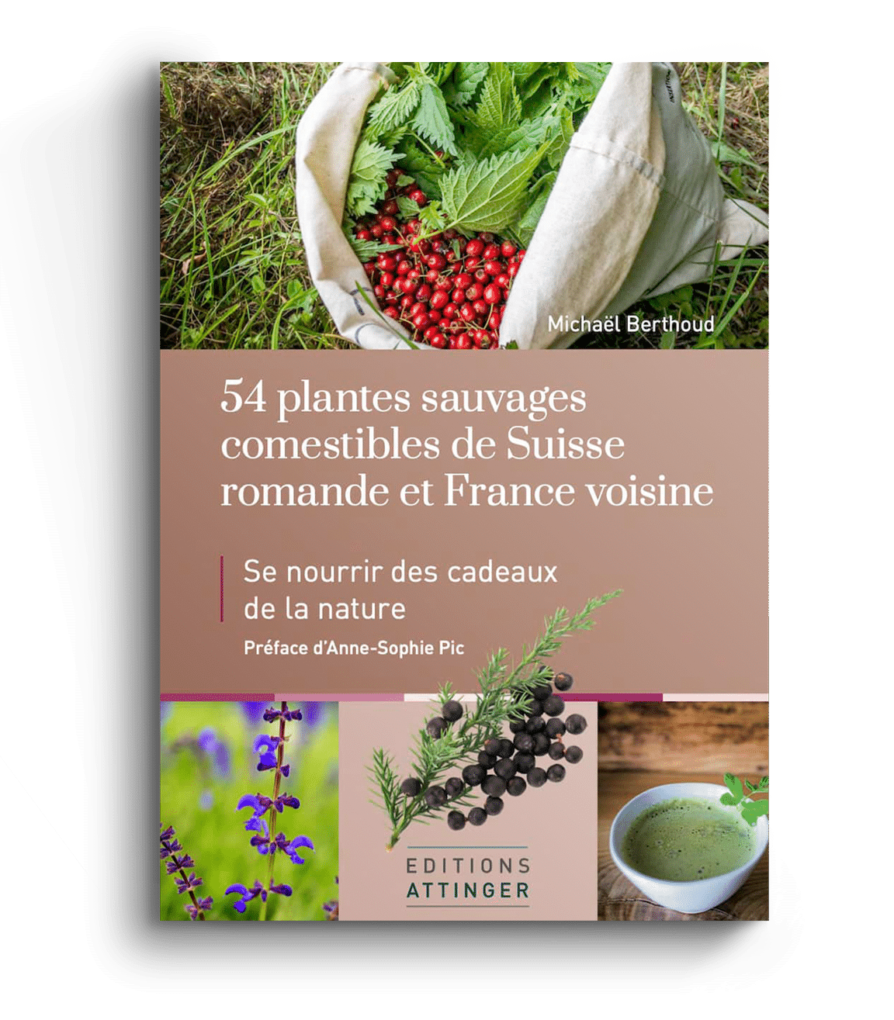
54 edible wild plants
Our book on wild plants, with a foreword by Anne-Sophie Pic, is available in bookshops and online!
Inside, you’ll find plenty of foraging tips and recipes to suit every taste!
Références
– Tita I, Mogosanu GD, Tita MG. Ethnobotanical inventory of medicinal plants from the South-West of Romania. Farmacia. 2009;57:141–156.
– Vogl S, Picker P, Mihaly-Bison J, Fakhrudin N, Atanasov AG, Heiss EH, Wawrosch C, Reznicek G, Dirsch VM, Saukel J, Kopp B J Ethnopharmacological in vitro studies on Austria’s folk medicine–an unexplored lore in vitro anti-inflammatory activities of 71 Austrian traditional herbal drugs. Ethnopharmacol. 2013 Oct 7; 149(3):750–71.
[1] Paul-Victor Fournier, Dictionnaire des plantes médicinales et vénéneuses de France, Omnibus.
[2] Dr. Jean Valnet, La phytothérapie, Se Soigner par les plantes, Le livre de Poche, 2001.
– Cuisine sauvage, François Couplan, Sang de la Terre



8 comments
✍️ Leave a comment






29 November
Les Pléiades
- Marie Mellioret

Making a Christmas star Sold Out
Lally railway station, car park, Blonay, Switzerland.
04 April
La Sarraz
- Michaël Berthoud

Wild edible and medicinal spring plants in La Sarraz
La Sarraz football pitches car park. Route de Cossonay.
10 April
Les Pléiades
- Michaël Berthoud

Natural incense stick-making workshop
Lally railway station, car park, Blonay, Switzerland.
No events found.
Hello, I’ve just read your article about avens and learnt a great deal about this plant, so thank you. But this summer I’ve noticed something new about the avens I planted a few years ago. After its usual bright orange-red semi-double flowers, small yellow flowers with five petals appear on the same stems. At first glance, I thought they were an entirely different flower.
Could you explain this curiosity?
Many thanks.
Author
Hello Sonia,
Hmm… yellow flowers with five petals are normal for wood avens; those are its flowers.
“After its usual bright orange-red semi-double flowers” – that isn’t “normal” for wood avens. Do they look like the photo in the link? If so, you’re probably looking at water avens instead.
https://www.infoflora.ch/fr/flore/geum-rivale.html
Hello
I’d like to harvest avens root. Should I do it before or after flowering? Thanks.
Author
Hello,
Ideally in spring, just before flowering, when the leaves are large but the plant hasn’t flowered yet. Autumn is also possible.
Best wishes
Michaël
Hello,
I’ve just discovered this plant. I collected its root, dried and blended it, then made a crème brûlée with it and a hint of vanilla. Absolutely delicious and wonderfully fragrant!
Author
Hello Jolacascade,
Brilliant, thanks for sharing!
Best wishes,
Michaël
A very good, very thorough introduction. Thank you.
Author
Thank you for your comment! 🌿