



Log in
4 wild fruits to forage in autumn and winter
Michaël Berthoud
/
13 September 2019
Haws, juniper berries, cornelian cherries, rowan berries… From late summer onwards, many trees and shrubs brighten hedgerows and woodland edges with beautiful wild fruits. These fruits are an important food source for our feathered friends and, if gathered responsibly, an incomparable treat for us! Here are 4 wild fruits you can forage even in winter!
Sustainable foraging
Let’s not forget that these fruits are an important resource for wildlife, especially birds. So, as always, let’s gather only a modest amount, taking just those within reach, leave the rest where they are and follow the principles of responsible foraging.
Common juniper
Juniperus communis
Juniper is a shrub common throughout Europe. It grows on sunny hillsides, heathland and in the mountains up to an altitude of 3000 m, where it occurs in a dwarf form. Its needles are pointed and very stiff, with a white stripe along their underside.


The berries ripen after 2 or 3 years. They turn from green to dark blue and become covered in a protective waxy bloom. Harvesting them is quite difficult because the needles hurt your hands. Place a cloth or an umbrella beneath the tree and shake it with a stick; the ripe berries should fall, sparing you injury and frustration.
The berries are sweet and very aromatic. They have diuretic and digestive properties; add them to stews or eat them as they are. They are used to make many liqueurs.

Fermented juniper berry lemonade recipe
Here’s a recipe for juniper berry lemonade. First, you prepare a highly active ferment, a liquid starter culture, which will ferment the lemonade and make it fizzy. You should see bubbles appearing on their own. This juniper berry lemonade contains a little alcohol because the yeasts ferment the sugars. Most people won’t notice it, but those who are sensitive to alcohol will.

Digestive wine with juniper berries
Equipment
- 1 1 L jar
- 1 Reusable coffee filter, sieve, cloth…
Ingredients
- 30 to 60 g Juniper berries
- 1 L White wine
Instructions
- Steep 30 to 60 g of berries in 1 L of white wine for 1 week.
- Squeeze and strain.
Notes
This digestive wine can be taken before meals to prepare for digestion or afterwards in case of flatulence.
Dog rose
Rosa canina
The dog rose is a wild rose. In fact, there are many wild roses, and the differences between them are hard to spot. Just remember that all wild roses, as well as cultivated roses, can be used in the same way.
Their false fruits, called rose hips, are edible. The actual fruits are the ‘seeds’ inside. These rose hips, nicknamed ‘gratte-cul’ in French, contain hairs that irritate the entire digestive tract, from mouth to anus – hence the name 😉 Be careful not to rub your eyes, either!

From late summer, while the rose hips are still firm, I cut them in half, remove the seeds and hairs, and eat the flesh. Later, after the frosts, they soften and become mushy.
Rose hips are among the wild fruits with the highest vitamin C content. Just one can help meet your daily needs! Discover an in-depth article about this fruit!

Rose hip syrup for winter
Here is my recipe for delicately flavoured rose hip syrup, with medicinal properties that are useful in winter.

Candied rose hips
This candied rose hip recipe will delight young and old alike. They are perfect served with game or simply enjoyed like sweets.
Hawthorn
Crataegus monogyna aggr
Hawthorn gets its French name ‘épine blanche’ (‘white thorn’) from its beautiful spring flowers. It is a thorny shrub in the same family as the dog rose, the Rosaceae. It is common along woodland edges in lowland areas.



An infusion of its flowers is traditionally used for certain heart conditions. However, medical advice is needed before using it for cardiac arrhythmia, palpitations or emotional disturbances.
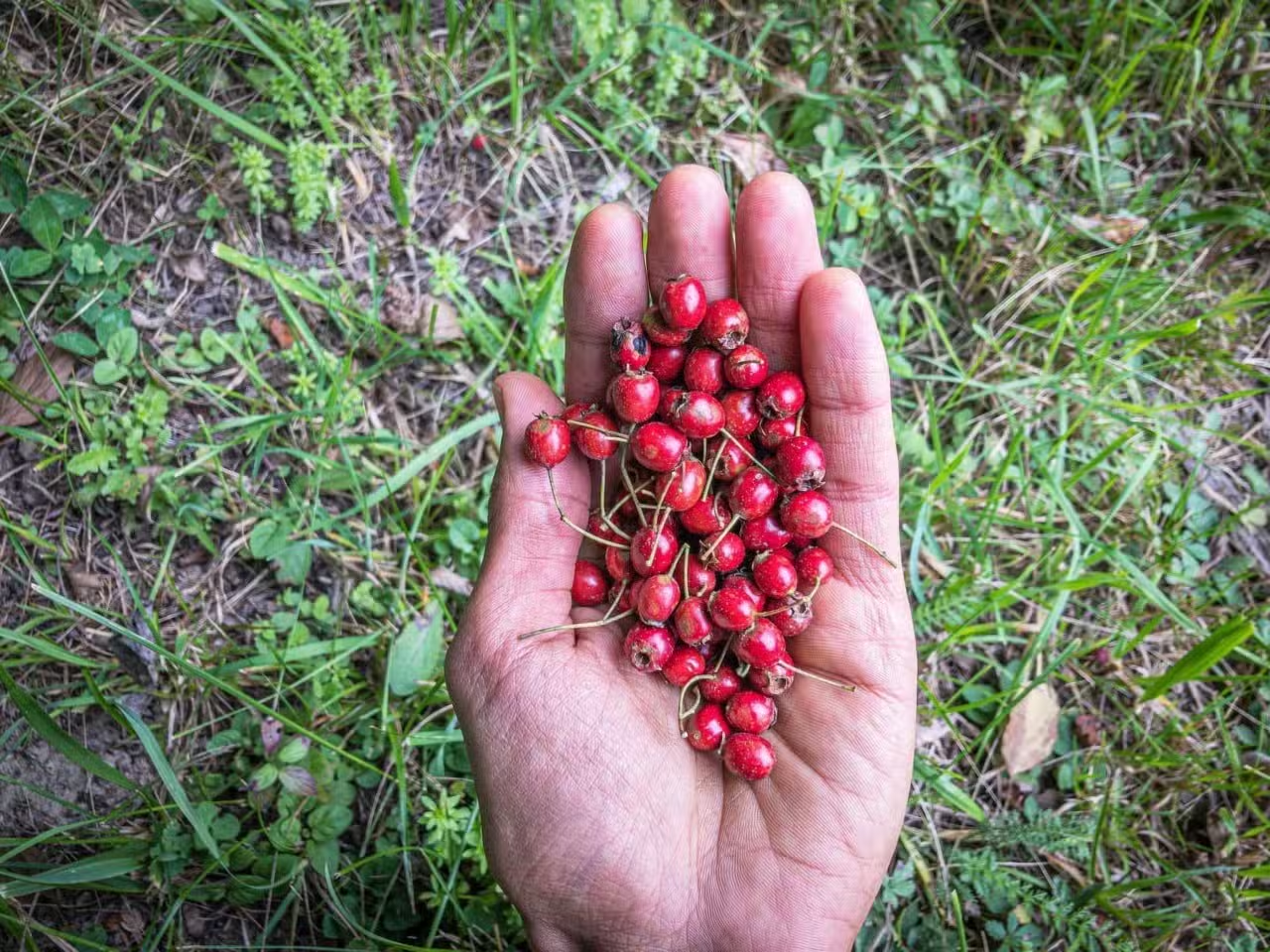
After fertilisation, the berries give us one of autumn’s treasures: haws. These small wild fruits are mealy and seem to have little flavour. They are not particularly appealing eaten as they are, but lend a pleasant flavour to jellies, cakes and other sparkling drinks.

Fermented haw drink
This drink is slightly alcoholic and fizzy. You can add a few spoonfuls of sugar to ensure fermentation.
Equipment
- 1 Large jar
- 1 Reusable coffee filter, sieve, cloth…
Ingredients
- 1/4 Haws
- 1/4 Sugar
Instructions
- Fill a 1 L airtight jar one-quarter full of haws and add sugar to fill another quarter.
- Fill with water, close the jar and shake until the sugar has dissolved.
- Leave for 5 to 6 days at room temperature, stirring regularly. Fermentation will begin and bubbles will appear.
- Leave to ferment for about 3 weeks, opening the jar from time to time to let the CO2 escape. Do not leave it closed without checking on it!
- Strain and store in a cool place.
Notes
You can make this drink with other wild fruits, such as medlars and haws.
The photo shows a mixture of medlars and haws.
Rowan
Sorbus aucuparia
Another tree in the Rosaceae family, the large family that includes fruit trees. The rowan gets its French name, sorbier des oiseleurs, from the fact that birds enjoy its fruit, the rowan berries. Birdcatchers (oiseleurs in French, people who caught wild birds) therefore used them as bait.
It is a common tree from the lowlands to the mountains, and its clusters of orange-red berries make it stand out against the winter snow. Eaten as they are, its berries are very bitter and toxic, but they make excellent savoury sauces and chutney.

Rowan berry sauce
This unusual sauce goes well with meat, game or any other strongly flavoured dish.
Ingredients
- 2 handfuls Rowan berries (fruit of the rowan tree)
Instructions
- Sauté 2 generous handfuls of rowan berries in olive oil.
- Cook them until they burst.
- Press the berries through a food mill, sieve or potato masher to extract the sauce.
- Season with salt and pepper.
Notes
For a sweet-and-sour version, add the same weight of sugar as rowan berries.
Let's put this into practice!
You’ll find all these recipes and many more in my book, 54 plantes sauvages comestibles de Suisse romande et France voisine.

54 edible wild plants
Our book on wild plants, with a foreword by Anne-Sophie Pic, is available in bookshops and online!
Inside, you’ll find plenty of foraging tips and recipes to suit every taste!
Références
– Genévrier commun (Juniperus communis)
– Églantier (Rosa canina)
– Aubépine (Crataegus monogyna)
– Sorbier des oiseleurs (Sorbus aucuparia)



8 comments
✍️ Leave a comment






29 November
Les Pléiades
- Marie Mellioret

Making a Christmas star Sold Out
Lally railway station, car park, Blonay, Switzerland.
04 April
La Sarraz
- Michaël Berthoud

Wild edible and medicinal spring plants in La Sarraz
La Sarraz football pitches car park. Route de Cossonay.
10 April
Les Pléiades
- Michaël Berthoud

Natural incense stick-making workshop
Lally railway station, car park, Blonay, Switzerland.
No events found.
Hello,
I’d like to sign up for the fruit-foraging outing on 19 October, but I can’t seem to book a place.
Also, if anyone drops out of the foraging and preparation day in October at Chalet-à-Gobet, I’d love to take their place.
Have a good evening.
Brigitte Nowbuth
Author
Hello,
I see you’ve managed to sign up after all! I look forward to meeting you.
Michaël
Hello,
I’d like to make a juice with sea buckthorn berries, rowan berries and rose hips.
Have you ever tried it?
I can’t find a recipe using rowan berries.
Thank you in advance.
Author
Hello,
Good idea, Célice, I’ve never tried that combination! Rowan berries are bitter and astringent, though. So it could work as a punchy sauce to serve with meat, such as game. For a juice to drink, I think you’d need to leave them out. There aren’t many recipes using rowan berries because of their distinctive taste. The important thing is to cook them thoroughly and strain out the seeds. Otherwise, you’ll be running to the loo 😉
Best wishes,
Michaël
Thank you for this article about autumn fruits. I grow a shrub in my garden whose fruits look similar to juniper berries. It’s myrtle. Can I use it to make the same recipes as with juniper berries?
Author
Hello,
Yes, myrtle berries are edible and are used in much the same way as juniper berries, except that they are astringent when raw.
I haven’t used them myself, but you’ll certainly find plenty of recipes online 😉
Best wishes,
Michaël
Thank you so much, Michaël, for the lovely information! I’m trying the rose hip syrup. It’s a shame you’re so far away; I would have loved to attend one of your workshops. Thank you for everything,
Gaëtane
Author
Hello, and thank you for your comment!
Best wishes,
Michaël