

Log in
The best apps for learning about wild plants
Michael Berthoud
/
21 July 2017
Looking for tools to help you recognise wild plants while foraging? You’re in luck: your mobile phone is packed with botanical apps. From digital floras to automatic identification from a photograph, you’re spoilt for choice. Here’s a selection of some of my favourite iOS/Android apps!
There are (as far as I know) two types of apps to help you: digital floras and plant identification apps. The first are collections of plants; in some cases, they are electronic versions of books, such as Flora Helvetica, but with extra features. The second type is an app that lets you identify a plant from a photo. I’ve also written an article specifically on this subject! How to identify wild plants easily with apps.
These apps are really useful. I consult Flora Helvetica very often; it has become an everyday companion. I have the complete flora of Switzerland in my pocket! I use identification apps when I don’t have the time or inclination to carry out a proper identification using an identification key; they offer a «shortcut» and let you make progress more quickly, but they need to be used with care! Of course, they’re no substitute for good, reputable books. Discover the best books on edible wild plants.
Digital floras
Baies Et Herbes Sauvages
- €6.99
- iOS / Android
- Identification of 180 edible plants


A beautiful, useful and fun app!
This app is truly one of the best. The authors have managed to combine teaching and learning in an app that is intuitive and easy to use. If you’re new to the world of plants, start by reading the various chapters in the «Introduction» section. You’ll learn the basic rules of foraging as well as the main risks.
The main part of the app is a flora featuring 180 edible or poisonous plants. You can browse them in alphabetical order (French or Latin) or by botanical family. Pull up the section at the bottom to reveal filters. Imagine you have a yellow-flowered plant in front of you. Select «yellow flowers» in the filters. Of the 186 species in total, only 58 remain. You can then add more criteria to narrow down the list as much as possible and identify your plant.
The plant profiles include several very high-quality photos, which is impressive for such an inexpensive app. The text includes a botanical description of the plant, its distribution (where it grows), its uses and the risk of confusion with similar species. To top it all off, a quiz lets you brush up on your knowledge!
It’s a shame there are so few plants; 180 really isn’t enough…
Fleurs en poche: an inexpensive but generous app!
- CHF 5
- iOS / Android
- Identification of 1,700 plants


Here’s another very good app at an affordable price. It’s a flora, that is, a database you can browse offline whenever you like. It contains no fewer than 1,711 species of European flowering plants, which is pretty impressive!
You can enter the plant’s name, if you know it, to find its profile. This contains (just) one photo, generally of very good quality, a botanical description, a map showing its distribution in Europe, and information about its ecological requirements (that is, the soils and climates it favours). That’s a lot of information for the price!
The authors have also gone to the trouble of creating an assistant to help with identification. You tick the relevant botanical characteristics (flower colours, leaf types, etc.) and the app selects the plants that match. As the characteristics aren’t exhaustive, you’ll still have to choose between several species yourself.
Finally, Fleurs en Poche also includes an illustrated glossary of some botanical terms!
It’s a shame this app doesn’t provide any information about how the plants are used… And be aware: this app only contains flowering plants, so there are no ferns or trees…
Botany Click (IK-Botanic)
- Free
- iOS / Android
- Identification of 200 plants


Déclic botanique is an app created by the Klorane Botanical Foundation, which aims to «preserve and promote plant heritage around the world». It is also a flora with photos and descriptions of 200 plants from mainland France. Most of them can also be found on the Swiss Plateau.
The design of this app is very well done. The plant descriptions are comprehensive and organised into categories: general descriptions, stem, leaves, flowers and fruit. Properties and uses are also mentioned!
Like Fleur en Poche, Ik-Botanic offers an identification key based on botanical features that you tick off: the more you tick, the fewer species remain. This one is more effective because there are more options to tick, but the app includes far fewer species, so there’s a significant risk of overlooking the right one.
Ik-botanic also offers a very handy glossary of botanical terms, and on top of that, the app includes botany lessons! These are fairly basic and useful only for beginners.
Flower Walks (CH)
- Free
- iOS / Android
- Botanical walking guide to Switzerland


Have no idea where to go for a walk? Flower Walks takes you across Switzerland to discover wild plants. This app offers 40 routes through 60 different ecological habitats, and 800 plants to learn about!
You can access the information in three ways: via the map of Switzerland, which shows each route; via the list of walks; or via the list of species. For each route, you’ll find a description, walking time, species list, photos… in short, everything you need to get started!
A tip: you’ve read in your book on edible wild plants that hogweed looks delicious, but you don’t know how to recognise it. Just type «hogweed» into the search box and a list of routes where it can be found will appear! But take care: use this app for learning purposes only, not for foraging! Otherwise, these plants could disappear if too many people pick them in the same place…
One drawback: this app is much too large for my 16 GB iPhone 5s. It takes up 700 MB! If you can’t use the app, the website contains exactly the same information.
Flora Helvetica: the most comprehensive app (CH)
- 100 CHF
- iOS / Android
- Identification of 3,297 plants
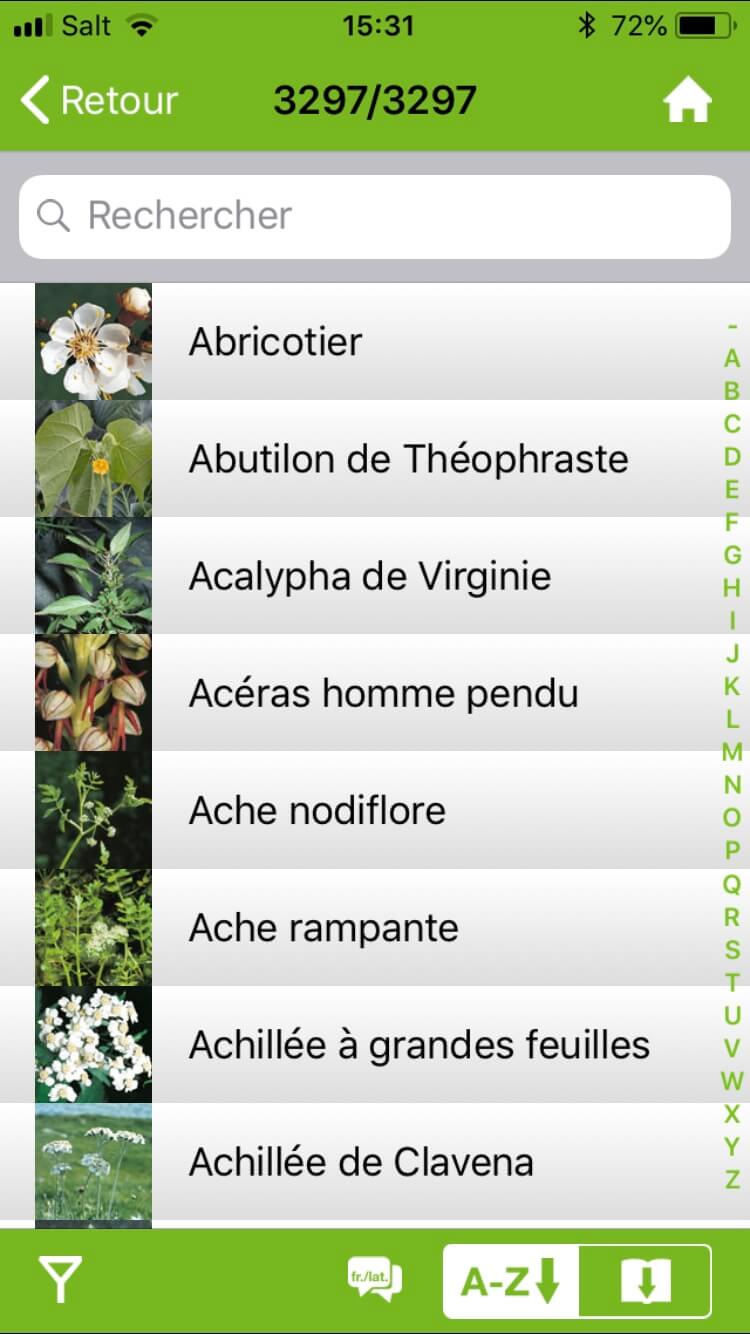


It took me a while to get this app, because of its price and the resources it requires. But it’s an investment I don’t regret!
The book Flora Helvetica is the standard flora for Switzerland. It’s a comprehensive, enormous and heavy book… Taking it into the field is a burden. I usually take Flora Vegetativa, which is lighter, but I miss the photos. Imagine having this huge book on your mobile phone, which you can take everywhere with you. Well, it’s possible, because Haupt publishers have condensed the print book into a mobile app! So you have access to descriptions, photos, distribution maps… and more!
The app is divided into three sections.
Species
The descriptions are the same as in the book. They are comprehensive and detailed, with a photo and distribution map. Be warned: beginners may find them hard to read. And as I’ve mentioned elsewhere, they’re available free of charge on www.infoflora.ch!
Identify
You can identify plants in three ways. Using a dichotomous key (the same one as in the print edition), you are asked questions and answer yes or no. If the answer is yes, the key directs you to question x; if it’s no, to question y. You continue in this way until you find the plant. This is the most reliable way to identify a plant, but it takes time and requires a knowledge of botanical terminology. Two multi-criteria keys (simple or complex) are also available. You select different criteria (flower colour, leaf shape…) to gradually filter the list of plants.
Field notebook
It allows you to take notes on your observations.
Glossary
The glossary, an essential tool for making progress, is tucked away in the settings. Refer to it regularly!
Conclusion
Despite its price, this app will meet the needs of most users. I do have a few reservations, though: I don’t think there are enough photographs for each plant (there’s only one, in fact). Given the price, the authors could have added the other images available on the Infoflora website.
Another downside is the size of the app (1.4 GB). I had to wait until I changed phones before I could install it. But given the amount of data, I imagine the authors had no other option.
Plant identification apps
Advice and warnings
Identification apps cannot provide a 100% reliable botanical identification! They are simply one more tool in your bag.
Do not eat a plant identified by your phone!
When the app gives you a result that seems plausible, open your reference botanical book, read the description and compare it with the living specimen. The description must match 100%.
Take notes. The danger with these apps is that you keep taking photos without taking the time to absorb what you’ve learnt. Time wasted…
@PlantNet
- Free!
- iOS / Android
- Photo recognition


Easy, automatic plant identification
@PlantNet is an impressive app developed by the French agricultural research centre (CIRAD). It began as a purely scientific project and was later turned into a mobile app. It’s simple: you take photos of a plant, the app sends them to its server and analyses them using advanced algorithms, then sends you back a list of plants. To do this, PlantNet compares your images with its database of 395,000 images of 6,549 species (in 2017)!
I’ve tested this app many times. Don’t expect 100% accuracy. The result depends heavily on the quality of the images you take. For better results, take several photos of the leaves and several of the flowers. There’s a good chance the plant will be among the first results on the list. You’ll need to finish the job using books.
I therefore strongly advise against eating a plant identified by PlantNet because this is not a proper identification. However, this app is fun and may help you learn more quickly, if you use it alongside your books! If in doubt, don’t eat it, or go out with someone knowledgeable.
Flora Incognita
- Free
- iOS / Android
- Identification of more than 4,800 Central European plants


Flora Incognita is the German counterpart to @PlantNet. It is also a scientific project, except that this second plant-identification app focuses solely on European flora. The method is different too: with Flora Incognita, identification takes place in several steps, which I think is a very sensible approach.
Bonus: the app includes information on toxicity and edibility! This is really useful!
To find out which of the two apps I prefer, take a look at the article How to identify wild plants easily using apps.

4 comments
✍️ Leave a comment

November 28
The Pleiades
- Marie Mellioret
Making a Christmas star
Lally Station, Parking, Blonay, Switzerland.
November 29
The Pleiades
- Marie Mellioret
Making a Christmas star Sold Out
Lally Station, Parking, Blonay, Switzerland.
4 April
La Sarraz
- Michael Berthoud

Edible and medicinal wild plants of spring in La Sarraz
Parking at the Sarraz football fields. Cossonay road.
No events found.
Brilliant, thank you for this very detailed article on mobile apps.
It gives us a good overview of what’s available, how each app is used and what we can find in them.
THANKS
Author
Thank you for your message, Yves,
I’ll be updating it soon as there are new developments! Check back in a few days 😉
Michaël
Thank you very much for your articles and valuable help.
Author
Hello Patricia,
Thank you for your comment. I’m glad our articles are helping you!
Michaël