



Log in
Sloes: how to harvest and cook them
Michaël Berthoud
/
27 September 2021
Sloes, the fruits of blackthorn, a plentiful shrub commonly found along woodland edges in lowland and mid-altitude areas, lend their delicate flavour to many preparations. Harvesting and preparing them takes work, but they’re delicious!
Blackthorn
Prunus spinosa (InfoFlora, TelaBotanica)Family: Rosaceae
Flowering: April
Habitat: hedgerows and woodland edges
Parts used: fruits, leaves
Uses: flavours drinks (lemonades, wines and liqueurs), jellies and lacto-fermented foods.
⚠️ Precautions: the stones of Prunus spinosa are suspected of containing compounds capable of releasing cyanide, which may pose a danger if ingested. Eating them is therefore strongly discouraged. See the notes at the end of the article.
“I treasure them like the apple of my eye”. Another lovely popular expression inspired by nature! In French, prunelles once meant pupils, a part of the eye that is vitally important to us all. What is the connection with the sloe, the fruit of blackthorn, Prunus spinosa?
At first, this fruit seems unappealing. Rich in tannins, it is so astringent that everyone grimaces at the first bite. It’s not so much the taste as the sensation that comes as a surprise.
Tannins constrict the tissues of the mucous membranes, drying out the mouth almost instantly. Frankly, not very appetising. But if you know how to prepare it, the sloe reveals a very subtle flavour. It really is one of those plants that takes a little work to appreciate fully.
And who knows? In time, perhaps you’ll treasure sloes like the apple of your eye?
Identifying sloes
The first step is to identify the fruit. Sloes grow on a shrub called blackthorn, Prunus spinosa, which can reach 3 m in height. A shrub is a plant without a single trunk: it has several small to medium-sized stems.
Blackthorn is also known as the blackthorn bush because of its many long thorns. Take care, as they have a reputation for easily causing wounds to become infected if you are careless when foraging… Blackthorn leaves are 2 to 4 cm long and lanceolate. They appear after the flowers, which are white and have 5 petals, like all members of the Rosaceae.
For foraging, the fruit is the part that interests us most. It is a drupe, a fleshy fruit with a stone, 6–12 mm across and blue, almost black, in colour. It has a distinctive waxy coating called a waxy bloom. When you run your finger over it, the colour changes and darkens.


Where can you find sloes?
It is an easy tree to recognise, found throughout Switzerland and France except in the high mountains. Its range covers much of Europe.
It grows along woodland edges, in hedgerow landscapes and in hedges. Start by looking for it in autumn, when its fruits make it easy to spot. That way, you will learn to recognise the shrub and its leaves. Then look out for its leaves in spring. They will help you recognise it from a distance, and you can simply return in autumn to pick the sloes.

Possible confusion
Sloes can be confused with other fleshy blue fruits. Size is a first clue, as sloes are fairly large. To our knowledge, the main risk is confusing them with the fruit of deadly nightshade, Atropa bella-dona, which is about the same size. This fruit is known to be highly toxic.
You can tell them apart by the deadly nightshade fruit’s black colour and lack of a blue waxy bloom. What is more, it is a berry rather than a drupe, so it has seeds rather than a stone. Also look for the 5 green bracts (leaves), arranged in a star at the base of the fruit. Finally, deadly nightshade is a plant, not a shrub.
With all these clues, you should not mistake one for the other.

Foraging for sloes
The sloe harvest begins in September, but usually takes place from October to December. Frost will make them a little sweeter, though they will still be very astringent. That’s normal. Don’t let that put you off during your first harvest, or you might miss out on something!
In any case, they should taste sweet when you pick them. Frost doesn’t eliminate the astringency, but it does reduce it. Wait a few more days if you can’t taste any sweetness.
Remember that wild fruit is a food source for many animals, especially thrushes and blackbirds, which eat sloes. So always leave some behind. About 3/4 of the fruit should remain on the bush. This is one of the principles of sustainable foraging.
There should be no trace of your visit. That’s the motto of a forager who cares for the land. Remember that every harvest has an ecological impact, that foraging is not something to do lightly, and that it must be done with awareness and respect.
If you don’t have time to use your harvest straight away, you can freeze it. Sloes keep well in the freezer, so you’ll have plenty of time to prepare them later.
3 ways to prepare sloes and reduce their astringency
As we’ve seen, and some of you have discovered for yourselves, sloes are astringent fruit containing tannins. Not very appealing to cook with at first glance… Depending on how you prepare them, their astringency will decrease and may even become imperceptible. Bear in mind, though, that it may not disappear completely.
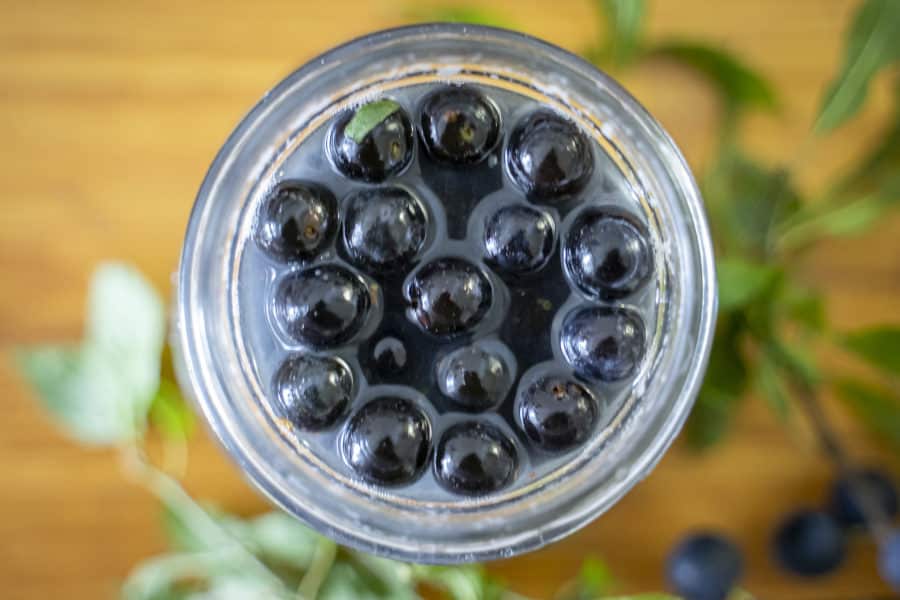

There are three ways I know of to prepare sloes:
Heat: cook the sloes in water (using the same quantity of water as fruit). After a few tens of minutes, the heat and the infusion in the water will have reduced the astringency. This gives us a liquid we can use to make syrups, jellies or jams, as a base for stocks or, once cooled, as a base for a vinaigrette, for example. Follow the hawthorn jelly recipe: it will be a hit made with sloes, or why not use half of each! If this infusion is too astringent for your taste, sloes may not be for you.
Cold infusion: we put our sloes in cold water. We leave them to infuse for several days: two, three or four, depending on the quantity of fruit. Just taste it and stop when you like the flavour. This extracts and preserves the volatile compounds, but there is not enough energy (heat) to extract the tannins. I use this cold infusion as a base for wild lemonades, kefir, wild wine… The flavour is exquisite. You can follow the recipe for juniper berry lemonade, replacing the juniper berries with sloes.
Lacto-fermentation: we put our harvest in brine to lacto-ferment it. You can eat the fruit as pickles and use the fermentation liquid as a base for salad dressing, for example.
More tips for reducing astringency
- The astringency is mainly in the flesh. Strained preparations (syrups, jellies, salad dressings) are less likely to be astringent.
- Tannins are readily extracted by heat: cold preparations (lemonades, macerations) will be less astringent than hot infusions.
There you have it: you know everything we know; now all that’s left is to put it into practice! ^^

Lacto-fermented wild sloe pickles
Sloes are the wild fruit of the blackthorn and are excellent preserved in brine and eaten as pickles.
Toxicity of sloes
Blackthorn belongs to the genus Prunus, whose stones may contain cyanogenic compounds. As a precaution, it is advisable to limit consumption of these stones, for example as flour, even though this species has not been specifically studied.
The seeds and leaves of Prunus species contain cyanogenic glycosides, mainly amygdalin and prunasin, which release cyanide when hydrolysed[2]. The concentration is generally low, but excessive consumption can cause serious problems, such as respiratory failure or even death, hence the importance of not exceeding the recommended amounts [3].
There is, however, no risk in eating the flesh, which is what we discuss in this article.
Discover lots of recipes and tips for identifying wild plants in my first book:
54 edible wild plants
Our book on wild plants, with a foreword by Anne-Sophie Pic, is available in bookshops and online!
Inside, you’ll find plenty of foraging tips and recipes to suit every taste!
Références
- [1] Caudullo, G., Welk, E., San-Miguel-Ayanz, J., 2017. Chorological maps for the main European woody.
- [2] Cho, H., , B., Shim, S., Kwon, H., Lee, D., Nah, A., Choi, Y., & Lee, S. (2013). Determination of Cyanogenic Compounds in Edible Plants by Ion Chromatography. Toxicological Research, 29, 143 – 147. https://doi.org/10.5487/TR.2013.29.2.143.
- [3] Michal, K., Andrzej, K., & Michał, T. (2018). Cyanide poisoning from an alternative medicine treatment with apricot kernels in a 80-year-old female.



30 comments
✍️ Leave a comment






29 November
Les Pléiades
- Marie Mellioret

Making a Christmas star Sold Out
Lally railway station, car park, Blonay, Switzerland.
04 April
La Sarraz
- Michaël Berthoud

Wild edible and medicinal spring plants in La Sarraz
La Sarraz football pitches car park. Route de Cossonay.
10 April
Les Pléiades
- Michaël Berthoud

Natural incense stick-making workshop
Lally railway station, car park, Blonay, Switzerland.
No events found.
Hello, I only knew about freezing or waiting for the first frosts to soften sloes.
In the Vosges, there is alder buckthorn in the forest.
A small shrub that also produces little black berries, but they are poisonous.
I use alder buckthorn wood, which is pink, to make jewellery and buttons.
Forestry workers simply cut it down because it gets in the way.
I’m delighted to receive your newsletters.
Author
Hello, and thank you for your message ^^
Oh, well, there you go! Blackthorn… I didn’t know about this shrub until this summer. I’m moving into a house, and there’s a shrub with long thorns in the garden. I looked up what it was: blackthorn. I didn’t know you could eat the sloes. I like the sound of the jam or syrup recipe, and I’ll try it soon ^^
Author
Do let us know what you think! ^^
Best wishes
Michaël
The birds have already eaten the lot… 🙁 Good for them, bad luck for me! I’ll try again next year 🙂
Author
Yes, they really need them this year ^^
Hello,
I still haven’t received my book. Is it out of stock?
Ordered on 27/09/2021.
Kind regards
éric
Author
Hello Eric,
I don’t handle shipping or distribution. You’ll need to ask your seller. It isn’t out of stock, but availability depends on the distributor.
Best wishes,
Michaël
Thank you for your wonderful advice
Author
My pleasure ^^
Best wishes,
Michaël
Good evening,
Your work is magnificent!!!! All this advice, all these plants – truly wonderful!!!
Thank you so much!!! I haven’t been able to join any of your outings yet; my health problems don’t make life easy… but I haven’t given up hope!!!!
Author
Thank you for your comment; it really warms my heart!
I look forward to meeting you!
Michaël
Hello, I’ve just moved into a lovely farmhouse in the Tarn, and I have blackthorn growing on my land. I’m delighted because it brings back childhood memories! I spent every summer in the Ariège, and we loved picking sloes, blackberries and raspberries
As I’m going to cut down a few blackthorn bushes, I’ve picked the sloes and will put them in the freezer to make jam later.
Thank you for your articles. I’ll keep reading them.
Best regards
Author
Wishing you some wonderful foraging trips! ^^
I’ve been making sloe jam for several years!
I make sure to freeze them two or three times, letting them thaw slowly in between. The biggest fan is Ines, who takes some to her very elderly mum every year to ease her aches and pains as much as it can!!!
At home, we have it by putting a quarter of a teaspoon of well-set jam, made with agar-agar, on a thin piece of Comté cheese. With whisky or rosé….
Thank you for your humble and helpful replies.
François
Author
Hello to you both,
Thanks for sharing your delicious experiences ^^
Best wishes,
Michaël
Hello, there’s a tree on the land I’ve just bought. I think the fruits might be sloes, but I can’t identify it, and the fruit doesn’t match any of the descriptions I’ve read. The fruits are round like plums, not sour and good to eat from late July. The tree flowered in March and then got its leaves, but it looks more like a large tree than a bush. How can I tell if the fruit is edible? The branches have thorns. Thanks in advance.
Author
Hello,
I can’t give you a satisfactory answer based on your description. I suggest getting hold of a good field guide to plants and checking the information against at least two mobile apps. That should help you identify your tree. Blackthorn is not a bush but a shrub, and can grow to 3 m tall.
Good luck!
Michaël
Hello
Thank you for your article.
I’m identifying what grows around my new home. Blackthorn and hawthorn grow side by side. And I’ve just found a recipe that lets me combine them and make use of the sloes too! Thank you 💛
Author
My pleasure! ^^
Hello,
I use blackthorn leaves to make ‘vin de buisson’. I didn’t know the leaves contained cyanide. I’ll have to enjoy it in double moderation (first because of the alcohol, and second because of the cyanide);).
Author
Hello, yes, it’s best to limit how much of the leaves you use, and how much alcohol you drink 😉 All the best.
I like eating sloes straight from the bush in autumn. I enjoy their slightly ‘wild’ flavour. Like the birds, I scatter the stones from the fruit I pick among the hedgerows. It’s my way of giving something back for what I take.
Author
What a lovely ritual. Thank you for sharing this wild experience.
Eating sloes straight from the bush and sowing the stones again – that’s exactly the spirit of respectful foraging we love! 😊
Hello,
I’m trying to collect blackthorn seeds. How do I remove the flesh?
Thank you for your reply.
le Chapelin
Author
Hello,
What do you mean by ‘collect seeds’?
I discovered Cueilleurs Sauvages on my way back from a walk in the lower mountains of the Jura.
Excellent information about sloes, known here as ‘plous’. Thank you.
Author
Thank you for letting me know 😊 I didn’t know that name for sloes!
Hello, my sloe jam still tastes astringent… is it safe to eat?
Thank you!
Author
Hello,
Thank you for your question. It’s difficult for me to say. I would say yes, if there is no visible mould and no unpleasant smell.
The fruit’s astringency varies with the season, and it’s possible that cooking it wasn’t enough to reduce it. It’s better to wait until after the first frosts. The fruit should taste sweet when picked (even if it’s astringent).
The tannins don’t really disappear with heat anyway; rather, they dissolve into the cooking water, and their effect is lessened, particularly by the sugar. But the astringency may remain, depending on how the fruit is prepared.