



Log in
Wild chervil (Anthriscus sylvestris): how to identify it with certainty
Michaël Berthoud
/
19 April 2024
Wild chervil, Anthriscus sylvestris, is a very common wild plant in most of our meadows. Identifying this relative of the familiar culinary chervil requires careful observation, however, to avoid any risk of confusion.
Wild chervil (cow parsley)
Anthriscus sylvestris
Family: Apiaceae
Flowering: April to August
Habitats: Meadows, pastures, more or less all types of open habitat with soil rich in organic matter, and the edges of forest paths
Abundance: Abundant
⚠️ Toxicity: the whole plant contains various cytotoxic lignans (see the toxicity notes).
The first version of this article included a recipe. In light of new information about the toxicity of this plant, we have removed the recipe and the section on its uses, and now consider wild chervil toxic.
Table of contents
Learning to recognise wild chervil, also known as cow parsley, is a wonderful opportunity to begin mastering the subtle art of identifying members of the Apiaceae. This process will certainly take time, perhaps even several seasons of closely observing the leaves, stems, flowers and fruits.
Warning: this plant is not edible! We have written a detailed article about its toxicity!
This plant is difficult to recognise when you are new to foraging, as it belongs to a family that includes some highly toxic plants, such as hemlocks. If you are not yet familiar with hogweed or ground elder, we recommend starting with plants like these, which are easier to recognise. Then, once you have some experience with the Apiaceae family, you can begin learning to recognise wild chervil.
To make things easier for you, we have put all the important points to remember in bold.
We also recommend reading our full article on hemlocks and the poll on the same subject. You will learn many interesting things about toxic members of the Apiaceae.

Habitats
Its scientific name, Anthriscus sylvestris, gives us a first clue as to where we might find it. Sylvestris means both “wild” and “of the forest”.
Indeed, it is very common to encounter it beside a path that gets a little light while walking in the woods. It likes deep soils rich in organic matter. This kind of soil is also found in some lush meadows. We prefer to gather it in this kind of habitat because fewer walkers pass through. It may grow in small numbers or even carpet a meadow and be its dominant species.
Before you set out to look for wild chervil
To identify wild chervil with complete confidence, you will need to be able to recognise it at every stage of growth. You will need a good field guide to plants and a botanist’s hand lens. You cannot do without them unless you already have a great deal of experience. Bear in mind, too, that mobile apps tend to mistake wild chervil for its lookalikes.
You will need to bring together many small distinguishing features which, taken together, allow reliable identification. You should also know one of the principles of reliably identifying members of the Apiaceae: do so when flowers and fruits are present on the same plant. This is the most effective way.

The method we suggest here has several steps:
- In spring, you find a plant whose leaves look like wild chervil (they match the features described below).
- You return a little later in the season. You find a plant with both flowers and fruits. Its features must match those described in this article and in your field guide exactly.
- You have identified wild chervil – well done!
- Now that you know it is wild chervil, look closely at the leaves. Later, you will need to be able to recognise them when they are very young. Memorise all the morphological and sensory features (including how it feels to the touch).
- Put a specimen in a herbarium; this will help you remember it.
- Return the following spring to see whether you can recognise it when it is very young.
Take your time: it will certainly take several seasons before you are 100% sure, and that is normal.
Identifying wild chervil
Leaves
At the beginning of spring, young leaves appear. They have a triangular outline, look roughly like parsley and are divided into fine segments. The small parts are not leaves! The leaf is everything within the triangular outline (see image below).
This triangular leaf is divided several times into parts that are themselves triangular. So there are small triangles within the larger ones. To work out how many times the leaf is divided, start at the main vein, the rachis, and count the triangles (or veins) you pass on the way to the tip of a small triangle. The small teeth do not count. A triangle must be clearly distinct to be counted.
The result may differ depending on where you count on the leaf. In some places it may be divided twice and, nearby, three times. The leaf of wild chervil is therefore twice to three times pinnatisect.


These criteria alone are not enough, as many other members of the Apiaceae have similar leaves (see below). We need more criteria.
You will also notice that the petiole has a small channel running along its upper surface: it is described as channelled. This will help you distinguish it from poison hemlock, whose petiole is circular in cross-section:

Let us continue examining the plant. You will find fine hairs on the petioles and stems, as well as on the underside of the leaves. Not everywhere, and not always in large numbers, but they are there somewhere. The underside is also matt. These two features distinguish it from fool's parsley, whose leaf underside is glossy and hairless.

Stem
The stem is hollow, with small grooves running along it; it is described as fluted and is slightly swollen at the nodes. The nodes are often tinged purple, but have no spots!


Flowers
In fields and meadows, it is one of the first members of the Apiaceae to flower in April. The plant is not very tall, reaching around 1 to 1.5 m when in flower. The compound umbels are fine and delicate and, as with all members of the Apiaceae, the small flowers have five petals. In wild chervil, these are white and have no cilia (tiny hairs around their edges).


Fruits
These flowers will produce small fruits called achenes. This part of the plant provides one of the most reliable identification features. You will therefore need a magnifying glass to examine them properly. You will then notice that they are smooth and have a small dark, constricted section at the top. This section is darker and has 10 small ribs running around the entire fruit.
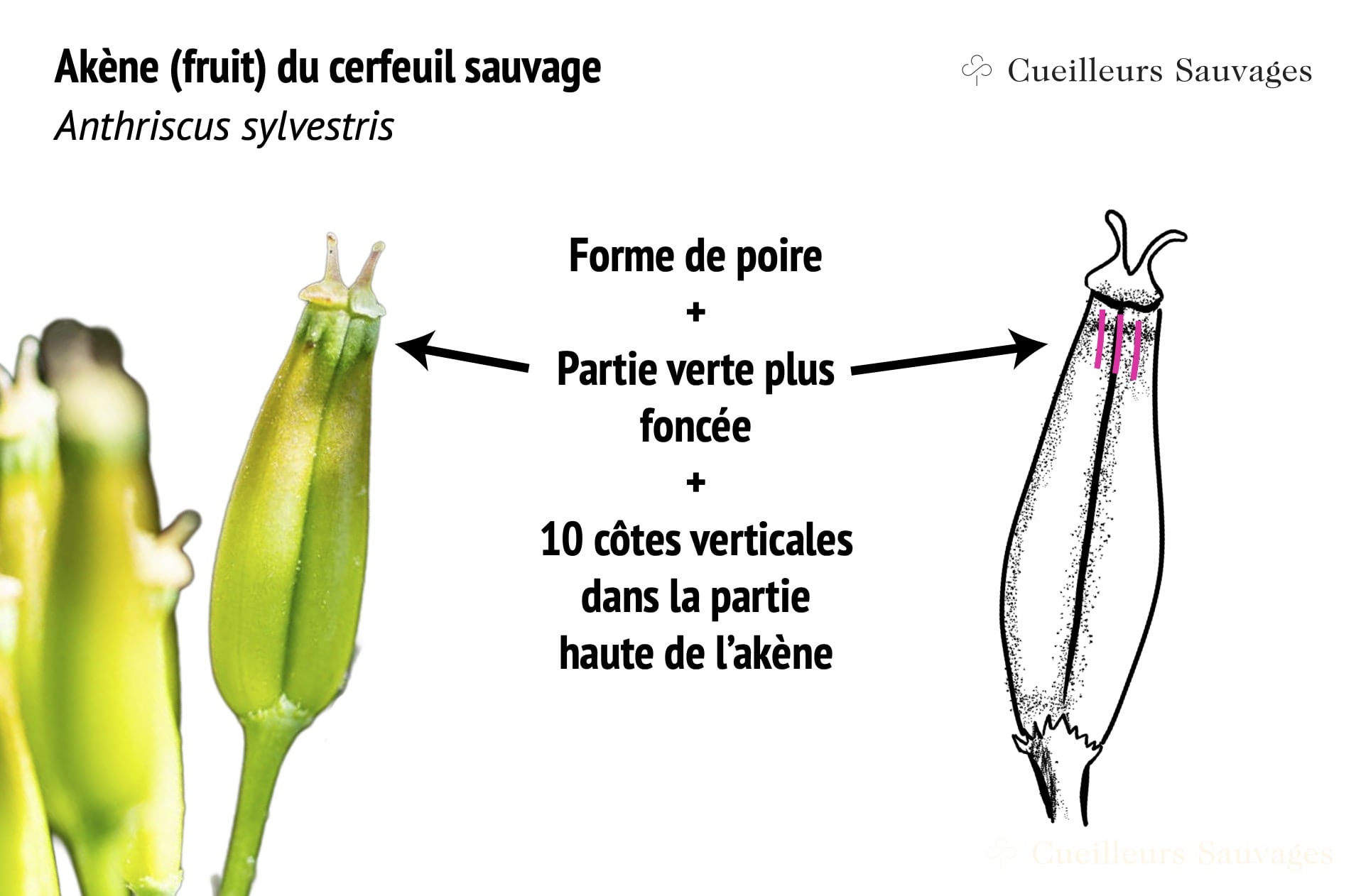
If you see a fruit like this and the other features match, you have another clue to help you identify the plant before gathering any! The fruits will therefore help you locate sites where wild chervil grows more reliably than the leaves alone. This is the safest approach we can suggest for identifying wild chervil.
Of course, if you are new to botany, this article is no substitute for a field course with someone who can show you the plant and answer your questions.
Possible confusion
In a previous survey of our newsletter subscribers, we asked which plants worried you most when foraging because of the risk of confusing them with hemlocks. We were not surprised to learn that wild chervil is the plant foragers are most likely to avoid picking.
The risks are real, and it would be difficult to cover them all here: they are numerous and vary from one part of Europe to another. Nevertheless, we will discuss those we know about and consider the most problematic.
It is not uncommon to find wild chervil growing among other plants, toxic or otherwise, that look very similar to it. That is the case in this image, with Chaerophyllum aureum, whose edibility I have found no information about. As you can see, telling them apart is not easy…

Here are the key features for distinguishing wild chervil from the three best-known toxic members of the Apiaceae at the young-leaf stage, when the risk is greatest:
- Poison hemlock
- Is completely hairless
- Its stem has purple blotches
- Its petiole is round, not channelled
- Fool's parsley
- Is completely hairless
- Has leaves that are distinctly glossy underneath, whereas wild chervil leaves are matt underneath
- Rough chervil
- Is hairy too
- Its stem has purple blotches
- Its leaves have oval leaflets with slightly rounded, rather than pointed, tips
Have a go at identifying the members of the Apiaceae that grow near you or where you forage. You will feel more confident as a result!
Toxicity of wild chervil (cow parsley)
We have recently changed our view on the edibility of wild chervil. We now advise against eating it until further studies can establish whether this plant is safe. See the dedicated article for details.
The toxicity of wild chervil is mainly associated with compounds called lignans, which are present in all parts of the plant [5]. One of these is deoxypodophyllotoxin, a cytotoxic compound known for its potent antitumour properties. This is of great interest for cancer research, but makes the root unfit for consumption [1, 2]. The plant may even be a potent abortifacient [4]. The chemistry of this plant is therefore not to be taken lightly.
The aerial parts of the plant (leaves) are used in traditional medicine for their anti-inflammatory and other medicinal properties, but it is important to know that they also contain lignans[6].
As the studies were conducted in vitro and on animals, there is uncertainty about human consumption of this plant.
Read our full article on the toxicology of wild chervil, reviewed by a doctor of pharmacognosy at the University of Geneva.
The information given here may not be sufficient to identify or use a plant safely. Remember: if in doubt, leave it out! Seek advice from a professional guide, buy good reference books and use photo-based plant identification apps with discernment. We regularly run courses on edible, medicinal and poisonous wild plants.
Références
- [1] Koulman A, Kubbinga ME, Batterman S, Woerdenbag HJ, Pras N, Woolley JG, Quax WJ. A phytochemical study of lignans in whole plants and cell suspension cultures of Anthriscus sylvestris. Planta Med. 2003 Aug;69(8):733-8. doi: 10.1055/s-2003-42776. PMID: 14531024.
- [2] Ikeda R, Nagao T, Okabe H, Nakano Y, Matsunaga H, Katano M, Mori M. Antiproliferative constituents in umbelliferae plants. III. Constituents in the root and the ground part of Anthriscus sylvestris Hoffm. Chem Pharm Bull (Tokyo). 1998 May;46(5):871-4. doi: 10.1248/cpb.46.871. PMID: 9621422.
- [3] Fejes S, Blázovics A, Lugasi A, Lemberkovics E, Petri G, Kéry A. In vitro antioxidant activity of Anthriscus cerefolium L. (Hoffm.) extracts. J Ethnopharmacol. 2000 Mar;69(3):259-65. doi: 10.1016/s0378-8741(99)00171-3. PMID: 10722209.
- [4] Schauenberg P. & F. Paris, Guide des plantas medicinales, Delachaux & Niestle, 396 p., 46 ill. n. & bl., 234 ill. coul. (39me ad.)
- [5] Ruderon Jean-Pierre, Ombellifères de France, Bulletin de la Société Botanique du Centre-Ouest, Volumes 1 à 5. Nouvelle Série Numéro spécial 26. 2007
- [6] Orčić, D., Berežni, S., & Mimica-Dukić, N., Quantitative HPLC–UV Study of Lignans in Anthriscus sylvestris, Molecules, 2022. 27









29 November
Les Pléiades
- Marie Mellioret

Making a Christmas star Sold Out
Lally railway station, car park, Blonay, Switzerland.
04 April
La Sarraz
- Michaël Berthoud

Wild edible and medicinal spring plants in La Sarraz
La Sarraz football pitches car park. Route de Cossonay.
10 April
Les Pléiades
- Michaël Berthoud

Natural incense stick-making workshop
Lally railway station, car park, Blonay, Switzerland.
No events found.