



Log in
Silver fir (Abies alba): how to identify and cook it
Michaël Berthoud
/
14 May 2021
Silver fir often brings back winter memories of syrups and sweets. Let’s find out how to identify, forage and cook it.
Silver fir
Abies albaFamily Pinaceae
Flowering May
Habitat Forests with deep soil
Altitude 400-1900 m
Abundance Locally abundant
Parts used Needles and wood (all year round), cones (autumn)
Medicinal properties Pectoral
Trees with similar uses Pines, Norway spruce, juniper, larch
Lookalikes Norway spruce, yew (toxic), other fir species
A little history
Curious names
The silver fir has a rich history that we’ll only touch on here. For more scientific and historical details (legends, etc.), I recommend the excellent Histoires d’arbres by Dumont and Montelle.
Let’s start with its French name, sapin. The word contains the Sanskrit sapa, meaning “resin”, and the Gaulish sap, meaning “to drip”. Can we conclude that the tree drips with resin? I don’t think so myself, as I’ve observed that its relative, the Norway spruce, generally produces more. But my experience is, of course, not universal. It might nevertheless show that people in the past knew about resin and perhaps used it.
There are all sorts of derivatives of the French word sapin: sapinage, sapine, sapineau, sapinette, sapinière… Many places, towns and villages have names with the same etymology: Sapel, Seppey, Savolière and even Savoie (meaning “the land of fir trees”)!
The fir also has other names that you’ll easily find in place names near you, such as Darbey (meaning “young fir”), from which the surname Darbellay derives (borne by a fairly well-known Swiss politician). There is also Vuargne, which often appears in place names on topographic maps: Les Vuargnes, Vargne, Vuarne, Vargnoz.
In short, as you’ve gathered, the silver fir is all around us 😉
How about another drop of antiscorbutic fir beer?
It’s therefore no surprise that its needles (like those of other conifers) have been used since at least the 16th century for their anti-inflammatory and antiseptic properties, particularly to prevent scurvy[1]. We now know that essential oils, polyphenols and flavonoids give them these benefits [2], but fir was also used for pleasure, particularly to flavour beer. Did the beer also help prevent scurvy? Possibly.
Today, silver fir is mainly used in folk medicine as a cough syrup.
How to identify silver fir (botany)
The silver fir is a tree that can grow to 40 m tall. In Switzerland, every forest has its ‘President’ fir: the tallest of them all (and therefore more likely to be struck by lightning…). It is a resin-producing conifer. It is also a conifer, so it produces neither flowers nor fruit. It does, however, produce cones. The male cones produce pollen, which is dispersed by the wind, while the female cones (known locally as pives or pine cones) are the larger of the two. You never find silver fir cones on the ground, because they disintegrate on the tree when they reach maturity, unlike the hanging cones of the Norway spruce, which fall to the ground. So remember this little rhyme:
Norway spruce, cones beneath our feet,
Silver fir, cones scattered on the breeze.
A good way to recognise the silver fir is to look at its needles. They are arranged in a single plane. They can sometimes curve upwards (especially on shoots in the upper part of the tree), but broadly speaking, the plane is horizontal. Now look closely at the underside of the needles, and you will notice two white lines running along them. Finally, take out your botanist’s hand lens and look at the tip of a needle: you will see that it is notched, with a small indentation.


Silver fir, Abies alba. Photographs: Michaël Berthoud.
Possible confusion
There are around fifty species of fir worldwide. They differ from spruces in that their needles are attached to smooth shoots by a small disc. On spruces, the shoots are grooved (marked with lines) and dotted with small pegs to which the needles are attached. In France and Switzerland, these other firs are uncommon in the wild, but may be planted here and there.
Confusion with Norway spruce
The silver fir can therefore be confused with Norway spruce, Picea abies, also known in French as sapin rouge. The latter is edible, so there is no concern on that score. I often make syrup using both, so I can gather them more quickly. Bear in mind, though, that Norway spruce shoots are less fragrant.
How to identify Norway spruce:
- Needles arranged all around the shoot, rather than in a single plane.
- Needles that are prickly and finer than those of the fir.
- A reddish rather than whitish trunk.
- Hanging rather than upright shoots and cones.


Norway spruce, Picea abies. Photographs: Michaël Berthoud
It is worth knowing that conifers whose needles have two white lines running along them are commonly called firs, even if they are not botanically firs…
For example, on our land we have a conifer with needles arranged in a flat plane and two white lines underneath. So I thought it was a silver fir. But on closer inspection, we realised that the trunk looks like that of a Norway spruce: it is reddish and more scaly. What’s more, it lacks the citrus scent of silver fir.
After discussing it with my father-in-law, an excellent botanist with many years of experience, and checking a good European flora, we concluded that it is a Serbian spruce, Picea omorika.
The more observant among you will notice that Picea is indeed the genus of spruces, not firs. To help you make sense of it all, I recommend the Delachaux guide to European trees.
Confusion with yew
Silver fir, Abies alba, can be confused with yew, which is toxic and dangerous to health. It is important to be able to tell them apart. We have already written an article about the difference between yew and fir. There you will find pictures of both conifers and the features that distinguish them. One particularly useful feature when foraging is that the tip of a yew needle is pointed, rather than notched like that of silver fir.
Where can you find silver fir?
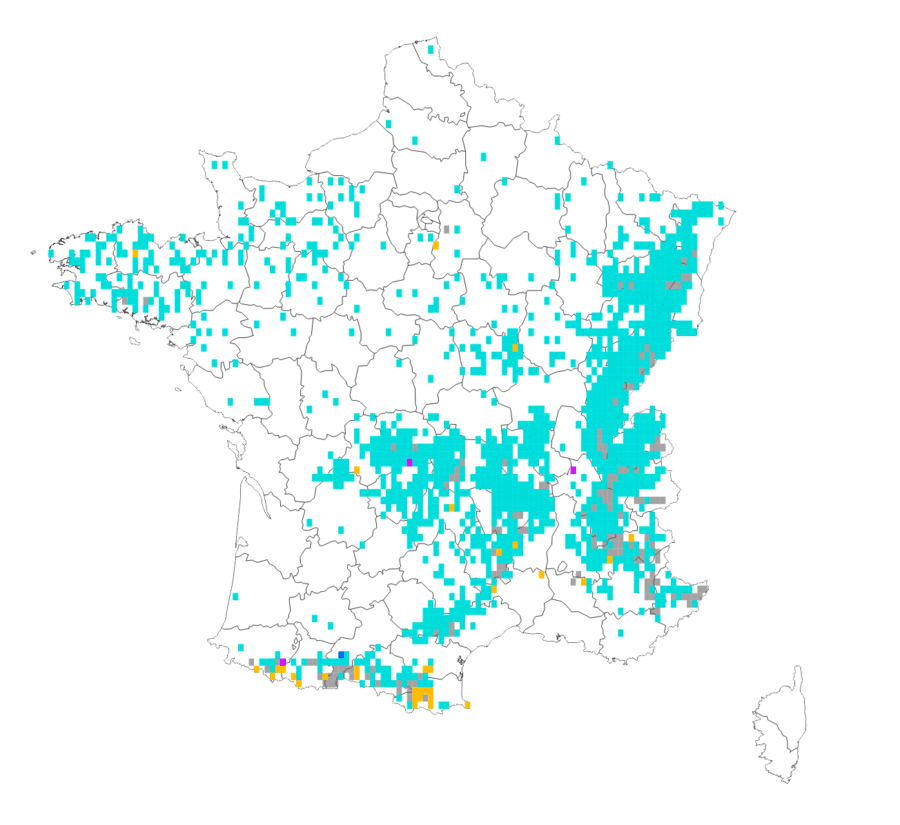
Silver fir is found throughout much of Switzerland. In France, it is absent from the Mediterranean coast, part of the Atlantic coast and the north. It grows in forests with deep, fairly moist soils; it does not tolerate drought.


When can you harvest fir?

Silver fir can be harvested all year round, which is why it’s one of my favourites!
First, let’s talk about the young shoots, incorrectly called “buds”. These so-called buds are generally gathered in May. The harvest begins in the lowlands and then gradually moves up into the mountains. There are generally two or three shoots on each branch, so we harvest only the side shoots and leave the terminal shoot to allow the tree to keep growing! This is very important for sustainable foraging that respects nature. If you haven’t read it yet, I recommend our rules for sustainable foraging.
You can also harvest whole branches throughout the year, as needed. But ideally, make a larger harvest in autumn or winter, when foresters fell trees. That way, you can gather plenty without harming the trees – brilliant!
As for the resin, I also collect it throughout the year. I take only the dry, hard resin around wounds, as it acts like a scab. That way, the tree keeps what it needs to heal.
How to cook with silver fir
Young shoots (buds)
Ah, we’ve finally got to it, you might say 😉 The part most traditionally used is the young shoots, the famous ‘fir buds’, with their powerful citrus scent. They remind me of throat sweets; others think of syrup. Making the latter is a classic that every forager should try at least once in their life. If you don’t have silver fir nearby, use Norway spruce or pine: the result will be just as good! The shoots also flavour drinks such as liqueurs and lemonades. But for the latter, I prefer to use whole branches!
The buds have a lemony flavour, so wherever you would use lemon, try fir instead.
- Salad dressing (finely chopped)
- Fish (finely chopped)
- Vegetable dishes (preferably added towards the end of cooking)
- Crèmes brûlées (infused)
- Ice creams and sorbets (infused)
- Syrups (macerated in sugar, infused or macerated in water)
Discover how to make traditional silver fir syrup!
Branches and needles
As for the needles on the branches, rubbing them between your hands releases a wonderful citrus scent reminiscent of mandarins. You can use whole branches to flavour all sorts of drinks, or make them into a powder as explained below.
Fir needle powder
I love using the needles from the branches and shoots. To enjoy them every day, all year round, I dry them, strip them from the branches and finally grind them in a coffee grinder. The resulting powder is a wonderfully potent seasoning that I use in all sorts of cooking!
- Vegetable dishes
- Soups
- Yoghurts
- And even to make incense!
Fir goes very well with rosemary! You could make fir and rosemary salt, for example, or serve fir, rosemary, goat’s cheese and walnuts as an appetiser!

Pumpkin and silver fir soup
Pumpkin soup is an autumn and winter classic. Why not add a little something wild and seasonal? Yes, it would need to be a plant you can forage all year round, even in the depths of winter… Guessed it? I’m talking about silver fir, of course!
Ingredients
- 2 tbsp Powdered fir needles
- 1 Pumpkin
Instructions
- Put the pumpkin in a saucepan, cover it with water and cook until tender.
- Blend once cooked.
- Add 1 tablespoon of dried silver fir powder per litre of soup.
Notes
This recipe comes from my book “54 Plantes sauvages comestibles de Suisse romande et de France voisine”.
Références
[1] Lind, J. (1772). A treatise on the scurvy: in three parts. Containing an inquiry into the nature, causes, and cure, of that disease. Together with a critical and chronological view of what has been published on the subject. S. Crowder.
[2] Albanese L, Bonetti A, D’Acqui LP, Meneguzzo F, Zabini F. Affordable Production of Antioxidant Aqueous Solutions by Hydrodynamic Cavitation Processing of Silver Fir (Abies alba Mill.) Needles. Foods. 2019;8(2):65. Published 2019 Feb 12. doi:10.3390/foods8020065
[-] Histoires d’arbres, des sciences aux contes, Pascal Domont et Edith Montelle, Delachaux et Niestlé
[-] Guide Delachaux des arbres d’Europe, Owen Johnson et Davis More, Delachaux et Nieslté









29 November
Les Pléiades
- Marie Mellioret

Making a Christmas star Sold Out
Lally railway station, car park, Blonay, Switzerland.
04 April
La Sarraz
- Michaël Berthoud

Wild edible and medicinal spring plants in La Sarraz
La Sarraz football pitches car park. Route de Cossonay.
10 April
Les Pléiades
- Michaël Berthoud

Natural incense stick-making workshop
Lally railway station, car park, Blonay, Switzerland.
No events found.