



Log in
10 wild edible plants to discover!
Michaël Berthoud
/
27 April 2020
Are you new to foraging for wild plants and unsure where to start? You’re in the right place: in this article, you’ll discover a selection of some of the best wild edible plants in France and Switzerland!
Table of contents
There are many wild edible plants in our European flora. Some are easy to recognise; others are less so and can be mistaken for poisonous lookalikes. If you’re new to foraging for plants, start with the easiest to identify and the most abundant. These are classics that can be cooked in countless ways. If I had to choose just ten or so, I’d pick these without hesitation!
For each plant, you’ll find links to Infoflora and Tela Botanica beside its scientific name. These are botanical websites for Switzerland and France, where you’ll find photos, maps and descriptions of the plants and their habitats. I encourage you to take a look: you’ll learn many interesting and useful things.
I also suggest reading the other tips for beginners, particularly the golden rules for foraging with respect for nature.
We were curious to know which of these plants you prefer. We added a poll to this article for several months. Here are the results:
Your favourite wild edible plants
Ranking of favourite plants
Wild garlic: the king of pestos
Wild garlic, Allium ursinum (Infoflora, Telabotanica), is one of the most widely foraged wild edible plants in Europe. Why? Because it’s one of the best, and it grows abundantly in spring. Although it can be confused with other plants, it’s easy to recognise if you know how to distinguish it from toxic ones (read the linked article to find out how!).
Every part of this wild plant is edible! Its unmistakable garlicky flavour enhances all your dishes. You can eat it raw, added to salads and pestos, or cooked. I love adding it to my stir-fries of wild vegetables at the end of cooking to make the most of all its properties (particularly its vitamin C). It’s also worth trying as a vegetable cooked for longer. It’s so abundant that it can make up a substantial part of your diet. You lose the vitamins, of course, but it’s still very good for you.
Uses: Raw, in pesto, salads and soups, as a vegetable or seasoning, in oils and vinegars, infused or dried.
Parts used: Bulbs, leaves, flowers, leaf sheaths.
Possible confusion with toxic plants: Lily of the valley, autumn crocus, lords-and-ladies.
Find out more: The secrets of wild garlic: how to recognise it and use it in cooking
To avoid potentially fatal mix-ups: Wild garlic, autumn crocus, lily of the valley and lords-and-ladies: the risk of confusion
Wild garlic tofu stir-fry: Here’s my recipe for an Asian-style wild garlic tofu stir-fry.


Sweet woodruff: one of the most fragrant wild plants
Sweet woodruff, Galium odoratum (Infoflora, Telabotanica), is the jewel of May, used to make the famous May wine. It’s an unassuming wild edible plant that spreads across the floor of beech woods. Don’t look for it in Norway spruce or fir woods: they’re too dark and the soil is too acidic. Curiously, it belongs to the same family as coffee, the Rubiaceae. It’s easy to recognise by its leaves arranged in whorls.
If you taste it in the wild, you won’t be particularly impressed. It’s slightly acrid, but nothing remarkable. So where does its great reputation come from? Drying it brings out a rich fragrance. Coumarins are responsible for this vanilla-like scent, which flavours desserts and drinks.
Uses: Crèmes brûlées, flan, herbal tea, lemonade, sweet woodruff steeped in wine.
Possible confusion with: Hedge bedstraw, cleavers (both edible), lady’s bedstraw.
Find out more: Sweet woodruff: foraging and uses
Sweet woodruff May wine: Here’s my simple recipe for sweet woodruff May wine!


Common hogweed: one of the most powerful wild plants!
Common hogweed, Heracleum sphondylium (Infoflora, Telabotanica), is a wild plant that is hard to miss, with its large hairy leaves and tall stem, which can reach the height of a person and is crowned with a beautiful white umbel. It grows mainly in meadows and along woodland paths.
With its aromatic, citrus-like scent, this is one of our best wild vegetables, whether eaten raw (young leaves, stems and flower buds) or cooked when it is more mature. The young flower buds, still enclosed in their sheaths, are a real treat simply stir-fried in a wok with a good oil. The roots have a pungent flavour, and the fruits are a powerful aromatic seasoning to use in moderation.
Parts used: roots, leaves, stems, flower buds, fruits.
Uses: raw, cooked as a vegetable, as a seasoning.
Possible confusion: giant hogweed, which is highly photosensitising (see the article on common hogweed).
Find out more: Foraging and using common hogweed


Ground elder: one of the most common wild plants
Edible wild plants can be very common. Ground elder, Aegopodium podagraria (Infoflora, Telabotanica), is another familiar plant in our part of the world. It is an excellent wild plant and very abundant too. You can easily recognise it by its triangular leaves, divided into three sections, each divided a further two or three times.
Every part of this plant is aromatic, with a flavour reminiscent of celery. Its young leaves make one of our best wild salads. Unlike other plants that are best mixed with something else, it is so tender and tasty that you can make a salad entirely from ground elder. It also works wonderfully in all sorts of cooked dishes: soufflés, tabbouleh, quiches…
Parts used: young leaves (raw), mature leaves (cooked), flowers, fruits.
Uses: raw, cooked as a vegetable, as a seasoning.
Possible confusion: with wild angelica (edible), but if you look closely at the leaves, angelica’s are larger.
Find out more: Foraging and using ground elder


Hedge bedstraw: a delicious wild salad plant
Hedge bedstraw, Galium album (Infoflora, Telabotanica), is one of my favourite spring salad plants and one of the first wild plants I forage in my area. It is easy to recognise in meadows by its leaves arranged in whorls.
It has a nutty flavour and is tender and juicy. It is excellent raw or cooked, sautéed or in soup. Once it flowers, and even a little before, it becomes acrid and is less pleasant to eat raw. It is really at its best when it is soft (its former French name, gaillet mou, means ‘soft bedstraw’) and tender. The flowers are fragrant and can be infused or cold-macerated.
Parts used: young stems and leaves, flowers.
Uses: raw, cooked as a vegetable, in drinks.
Possible confusion with other bedstraws: lady’s bedstraw (it has yellow flowers), cleavers (it clings firmly to clothes and even skin), sweet woodruff (grows in woodland).

Ground ivy: a wild aromatic herb
The Lamiaceae family gives us some fabulous edible wild plants, such as ground ivy, Glechoma hederacea (Infoflora, Telabotanica)! It is one of our best aromatic herbs. It is abundant, easy to recognise and adds a delicate flavour to all your dishes. Look for it in woodland, at the edge of a forest or in the garden, under a tree. It likes partly shaded places that are neither too dry nor too damp. The middle way, so to speak. To learn more about identifying it, take a look at the article about foraging for it!
It is a very aromatic plant, with a scent somewhere between mint, lemon balm and thyme, all of which belong to the same botanical family, the Lamiaceae. You can use it raw to flavour a salad, add it to a infusion or a wild-plant lemonade, make it into a syrup or serve it with fish. In short, there are lots of ways to use it!
Parts used: stems, leaves and flowers in spring; leaves throughout the rest of the year.
Uses: raw, infused or macerated, added towards the end of cooking.
Possible confusion with other members of the Lamiaceae, such as bugles, but these are also edible.
Find out more: Ground ivy: foraging and uses
Ground ivy syrup: here is my recipe for ground ivy syrup, made with a common and very aromatic wild plant!


Oregano
Oregano, Origanum vulgare (Infoflora, Telabotanica), belongs to the same botanical family as ground ivy. So they have some things in common. Both are aromatic, with square stems, hairs and opposite leaves… Oregano, however, likes sunshine and fairly dry habitats, and can be very abundant in some places. The further south you live in Europe, in warmer regions, the more aromatic it will be. Even so, it is a lovely herb to enjoy wherever you live.
Parts used: leaves, flowers.
Uses: as an aromatic herb, preferably fresh.
Possible confusion: without its flowers, it can be confused with other members of the Lamiaceae, such as certain mints whose scent is difficult to distinguish from its own.

Stinging nettle
The stinging nettle, Urtica dioïca (Infoflora, Telabotanica), needs no introduction! Everyone has experienced its delicate, fiery caress. But don’t let that put you off: it is a major edible wild plant, abundant and highly nutritious (iron, protein, Ca, Mg, vitamin C…). If you get the chance, use it in your cooking as often as possible for iron-clad health!
It can replace spinach in any recipe: simply boiled, in soup, pies or gratins… But it is also very good in sweet dishes, mixed with apples or plantain. As a drink, it is remineralising and very beneficial, whether prepared as a hot infusion or left to macerate overnight.
Parts used: leaves, fruits.
Uses: raw in salads, cooked as a vegetable, infused or macerated.
Possible confusion: with certain dead-nettles when young (edible) and with small nettle (rarer).
Find out more: Stinging nettle: foraging and uses
My recipe: stinging nettle tart

Common sorrel
Common sorrel, Rumex acetosa (Infoflora, Telabotanica), is another edible wild plant you should know. It is common in lush meadows, ideally harvested from a hay meadow that is neither grazed nor cultivated. Its spear-shaped leaves are distinctive, as is its purple inflorescence, borne in a cluster.
This plant always gets a strong reaction when people taste it for the first time! It is tangy, with a flavour reminiscent of lemon! It is fantastic eaten raw, added to a salad or to a cooked dish at the end of cooking so its flavour is not altered too much.
Parts used: leaves, inflorescences.
Uses: raw, briefly cooked, in a sauce (sorrel sauce).
Possible confusion: with arum, a deadly plant. It also has spear-shaped leaves, but grows in woodland. Both can be found at woodland edges. With experience, the two are very easy to tell apart: see the pictures of arum in the article on plants that can be confused with wild garlic.


Common dandelion
The common dandelion, Taraxacum officinale (Telabotanica, Infoflora), is, along with wild garlic, the most widely gathered wild plant in Europe. And for good reason: it makes an excellent spring salad, traditionally served with bacon lardons. But it would be a shame to stop there, as every part of the plant is edible and medicinal.
The leaves can be eaten raw all year round. After flowering, simply remove the midrib, which gives them their bitterness. They can also be cooked as a leafy vegetable. The roots have cleansing properties. I harvest them along with the leaves and sauté them before adding them to a salad. The flowers are sweet and can also be eaten in salads, or steeped or infused to make syrups, lemonades, wines and other wild vinegars.
Parts used: roots, leaves, buds, flower heads (flowers).
Uses: raw (leaves and flowers), cooked as a vegetable, preserved (buds), flowers to flavour drinks, honeys, syrups, infusions.
Possible confusion: with other yellow-flowered members of the Asteraceae, which are generally edible (beware of ragworts, which are toxic).


Plantains
I can’t finish this article without mentioning the plantains! There are several species, three of which are common and can be used in the same way. The most abundant and easiest to gather in my area is the plantain lanceolata. It is a wild plant that is both edible and medicinal, as is so often the case…
- Plantain lanceolata, Plantago lanceolata (Infoflora, Telabotanica)
- plantain media, Plantago media (Infoflora, Telabotanica)
- plantain major, Plantago major (Infoflora, Telabotanica)
The plantains all share a mushroom-like flavour! The young spring leaves can be eaten raw in salads, cooked in stir-fries or used in savoury or sweet tarts. The plantain soon becomes bitter and astringent after spring. Once flowering begins, you therefore need to pick the young leaves from the centre of the basal rosette.
The plantain is well suited to making an infusion, which tastes good (especially when fresh) and is good for your health, because it is a remineralising medicinal plant rich in potassium. It is traditionally used for skin problems and in the preparation of salves.
Parts used: roots, leaves, flower buds, inflorescences.
Uses: raw (leaves and flower buds), cooked as a vegetable, preserved (flower buds), to flavour drinks, syrups and infusions, as a medicinal plant.
Possible confusion: with other edible plantains.
Find out more: ribwort plantain, foraging and uses.
Make a plantain salve: here’s how to make a smooth plantain salve from an infused oil.


Of course, this selection is also somewhat subjective: tell us your favourites in the comments! You’ll find all these plants in my book, 54 plantes sauvages comestibles de Suisse romande et France voisine.
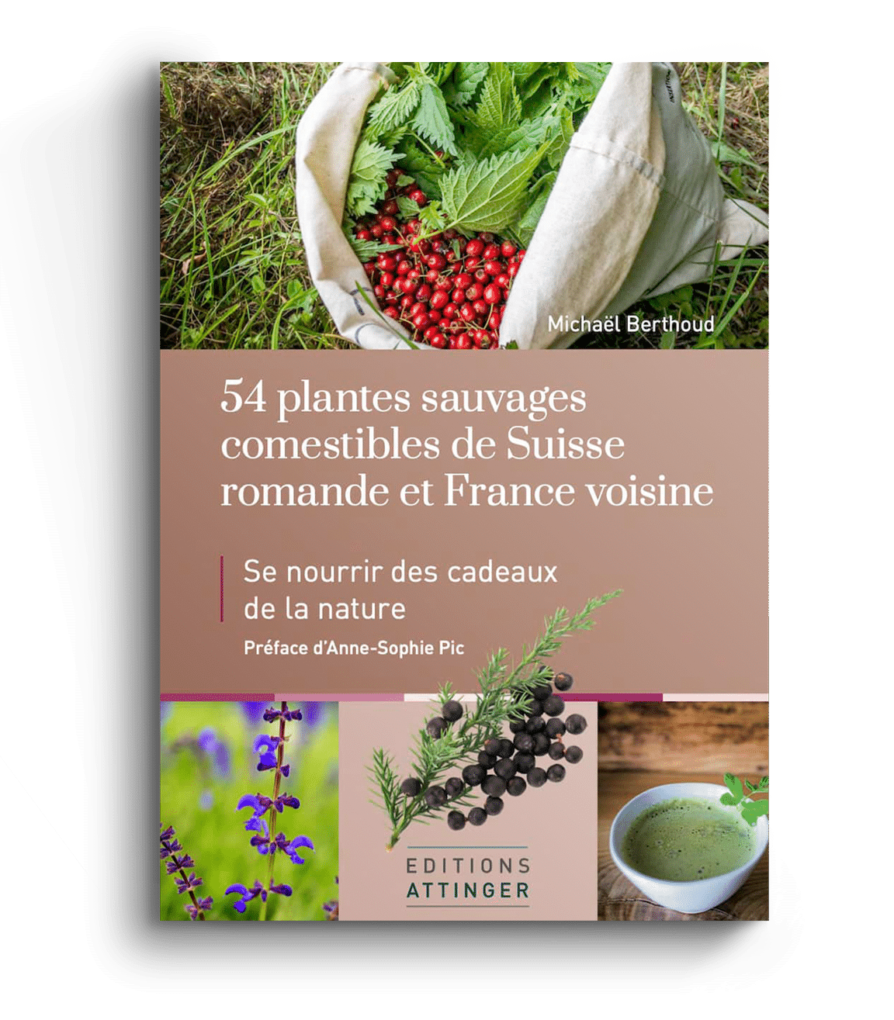
54 edible wild plants
Our book on wild plants, with a foreword by Anne-Sophie Pic, is available in bookshops and online!
Inside, you’ll find plenty of foraging tips and recipes to suit every taste!



4 comments
✍️ Leave a comment






29 November
Les Pléiades
- Marie Mellioret

Making a Christmas star Sold Out
Lally railway station, car park, Blonay, Switzerland.
04 April
La Sarraz
- Michaël Berthoud

Wild edible and medicinal spring plants in La Sarraz
La Sarraz football pitches car park. Route de Cossonay.
10 April
Les Pléiades
- Michaël Berthoud

Natural incense stick-making workshop
Lally railway station, car park, Blonay, Switzerland.
No events found.
The whole website is wonderfully put together and well structured, and it makes you want to cook… thank you, we have in our
The habitat of most of these lovely plants to pick and enjoy
Author
Hello Aurore, and thank you for your comment! 😊 Yes, it’s all there already!
Best wishes
Michaël
Hello Mickael
Congratulations on your website, which is very well organised. It’s great to find content of such high quality that’s accessible to the general public.
I’m new to foraging myself, and this year I picked wild garlic for the first time.
I was wondering what precautions I should take when picking plants to minimise the impact on their regeneration:
– Should I pick only a few leaves from each plant, choosing plants that are spread out?
– Is it forbidden to pull up the plant to harvest its roots?
– How do I determine the maximum amount to harvest in a given area?
– Should I always leave some leaves so the plant can recover from being picked and regenerate?
Thank you for your advice.
Author
Hello Felipe,
Thank you for your comment! You could start by reading the article on foraging guidelines, which I’ll be updating soon. https://cueilleurs-sauvages.ch/les-regles-dor-dune-cueillette-respectueuse/
– Should I pick only a few leaves from each plant, choosing plants that are spread out?
Only harvest where a plant is abundant, and take no more than a quarter of the population. That’s a rough guide: just leave the majority untouched. As long as you do that, you can take a whole plant. With experience, you’ll find that harvesting some plants can also encourage regrowth.
– Is it forbidden to pull up the plant to harvest its roots?
Not if they are not protected. It is up to you to check the rules for each plant in your country and region.
– How do I determine the maximum amount to harvest in a given area?
If there are only a few plants, I don’t pick any. Otherwise, I follow the quarter rule.
– Do you always need to leave some leaves so the plant can recover from picking and regrow?
In some cases you can, but not always. If you leave three-quarters of the population in place, the species can regenerate.
Best wishes
Michaël